

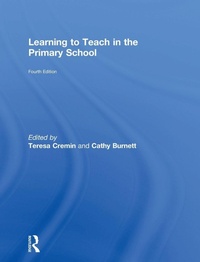
Learning to Teach in the Primary School
4th Edition
Published on 21. March 2018
Book
Hardback
576 pages
978-1-138-21104-9 (ISBN)
Description
How do you become an effective primary school teacher? What do you need to be able to do? What do you need to know?
Flexible, effective and creative primary school teachers require subject knowledge, an understanding of their pupils and how they learn, a range of strategies for managing behaviour and organising environments for learning, and the ability to respond to dynamic classroom situations.
The fourth edition of this bestselling textbook has been fully updated with the latest research and initiatives in the field, as well as the most recent changes to the National Curriculum across the UK. Twenty four new authors have contributed, sharing their expertise and experience as practitioners. Ten brand new units have been included on:
Becoming a professional in the current context
Building inclusive communities of engaged learners
Understanding schools' aims and enacting your own
Teaching for social justice
Reading
Grammar and punctuation
Mastery in mathematics
The value of outdoor learning
Primary education in a digital age
A selection of extra tasks have been woven throughout, with an emphasis on innovative, reflective practice, and new 'vivid examples' bring each chapter's argument to life in a classroom context. In addition, each chapter contains M-level tasks and further reading to assist with research assignments, and differences in the National Curriculum and policy in Scotland, Wales and Northern Ireland are highlighted.
Providing a comprehensive but accessible introduction to teaching and learning in the primary school, covering everything a trainee needs to know in order to gain QTS, this accessible and engaging textbook is essential reading for all students training to be primary school teachers.
This textbook is supported by a free companion website with additional resources for instructors and students (www.routledge.com/cw/Cremin) and an accompanying series of books on Teaching Creatively across the curriculum.
Flexible, effective and creative primary school teachers require subject knowledge, an understanding of their pupils and how they learn, a range of strategies for managing behaviour and organising environments for learning, and the ability to respond to dynamic classroom situations.
The fourth edition of this bestselling textbook has been fully updated with the latest research and initiatives in the field, as well as the most recent changes to the National Curriculum across the UK. Twenty four new authors have contributed, sharing their expertise and experience as practitioners. Ten brand new units have been included on:
Becoming a professional in the current context
Building inclusive communities of engaged learners
Understanding schools' aims and enacting your own
Teaching for social justice
Reading
Grammar and punctuation
Mastery in mathematics
The value of outdoor learning
Primary education in a digital age
A selection of extra tasks have been woven throughout, with an emphasis on innovative, reflective practice, and new 'vivid examples' bring each chapter's argument to life in a classroom context. In addition, each chapter contains M-level tasks and further reading to assist with research assignments, and differences in the National Curriculum and policy in Scotland, Wales and Northern Ireland are highlighted.
Providing a comprehensive but accessible introduction to teaching and learning in the primary school, covering everything a trainee needs to know in order to gain QTS, this accessible and engaging textbook is essential reading for all students training to be primary school teachers.
This textbook is supported by a free companion website with additional resources for instructors and students (www.routledge.com/cw/Cremin) and an accompanying series of books on Teaching Creatively across the curriculum.
Reviews / Votes
"There is a reason why this book is now in its fourth edition - it is a classic. The work of the editors and authors responding to new research, new policies and new practices, over the many years of the book's life, is one of its many outstanding features. And for this edition the renewed emphasis on critical analysis is most welcome. Not only is this book invaluable for trainee teachers but policy makers could well find food for thought as well."- Dominic Wyse, Professor of Early Childhood & Primary Education, University College London
"Unquestionably, teaching in the primary school is a messy, complex, demanding business. For anyone starting out in the classroom, this book is an easily accessible guide to the challenges you may face, offering both theoretical rationales and practical advice to help."
- Megan Dixon, Director of Literacy for the Aspire Educational Trust
"A welcome new edition of this outstanding, comprehensive book that should be a core reader for anyone embarking on primary teacher training. It will become the 'go-to text' for trainees across all routes into teaching. A highly accessible, interactive book written by highly qualified teacher educators who are experts in their field."
- Jane Warwick, Primary PGCE Course Manager, University of Cambridge
"This 4th edition is a contemporary and extremely relevant resource for prospective and qualified primary teachers alike. The wide range of established authors provides a detailed discussion and focussed insight into the complexities of being a primary teacher. The child as an individual and a reflective approach to the curriculum are valued as key components of effective learning and teaching. This is a must-read for all professional practitioners."
- Jenny Carpenter, Director of Partnerships, York St John University
More details
Series
Edition
4th edition
Language
English
Place of publication
London
United Kingdom
Publishing group
Taylor & Francis Ltd
Target group
College/higher education
Professional and scholarly
Professional and Undergraduate
Edition type
New edition
Product notice
sewn/stitched
Cloth over boards
Illustrations
26 s/w Abbildungen, 23 s/w Tabellen
23 Tables, black and white; 26 Illustrations, black and white
Dimensions
Height: 260 mm
Width: 208 mm
Thickness: 37 mm
Weight
1516 gr
ISBN-13
978-1-138-21104-9 (9781138211049)
Copyright in bibliographic data and cover images is held by Nielsen Book Services Limited or by the publishers or by their respective licensors: all rights reserved.
Schweitzer Classification
Other editions
New editions
Teresa Cremin | Helen Hendry | Anna Harrison
Learning to Teach in the Primary School
Book
06/2025
5th Edition
Routledge
€230.48
Shipment within 10-20 days
Additional editions
Teresa Cremin | Cathy Burnett
Learning to Teach in the Primary School
Book
03/2018
4th Edition
Routledge
€48.50
Article exhausted; check for reprint
Previous edition
Teresa Cremin | James Arthur
Learning to Teach in the Primary School
Book
02/2014
3rd Edition
Routledge
€185.70
Article exhausted; check for reprint
Persons
Teresa Cremin is Professor of Education (Literacy) at The Open University, UK. A former primary teacher and teacher educator, she has served as President of the UK Reading Association and the UKLA, and Board member of the Cambridge Primary Review Trust, BookTrust and the Poetry Archive. She has led and contributed to a number of projects on creativity and on teachers' literate identities and practices and has published widely in these areas (https://researchrichpedagogies.org/research/).
Cathy Burnett is Professor of Literacy and Education at Sheffield Hallam University, UK where she leads the Language and Literacy Education Research Group. She worked for many years as a primary teacher and teacher educator and is currently Vice President for the UKLA. She has published widely for professional and academic readerships and has led and contributed to research projects associated with literacy, digital media, teacher identities, and uses of new technologies in classrooms.
Cathy Burnett is Professor of Literacy and Education at Sheffield Hallam University, UK where she leads the Language and Literacy Education Research Group. She worked for many years as a primary teacher and teacher educator and is currently Vice President for the UKLA. She has published widely for professional and academic readerships and has led and contributed to research projects associated with literacy, digital media, teacher identities, and uses of new technologies in classrooms.
Content
Introduction Section 1: Becoming a Teacher 1.1. Primary teaching: a personal perspective 1.2. Becoming a professional in the current context 1.3. Making the most of your placements Section 2: Exploring the Nature of Learning and Teaching 2.1. Looking at children 2.2. Looking at learning 6. From learning to teaching 2.3. Moving from novice towards expert teacher 2.4. Building on firm foundations: Early years practice 2.5. The importance of play and explorative learning Section 3: Planning and Managing Learning 3.1. Building inclusive communities of engaged learners 3.2. Approaching Short-term planning 3.3. Organising your classroom for learning 3.4. Managing classroom behaviour 3.5. Handling difficulties in social, emotional and behaviour development 3.6. Organising effective classroom talk 3.7. The value of outdoor learning Section 4: Approaches to the Curriculum 4.1. Investigating the aims, values and purposes of primary education: the case of the Cambridge Primary Review 4.2. Aims into practice: Understanding schools' aims and enacting your own 4.3. Critical perspectives on the curriculum Section 5: Assessment 5.1 Assessment for learning: Formative approaches 5.2 Assessment for learning: Summative approaches Section 6: Diversity and Inclusion 6.1 Providing for differentiation 6.2 Special educational needs and inclusion 6.3 Teaching for social justice: Creating equity for pupils living in poverty and those from black minority ethnic backgrounds 6.4 Responding to cultural diversity and citizenship 6.5 Responding to linguistic diversity 6.6 Responding to gender differences Section 7: Recent Developments 7.1 Engaging with pupils: Listening to the voices of children and young people 7.2 Reading: marrying word recognition with comprehension and pleasure 7.3 The creative and the critical: Grammar and punctuation 7.4 Creativity and creative teaching and learning 7.5 Thinking skills 7.6 Understanding mastery in primary mathematics 7.7 Primary education in a digital age Section 8: Partnership in Practice 8.1 Working with teaching assistants 8.2 Partnerships with parents 8.3 Understanding the teacher's pastoral role Section 9: Your Professional Development 9.1 Applying for jobs and preparing for your induction year 9.2 Understanding and planning your continuing professional development 9.3 Research and professional development: using research and enquiry to develop as a teacher