

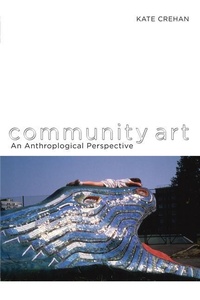
Community Art
An Anthropological Perspective
Published on 1. November 2011
Book
Hardback
224 pages
978-1-84788-834-1 (ISBN)
Description
Exploring key issues for the anthropology of art and art theory, this fascinating text provides the first in-depth study of community art from an anthropological perspective.
The book focuses on the forty year history of Free Form Arts Trust, an arts group that played a major part in the 1970s struggle to carve out a space for community arts in Britain. Turning their back on the world of gallery art, the fine-artist founders of Free Form were determined to use their visual expertise to connect, through collaborative art projects, with the working-class people excluded by the established art world. In seeking to give the residents of poor communities a greater role in shaping their built environment, the artists' aesthetic practice would be transformed.
Community Art examines this process of aesthetic transformation and its rejection of the individualized practice of the gallery artist. The Free Form story calls into question common understandings of the categories of "art," "expertise," and "community," and makes this story relevant beyond late twentieth-century and early twenty-first-century Britain.
The book focuses on the forty year history of Free Form Arts Trust, an arts group that played a major part in the 1970s struggle to carve out a space for community arts in Britain. Turning their back on the world of gallery art, the fine-artist founders of Free Form were determined to use their visual expertise to connect, through collaborative art projects, with the working-class people excluded by the established art world. In seeking to give the residents of poor communities a greater role in shaping their built environment, the artists' aesthetic practice would be transformed.
Community Art examines this process of aesthetic transformation and its rejection of the individualized practice of the gallery artist. The Free Form story calls into question common understandings of the categories of "art," "expertise," and "community," and makes this story relevant beyond late twentieth-century and early twenty-first-century Britain.
Reviews / Votes
The first historical ethnography of community arts, essential reading for students and scholars interested in the growing field of the anthropology of art. * Roger Sansi-Roca, Senior Lecturer in Anthropology, Goldsmiths, University of London *More details
Series
Language
English
Place of publication
United Kingdom
Publishing group
Taylor & Francis Ltd
Target group
College/higher education
Product notice
sewn/stitched
Paper over boards
With dust jacket
Illustrations
38 bw illus
Dimensions
Height: 236 mm
Width: 155 mm
Thickness: 15 mm
Weight
544 gr
ISBN-13
978-1-84788-834-1 (9781847888341)
Copyright in bibliographic data and cover images is held by Nielsen Book Services Limited or by the publishers or by their respective licensors: all rights reserved.
Schweitzer Classification
Other editions
Additional editions
E-Book
05/2020
1st Edition
Routledge
€55.49
Available for download
E-Book
05/2020
1st Edition
Routledge
€55.49
Available for download
Book
11/2011
1st Edition
Berg Publishers
€63.20
Shipment within 3-4 weeks
Person
Kate Crehan is Professor of Anthropology, College of Staten Island and Graduate Center, City University of New York, USA
Content
Preface
I. THE REJECTION
Chapter 1: Art Inside and Outside the Gallery
II. THE SHAPING
Chapter 2: Moving Beyond the Gallery
Chapter 3: From Performance to the Environment
Chapter 4: Community Arts and the Democratisation of Expertise
Chapter 5: Responding to Local Needs: Goldsmiths
Chapter 6: Making Art Collaboratively: Provost
Chapter 7: Theoretical and Political Locations
III. INTO THE 21ST CENTURY
Chapter 8: Free Form in 2004
Chapter 9: A Carnival and a Standing Stone
Conclusion: Art and the Community
Bibliography
I. THE REJECTION
Chapter 1: Art Inside and Outside the Gallery
II. THE SHAPING
Chapter 2: Moving Beyond the Gallery
Chapter 3: From Performance to the Environment
Chapter 4: Community Arts and the Democratisation of Expertise
Chapter 5: Responding to Local Needs: Goldsmiths
Chapter 6: Making Art Collaboratively: Provost
Chapter 7: Theoretical and Political Locations
III. INTO THE 21ST CENTURY
Chapter 8: Free Form in 2004
Chapter 9: A Carnival and a Standing Stone
Conclusion: Art and the Community
Bibliography