

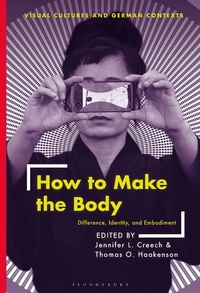
How to Make the Body
Difference, Identity, and Embodiment
Published on 2. June 2022
Book
Hardback
264 pages
978-1-350-19404-5 (ISBN)
Description
How to Make the Body: Difference, Identity, and Embodiment brings together contemporary and historical readings of the body, exploring the insights and limits of established and emerging theories of difference, identity, and embodiment in a variety of German contexts. The engaging contributions to this volume utilize and challenge cutting-edge approaches to scholarship on the body by putting these approaches in direct conversation with canonical texts and objects, as well as with lesser-known yet provocative emerging forms. To these ends, the chapter authors investigate "the body" through detailed studies across a wide variety of disciplines and modes of expression: from advertising, aesthetics, and pornography, to social media, scientific experimentation, and transnational cultural forms. Thus, this volume showcases the ways in which the body as such cannot be taken for granted and surmises that the body continues to undergo constant--and potentially disruptive--diversification and transformation.
Reviews / Votes
From biblical arousals to RAF corpse art; from Joy's feminist pornography to Dr Bitch Ray's bodily interventions, there is much to admire in this thought-provoking essay collection on the visual culture and politics of the body in real-world German contexts. * Michael Hau, author of Performance Anxiety: Sport and Work in Germany from the Empire to Nazism (2017), and Head of History, Monash University, Australia * How to Make the Body is a rich, multi-faceted volume that demonstrates the value of focusing on the body, and embodiment, in examining various aspects of visual culture in 20th and 21st-century German contexts [...] and with a strong and welcome emphasis on feminist and queer approaches. * Rick McCormick, Professor of German, Nordic, Slavic, and Dutch, University of Minnesota, USA * Engaging with a diverse array of events, texts, and representations of lived experience, How to Make the Body powerfully mobilizes a range of cutting-edge theoretical approaches to generate new understandings of embodiment vital to German Studies and beyond. * Sara F. Hall, Associate Professor of Germanic Studies, University of Illinois Chicago, USA * Scholars will find much to inspire future research in this rich body of work. * German Studies Review * This well-written and beautifully illustrated collection addresses corporeality, difference, and embodiment in German contexts from the early modern period until the 2010s. * Monatshefte *More details
Series
Language
English
Place of publication
London
United Kingdom
Publishing group
Bloomsbury Publishing PLC
Target group
College/higher education
Product notice
sewn/stitched
Cloth over boards
With dust jacket
Illustrations
17 colour and 37 bw illus
Dimensions
Height: 240 mm
Width: 163 mm
Thickness: 23 mm
Weight
717 gr
ISBN-13
978-1-350-19404-5 (9781350194045)
Copyright in bibliographic data and cover images is held by Nielsen Book Services Limited or by the publishers or by their respective licensors: all rights reserved.
Schweitzer Classification
Other editions
Additional editions
E-Book
05/2022
1st Edition
Bloomsbury Visual Arts
€32.99
Available for download
Persons
Jennifer L. Creech is Instructor of German at Oregon State University, USA. She is the author of Mothers, Comrades and Outcasts in East German Women's Films (2016) and co-editor of Spectacle: German Visual Culture, Vol. 2 (2015)
Thomas O. Haakeson is Associate Professor in Humanities & Sciences at California College of the Arts, USA. He is the author of Grotesque Visions: The Science of Berlin Dada (2021), and co-editor of Spectacle: German Visual Culture, Vol. 2 (2015)
Thomas O. Haakeson is Associate Professor in Humanities & Sciences at California College of the Arts, USA. He is the author of Grotesque Visions: The Science of Berlin Dada (2021), and co-editor of Spectacle: German Visual Culture, Vol. 2 (2015)
Content
1. Jennifer L. Creech and Thomas O. Haakenson, "Introduction: How to Make the Body"
2. Alison Stewart, "Arousal, the Bible, and Bruegel's Codpieces: The Male Body in Early Modern Visual Culture"
3. David Ciarlo, "The Construction of the Aryan Body in German Visual Advertising, 1908-33"
4. Jill Holaday, "Die Gruppe Zero: Transforming Trauma to Transcendence"
5.Ilka Rasch, "RAF Corpse Art: The Living Dead in the Work of Gerhard Richter, Ernst Volland, Astrid Proll and Andres Veiel"
6. Sebastian Heiduschke, "Penis-bodied Specimen in the Exhibit Koerperwelten ('Body Worlds')"
7. Jennifer L. Creech, "For the Porn Connoisseur: Cinema Joy"
8. Zachary Fitzpatrick, "Orientalized Bodies at Work: Cultural Zaniness in Berlin's Sayonara Tokyo Revue"
9. Thomas O. Haakenson, "Ai Weiwei's Body in Berlin"
10. Jamele Watkins, "Afrolocken: Natural Hair in German Literature and Media"
11. Faye Stewart, "Poppthority: The Politics of Dr. Bitch Ray's Bodily Interventions"
12. Lucy Ashton, "Becoming Invisible/ Against Visibility: Hito Steyerl's How Not to be Seen: A Fucking Didactic Educational. MOV File"
2. Alison Stewart, "Arousal, the Bible, and Bruegel's Codpieces: The Male Body in Early Modern Visual Culture"
3. David Ciarlo, "The Construction of the Aryan Body in German Visual Advertising, 1908-33"
4. Jill Holaday, "Die Gruppe Zero: Transforming Trauma to Transcendence"
5.Ilka Rasch, "RAF Corpse Art: The Living Dead in the Work of Gerhard Richter, Ernst Volland, Astrid Proll and Andres Veiel"
6. Sebastian Heiduschke, "Penis-bodied Specimen in the Exhibit Koerperwelten ('Body Worlds')"
7. Jennifer L. Creech, "For the Porn Connoisseur: Cinema Joy"
8. Zachary Fitzpatrick, "Orientalized Bodies at Work: Cultural Zaniness in Berlin's Sayonara Tokyo Revue"
9. Thomas O. Haakenson, "Ai Weiwei's Body in Berlin"
10. Jamele Watkins, "Afrolocken: Natural Hair in German Literature and Media"
11. Faye Stewart, "Poppthority: The Politics of Dr. Bitch Ray's Bodily Interventions"
12. Lucy Ashton, "Becoming Invisible/ Against Visibility: Hito Steyerl's How Not to be Seen: A Fucking Didactic Educational. MOV File"