

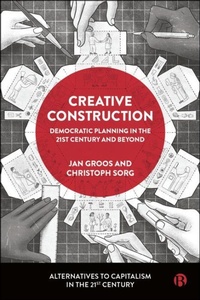
Creative Construction
Democratic Planning in the 21st Century and Beyond
Bristol University Press
1st Edition
Published on 12. February 2025
Book
Hardback
370 pages
978-1-5292-3512-8 (ISBN)
Description
Democratic planning allows us to effectively address the multiple crises of our time through cooperative modes of collective coordination. Given the destructive consequences of contemporary capitalism, such a structural alternative to market economies is needed more than ever.
This accessible work examines various approaches that theorise, practise and nurture a creative construction towards varieties of democratic planning. Drawing from current socio-economic and ecological movements, it explores what future non-capitalist democratic planning could look like.
Bringing together important voices in the ongoing debates from scholars to activists, this volume proposes an interdisciplinary and innovative approach to democratic planning in the 21st century and beyond.
This accessible work examines various approaches that theorise, practise and nurture a creative construction towards varieties of democratic planning. Drawing from current socio-economic and ecological movements, it explores what future non-capitalist democratic planning could look like.
Bringing together important voices in the ongoing debates from scholars to activists, this volume proposes an interdisciplinary and innovative approach to democratic planning in the 21st century and beyond.
Reviews / Votes
"This is the book that forms the starting point for anyone wishing to engage in contemporary debates on planning in/outside of contemporary capitalism. It brings to life what might be imagined in terms of how we use new technologies to re-engage the question, and actuality, of what a planned alternative to capitalism might look like." David J. Bailey, University of Birmingham "Modern capitalism is a system of such concentrated economic and political power that its opponents often feel helpless when they consider how it might be replaced. Creative Construction helps to address this issue by exploring varied approaches to the democratization of critical social institutions - and the challenges involved in this process of democratization - to empower those seeking to challenge capitalism while developing creative solutions to the multiple, overlapping crises capitalist systems have created."Grace Blakeley, author of Vulture Capitalism
"This is a brilliant and inspiring book about visions and the urge to imagine and create a socially and ecologically just and viable future. A refreshing exercise at a time of despair that pushes us to rethink democratic planning and how it can transform security and freedom into collective values. A must-read even - especially - for those that cannot avoid but thinking that planning is either authoritarian or doomed to failure."
Cecilia Rikap, University College London
"In the face of the climate emergency, war and financial crisis, a democratically planned economy is the only way to a more just and sustainable future. This book is an essential contribution to that project from some of its leading thinkers. Ranging from concrete models for organising production and reproduction, to pieces that address the challenges facing democratic planning, this is a must-read for activists, students and scholars alike."
Nick Srnicek, King's College London
More details
Series
Edition
First Edition
Language
English
Place of publication
Bristol
United Kingdom
Target group
Professional and scholarly
Product notice
Unsewn / adhesive bound
Cloth over boards
Illustrations
8 s/w Abbildungen, 1 s/w Tabelle
1 Tables, black and white; 8 Illustrations, black and white
Dimensions
Height: 242 mm
Width: 166 mm
Thickness: 27 mm
Weight
662 gr
ISBN-13
978-1-5292-3512-8 (9781529235128)
Copyright in bibliographic data and cover images is held by Nielsen Book Services Limited or by the publishers or by their respective licensors: all rights reserved.
Schweitzer Classification
Other editions
Additional editions
Book
approx. 09/2026
1st Edition
Alternatives to Capitalism in the 21st Century
€41.00
Not yet published
Creative Construction
Democratic Planning in the 21st Century and Beyond
E-Book
02/2025
1st Edition
Bristol University Press
€48.99
Available for download
Persons
Jan Groos is Researcher at the Centre for Sociological Theory, Kiel University.
Christoph Sorg is Researcher at Humboldt University Berlin.
Christoph Sorg is Researcher at Humboldt University Berlin.
Content
Foreword by Kohei Saito
Introduction - Jan Groos and Christoph Sorg
Part I: Blueprints of Desire
1. A Brief Sketch of Four Models of Democratic Economic Planning - Audrey Laurin-Lamothe, Frederic Legault and Simon Tremblay-Pepin
2. Basic Problems of a Democratically Planned Economy - Jakob Heyer
3. Social Dividend Socialism: Labour Autonomy in a Participatory Planned Economy - James Muldoon and Dougie Booth
4. Distributed Commonist Planning - Stefan Meretz and Simon Sutterluetti
5. Counter-Planning the Polycrisis: For Biocommunism - Nick Dyer-Witheford
6. Planning as an Art of Government - Jan Groos
7. Discovery Beyond Competition - Evgeny Morozov in conversation with Jan Groos
Part II: Building Bridges
8. (Re)-Imagining Housing as an Infrastructure for Social Reproduction - Rabea Berfelde and Philipp Moeller
9. Democratic Planning in One Country? From the Anarchy of Public Planning to Negotiated Globalization - Christoph Sorg
10. The Question of Transformation: Approaches to Economic Planning in Existing Policy Proposals - Samuel Decker
11. Care Revolution: A Transformation Strategy for a Solidary Society - Gabriele Winker and Matthias Neumann
12. Relational Revolutions - Eva von Redecker in conversation with Jan Groos
Part III: Non-Boundaries
13. Planned Degrowth: Macroeconomic Coordination for Sustainable Degrowth - Elena Hofferberth, Cedric Durand and Matthias Schmelzer
14. Post-Sovereign Planning? Nature, Culture and Care in the New Socialist Calculation Debate - Samia Zahra Mohammed
15. Democratizing the Forces of Re/Production: AI Planning as a Sensing Device for a Degrowth Economy - Simon Schaupp
16. Embracing the Small Stuff: Caring for Children in a Liberated Society - Heide Lutosch
17. Socialism, Planning and the Relativity of Dirt - Nancy Fraser in conversation with Christoph Sorg
Conclusion - Jan Groos and Christoph Sorg
Introduction - Jan Groos and Christoph Sorg
Part I: Blueprints of Desire
1. A Brief Sketch of Four Models of Democratic Economic Planning - Audrey Laurin-Lamothe, Frederic Legault and Simon Tremblay-Pepin
2. Basic Problems of a Democratically Planned Economy - Jakob Heyer
3. Social Dividend Socialism: Labour Autonomy in a Participatory Planned Economy - James Muldoon and Dougie Booth
4. Distributed Commonist Planning - Stefan Meretz and Simon Sutterluetti
5. Counter-Planning the Polycrisis: For Biocommunism - Nick Dyer-Witheford
6. Planning as an Art of Government - Jan Groos
7. Discovery Beyond Competition - Evgeny Morozov in conversation with Jan Groos
Part II: Building Bridges
8. (Re)-Imagining Housing as an Infrastructure for Social Reproduction - Rabea Berfelde and Philipp Moeller
9. Democratic Planning in One Country? From the Anarchy of Public Planning to Negotiated Globalization - Christoph Sorg
10. The Question of Transformation: Approaches to Economic Planning in Existing Policy Proposals - Samuel Decker
11. Care Revolution: A Transformation Strategy for a Solidary Society - Gabriele Winker and Matthias Neumann
12. Relational Revolutions - Eva von Redecker in conversation with Jan Groos
Part III: Non-Boundaries
13. Planned Degrowth: Macroeconomic Coordination for Sustainable Degrowth - Elena Hofferberth, Cedric Durand and Matthias Schmelzer
14. Post-Sovereign Planning? Nature, Culture and Care in the New Socialist Calculation Debate - Samia Zahra Mohammed
15. Democratizing the Forces of Re/Production: AI Planning as a Sensing Device for a Degrowth Economy - Simon Schaupp
16. Embracing the Small Stuff: Caring for Children in a Liberated Society - Heide Lutosch
17. Socialism, Planning and the Relativity of Dirt - Nancy Fraser in conversation with Christoph Sorg
Conclusion - Jan Groos and Christoph Sorg