

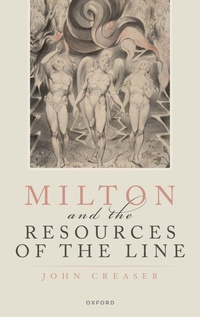
Milton and the Resources of the Line
Published on 22. July 2022
Book
Hardback
432 pages
978-0-19-286425-3 (ISBN)
Description
This book will change how readers read not only Milton but any poetry. Whereas prose is written in sentences, poetry is written in lines, lines that may or may not coincide with the syntax of the sentence. Lines add an aural and visual mode of punctuation, with some degree of pause and weight at the line-turn. So lineation, the division of poetry into lines, opens a repertoire of possibilities to the poet. Notably, it encourages an enhanced concentration on meaning, rhythm, and sound. It makes metrical patterns possible, with interactions between regularity and deviation; or it makes possible the presence or absence of structural rhyme; or the multiple variations of the line-turn, whether in harmony with syntax or overflowing, in ways that may be either more or less conspicuous.
Starting from theories of Derek Attridge, this book develops new methods for exploring the expressive resources of the verse line as exploited by the greatest of English poets, John Milton. Topics examined include: the interaction of strictness and freedom in the rhythms of Milton's line and paragraph; the interfusion of diverse prosodies in a single poem; approaches to free verse; rhyme in the earlier lyric verse and modes of near-rhyme in the later blank verse; the diverse modes of onomatopoeia; and the complex interweavings of prosody and ideology in this very political poet. The great themes and issues and characters of Milton's innovative and always controversial poetry are perceived afresh, being approached intimately through the rich possibilities of the line, and the insights of the approach illuminate the reading of any poetry.
Starting from theories of Derek Attridge, this book develops new methods for exploring the expressive resources of the verse line as exploited by the greatest of English poets, John Milton. Topics examined include: the interaction of strictness and freedom in the rhythms of Milton's line and paragraph; the interfusion of diverse prosodies in a single poem; approaches to free verse; rhyme in the earlier lyric verse and modes of near-rhyme in the later blank verse; the diverse modes of onomatopoeia; and the complex interweavings of prosody and ideology in this very political poet. The great themes and issues and characters of Milton's innovative and always controversial poetry are perceived afresh, being approached intimately through the rich possibilities of the line, and the insights of the approach illuminate the reading of any poetry.
Reviews / Votes
Creaser reveals Milton's mastery of all elements of poetic expression and compares him favorably with poets past and present. * Choice * Creaser writes brilliantly about one of the aspects of poetry to which lineation gives prominence, and which in his readings can connect not only line-with-line, but connect up andeven constitute the compelling structure of a poem as a whole: end-rhyme, and its embraces. * Tom Lockwood, The Seventeenth Century * Milton and the Resources of the Line is a large and formidable piece of criticism, the fruit of decades of teaching and writing, and one which demands the constant attention of the reader. * Nicholas McDowell, The Spenser Review *More details
Language
English
Place of publication
Oxford
United Kingdom
Target group
Professional and scholarly
Dimensions
Height: 240 mm
Width: 161 mm
Thickness: 28 mm
Weight
810 gr
ISBN-13
978-0-19-286425-3 (9780192864253)
Copyright in bibliographic data and cover images is held by Nielsen Book Services Limited or by the publishers or by their respective licensors: all rights reserved.
Schweitzer Classification
Other editions
Additional editions
John Creaser
Milton and the Resources of the Line
E-Book
06/2022
1st Edition
OUP eBook
€75.49
Available for download
John Creaser
Milton and the Resources of the Line
E-Book
06/2022
1st Edition
OUP eBook
€75.49
Available for download
Person
John Creaser is Emeritus Fellow of Mansfield College, University of Oxford and Emeritus Professor at Royal Holloway, University of London.
Content
Preface
1: 'Fear of Change': Closed Minds and Open Forms
2: Service is Perfect Freedom': Paradox and Prosodic Style in Paradise Lost
3: Variously Drawn Out': Lineation and Syntax in Paradise Lost
4: The Melting Voice Through Mazes Running': Rhythmic Verve in L'Allegro and Il Penseroso
5: Samson Agonistes: Chorus and Catastrophe
6: 'In Fit Sound': Modes of Onomatopoeia, and Beyond
7: Rhyme was Not his Talent': The Lyric Verse
8: Things Unattempted Yet in Rhyme': Rhyming in Blank Verse
9: Resonant Minutiae: Some Niceties of Rhythm and Rhyme
10: Cromwell's Three Great Poets: Interweavings of Prosody and Ideology
11: The Intrepid Milton: 1667, and Ever After
Appendix: Prosodic Symbols: an Outline
Works Cited
1: 'Fear of Change': Closed Minds and Open Forms
2: Service is Perfect Freedom': Paradox and Prosodic Style in Paradise Lost
3: Variously Drawn Out': Lineation and Syntax in Paradise Lost
4: The Melting Voice Through Mazes Running': Rhythmic Verve in L'Allegro and Il Penseroso
5: Samson Agonistes: Chorus and Catastrophe
6: 'In Fit Sound': Modes of Onomatopoeia, and Beyond
7: Rhyme was Not his Talent': The Lyric Verse
8: Things Unattempted Yet in Rhyme': Rhyming in Blank Verse
9: Resonant Minutiae: Some Niceties of Rhythm and Rhyme
10: Cromwell's Three Great Poets: Interweavings of Prosody and Ideology
11: The Intrepid Milton: 1667, and Ever After
Appendix: Prosodic Symbols: an Outline
Works Cited