

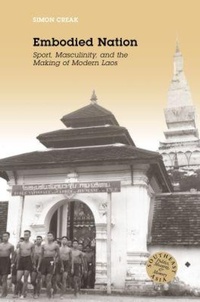
Embodied Nation
Sport, Masculinity, and the Making of Modern Laos
Will be published approx. on 31. August 2017
Book
Paperback/Softback
352 pages
978-0-8248-7512-1 (ISBN)
Description
This strikingly original book examines how sport and ideas of physicality have shaped the politics and culture of modern Laos. Viewing the country's extraordinary transitions-from French colonialism to royalist nationalism to revolutionary socialism to the modern development state-through the lens of physical culture, Simon Creak's lively and incisive narrative illuminates a nation that has no reputation in sport and is typically viewed, even from within, as a country of cheerful but lazy people. Creak argues that sport and related physical practices-including physical education, gymnastics, and military training-have shaped a national consciousness by locating it in everyday experience. These practices are popular, participatory, performative, and, above all, physical in character and embody ideas and ideologies in a symbolic and experiential way.
Embodied Nation takes readers on a brisk ride through more than a century of Lao history, from a nineteenth-century game of tikhi -an indigenous game resembling field hockey- to the country's unprecedented outpouring of nationalist sentiment when hosting the 2009 Southeast Asian Games. En route, we witness a Lao-Vietnamese soccer brawl in 1936, the fascist-inspired body ethic of the early 1940s, the novel modes of military masculinity that blossomed with national independence, the spectacular state theatrics of power represented by Olympic-inspired sports festivals, and the high hopes and frequent failures of socialist sport in the 1970s and 1980s. Of central concern in Creak's narrative are the twin motifs of gender and civilization. Despite increasing female participation since the early twentieth century, he demonstrates the major role that sport and physical culture have played in forming hegemonic masculinities in Laos. Even with limited national sporting success-Laos has never won an Olympic medal-the healthy, toned, and muscular form has come to symbolize material development and prosperity. Embodied Nation outlines the complex ways in which these motifs, through sport and physical culture, articulate with state power.
Combining cultural and intellectual history with historical thick description, Creak draws on a creative array of Lao and French sources from previously unexplored archives, newspapers, and magazines, and from ethnographic writing, war photography, and cartoons. More than an ""imagined community"" or ""geobody,"" he shows that Laos was also a ""body at work,"" making substantive theoretical contributions not only to Southeast Asian studies and history, but to the study of the physical culture, nationalism, masculinity, and modernity in all modern societies.
Embodied Nation takes readers on a brisk ride through more than a century of Lao history, from a nineteenth-century game of tikhi -an indigenous game resembling field hockey- to the country's unprecedented outpouring of nationalist sentiment when hosting the 2009 Southeast Asian Games. En route, we witness a Lao-Vietnamese soccer brawl in 1936, the fascist-inspired body ethic of the early 1940s, the novel modes of military masculinity that blossomed with national independence, the spectacular state theatrics of power represented by Olympic-inspired sports festivals, and the high hopes and frequent failures of socialist sport in the 1970s and 1980s. Of central concern in Creak's narrative are the twin motifs of gender and civilization. Despite increasing female participation since the early twentieth century, he demonstrates the major role that sport and physical culture have played in forming hegemonic masculinities in Laos. Even with limited national sporting success-Laos has never won an Olympic medal-the healthy, toned, and muscular form has come to symbolize material development and prosperity. Embodied Nation outlines the complex ways in which these motifs, through sport and physical culture, articulate with state power.
Combining cultural and intellectual history with historical thick description, Creak draws on a creative array of Lao and French sources from previously unexplored archives, newspapers, and magazines, and from ethnographic writing, war photography, and cartoons. More than an ""imagined community"" or ""geobody,"" he shows that Laos was also a ""body at work,"" making substantive theoretical contributions not only to Southeast Asian studies and history, but to the study of the physical culture, nationalism, masculinity, and modernity in all modern societies.
More details
Series
Language
English
Place of publication
Honolulu, HI
United States
Target group
Professional and scholarly
College/higher education
Product notice
Paperback (trade)
Unsewn / adhesive bound
Illustrations
50 black & white illustrations
Dimensions
Height: 234 mm
Width: 153 mm
Thickness: 23 mm
Weight
544 gr
ISBN-13
978-0-8248-7512-1 (9780824875121)
Copyright in bibliographic data and cover images is held by Nielsen Book Services Limited or by the publishers or by their respective licensors: all rights reserved.
Schweitzer Classification