

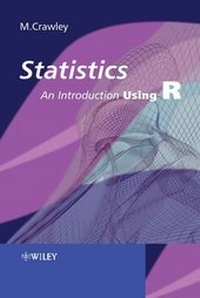
Statistics
An Introduction using R
1st Edition
Published on 11. March 2005
Book
Hardback
342 pages
978-0-470-02297-9 (ISBN)
Description
Computer software is an essential tool for many statistical modelling and data analysis techniques, aiding in the implementation of large data sets in order to obtain useful results. R is one of the most powerful and flexible statistical software packages available, and enables the user to apply a wide variety of statistical methods ranging from simple regression to generalized linear modelling. Statistics: An Introduction using R is a clear and concise introductory textbook to statistical analysis using this powerful and free software, and follows on from the success of the author's previous best-selling title Statistical Computing.
* Features step-by-step instructions that assume no mathematics, statistics or programming background, helping the non-statistician to fully understand the methodology.
* Uses a series of realistic examples, developing step-wise from the simplest cases, with the emphasis on checking the assumptions (e.g. constancy of variance and normality of errors) and the adequacy of the model chosen to fit the data.
* The emphasis throughout is on estimation of effect sizes and confidence intervals, rather than on hypothesis testing.
* Covers the full range of statistical techniques likely to be need to analyse the data from research projects, including elementary material like t-tests and chi-squared tests, intermediate methods like regression and analysis of variance, and more advanced techniques like generalized linear modelling.
* Includes numerous worked examples and exercises within each chapter.
* Accompanied by a website featuring worked examples, data sets, exercises and solutions:
http://www.imperial.ac.uk/bio/research/crawley/statistics
Statistics: An Introduction using R is the first text to offer such a concise introduction to a broad array of statistical methods, at a level that is elementary enough to appeal to a broad range of disciplines. It is primarily aimed at undergraduate students in medicine, engineering, economics and biology - but will also appeal to postgraduates who have not previously covered this area, or wish to switch to using R.
* Features step-by-step instructions that assume no mathematics, statistics or programming background, helping the non-statistician to fully understand the methodology.
* Uses a series of realistic examples, developing step-wise from the simplest cases, with the emphasis on checking the assumptions (e.g. constancy of variance and normality of errors) and the adequacy of the model chosen to fit the data.
* The emphasis throughout is on estimation of effect sizes and confidence intervals, rather than on hypothesis testing.
* Covers the full range of statistical techniques likely to be need to analyse the data from research projects, including elementary material like t-tests and chi-squared tests, intermediate methods like regression and analysis of variance, and more advanced techniques like generalized linear modelling.
* Includes numerous worked examples and exercises within each chapter.
* Accompanied by a website featuring worked examples, data sets, exercises and solutions:
http://www.imperial.ac.uk/bio/research/crawley/statistics
Statistics: An Introduction using R is the first text to offer such a concise introduction to a broad array of statistical methods, at a level that is elementary enough to appeal to a broad range of disciplines. It is primarily aimed at undergraduate students in medicine, engineering, economics and biology - but will also appeal to postgraduates who have not previously covered this area, or wish to switch to using R.
Reviews / Votes
"...the book contains some very good concepts..." (The American Statistician, February 2007) "...will provide you with enhanced statistical insights...and access to a free and powerful computing language." (Clinical Chemistry, May 2006) "...I know of no better book of its kind..." (Journal of the Royal Statistical Society, Vol 169 (1), January 2006) "...offers a demanding, non-calculus-based coverage of such standard topics as hypothesis testing, modeling, regression, ANOVA, and count data." (CHOICE, November 2005) "Appeal[s] to a broad range of disciplines" (Zentralblatt MATH Volume 1080)More details
Edition
1., Auflage
Language
English
Place of publication
Chichester
United Kingdom
Publishing group
John Wiley and Sons Ltd
Target group
Professional and scholarly
Illustrations
Illustrations
Dimensions
Height: 25.2 cm
Width: 17.6 cm
Thickness: 25 mm
Weight
784 gr
ISBN-13
978-0-470-02297-9 (9780470022979)
Schweitzer Classification
Other editions
New editions
Book
11/2014
2nd Edition
Wiley
€41.00
Shipment within 15-20 days
Additional editions
Book
03/2005
Wiley
€38.90
Article exhausted; check for reprint
Content
Preface.
Chapter 1 Fundamentals.
Chapter 2 Dataframes.
Chapter 3 Central Tendency.
Chapter 4 Variance.
Chapter 5 Single Samples.
Chapter 6 Two Samples.
Chapter 7 Statistical Modelling.
Chapter 8 Regression.
Chapter 9 Analysis of Variance.
Chapter 10 Analysis of Covariance.
Chapter 11 Multiple Regression.
Chapter 12 Contrasts.
Chapter 13 Count Data.
Chapter 14 Proportion Data.
Chapter 15 Death and Failure Data.
Chapter 16 Binary Response Variable.
Appendix 1: Fundamentals of the R Language.
Chapter 1 Fundamentals.
Chapter 2 Dataframes.
Chapter 3 Central Tendency.
Chapter 4 Variance.
Chapter 5 Single Samples.
Chapter 6 Two Samples.
Chapter 7 Statistical Modelling.
Chapter 8 Regression.
Chapter 9 Analysis of Variance.
Chapter 10 Analysis of Covariance.
Chapter 11 Multiple Regression.
Chapter 12 Contrasts.
Chapter 13 Count Data.
Chapter 14 Proportion Data.
Chapter 15 Death and Failure Data.
Chapter 16 Binary Response Variable.
Appendix 1: Fundamentals of the R Language.