

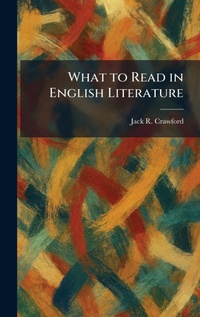
What to Read in English Literature
Description
"What to Read in English Literature" by Jack R. Crawford is a comprehensive and structured guide designed to assist readers in navigating the rich and vast landscape of English letters. Serving as both a curated bibliography and an educational roadmap, this work highlights the most significant authors and texts that have defined the English literary tradition. Crawford provides expert recommendations that bridge the gap between casual reading and academic study, offering a clear overview of the canon's most influential works.
The volume organizes literature into manageable sections, covering various genres and historical periods. From early foundational texts to the significant developments of later eras, it identifies the masterpieces that reflect the evolution of thought and style. Designed for students, educators, and lifelong learners, Crawford's guide emphasizes the historical importance and aesthetic value of the written word. "What to Read in English Literature" remains a timeless resource for anyone seeking to deepen their appreciation of the poetry, drama, and prose that comprise the backbone of English heritage.
This work has been selected by scholars as being culturally important, and is part of the knowledge base of civilization as we know it. This work was reproduced from the original artifact, and remains as true to the original work as possible. Therefore, you may see the original copyright references, library stamps (as most of these works have been housed in our most important libraries around the world), and other notations in the work.
This work is in the public domain in the United States of America, and possibly other nations. Within the United States, you may freely copy and distribute this work, as no entity (individual or corporate) has a copyright on the body of the work.
As a reproduction of a historical artifact, this work may contain missing or blurred pages, poor pictures, errant marks, etc. Scholars believe, and we concur, that this work is important enough to be preserved, reproduced, and made generally available to the public. We appreciate your support of the preservation process, and thank you for being an important part of keeping this knowledge alive and relevant.