

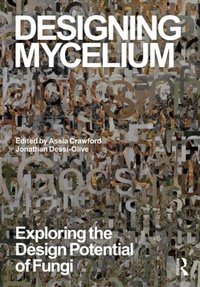
Designing Mycelium
Exploring the Design Potential of Fungi
1st Edition
Will be published approx. on 23. October 2026
Book
Paperback/Softback
460 pages
978-1-041-04821-3 (ISBN)
Description
A silent, sprawling web, mycelium permeates the soil beneath our feet, anchoring the world with stubborn resilience. It is now entering design, architecture, and our built environments with the promise of a new regenerative and grown aesthetic.
This book brings together artists, designers, architects, and thinkers who are discovering new ways of working with this living organism. It is an exploration of negotiations, experimentation, and craft as we re-imagine the designer's role and material agency. This book looks at ways of revitalizing damaged ecologies across scales and offers new ways of making for a world beyond extraction.
The practices featured in this book are those of care, exemplifying ways to reconnect with our humanity through metabolism and decomposition while serving needs beyond our own.
This book brings together artists, designers, architects, and thinkers who are discovering new ways of working with this living organism. It is an exploration of negotiations, experimentation, and craft as we re-imagine the designer's role and material agency. This book looks at ways of revitalizing damaged ecologies across scales and offers new ways of making for a world beyond extraction.
The practices featured in this book are those of care, exemplifying ways to reconnect with our humanity through metabolism and decomposition while serving needs beyond our own.
More details
Language
English
Place of publication
London
United Kingdom
Publishing group
Taylor & Francis Ltd
Target group
College/higher education
Professional and scholarly
Postgraduate, Professional Practice & Development, and Undergraduate Advanced
Illustrations
384 Farbfotos bzw. farbige Rasterbilder, 2 farbige Tabellen, 384 farbige Abbildungen
2 Tables, color; 384 Halftones, color; 384 Illustrations, color
Dimensions
Height: 254 mm
Width: 178 mm
ISBN-13
978-1-041-04821-3 (9781041048213)
Copyright in bibliographic data and cover images is held by Nielsen Book Services Limited or by the publishers or by their respective licensors: all rights reserved.
Schweitzer Classification
Other editions
Additional editions
Book
approx. 10/2026
1st Edition
Routledge
€191.50
Not yet published

E-Book
approx. 10/2026
Routledge
€49.99
Not yet available
E-Book
approx. 10/2026
Routledge
€49.99
Not yet available
Persons
Assia Crawford is an Assistant Professor of Architecture at Tulane University and the founder of Wild Futures Lab, an interdisciplinary research and teaching facility focused on bio-design. She is an ARB-registered architect and author of Designer's Guide to Lab Practice (Routledge, 2023) and Bios in Search of Zoe (ACTAR, 2025). She holds a PhD in Architecture from Newcastle University, Newcastle upon Tyne, UK, where her thesis, Living Building Practice: Design for a Post-Anthropocene Era, examined methods for working with living organisms and the ethical dimensions of emerging material practices. Assia's research centers on biological material alternatives and digital fabrication in response to ecological challenges. Positioned at the intersection of architecture, science, and critical theory, her work uses experimental and speculative design to explore resilient, adaptive responses to environmental uncertainty.
Jonathan Dessi-Olive is a researcher, designer, and educator whose work takes a critical approach to technology while integrating the history and theory of architecture, contemporary construction, and computational design. Presently, he is an Associate Professor in the School of Architecture at UNC Charlotte, where he teaches architecture design studios, structural design, and experimental research seminars. He previously taught at Kansas State University, Georgia Institute of Technology, and Massachusetts Institute of Technology. In 2021, he founded MycoMatters Lab, a design research and education practice that develops novel applications of fungi-based materials at diverse scales of structural design, architectural acoustics, and sculpture.
Jonathan Dessi-Olive is a researcher, designer, and educator whose work takes a critical approach to technology while integrating the history and theory of architecture, contemporary construction, and computational design. Presently, he is an Associate Professor in the School of Architecture at UNC Charlotte, where he teaches architecture design studios, structural design, and experimental research seminars. He previously taught at Kansas State University, Georgia Institute of Technology, and Massachusetts Institute of Technology. In 2021, he founded MycoMatters Lab, a design research and education practice that develops novel applications of fungi-based materials at diverse scales of structural design, architectural acoustics, and sculpture.
Content
All About the Fungus. Fungi: Ubiquitous, Relentless, and Essential. Fungal Living Materials. Critical History of Mycelium Architecture. How to Cast with Mycelium. Amulets. Scenographies of Becoming in the Age of Decomposition. Architectural Invocations. Articulating an Architectural Poetics of Rot. Dead Gods. Biospatial Tectonics. Alchemy. From (Im)practical to Imagination: Artificial Intelligence in Mycelium Design. Crafting with the Other. Farming Mycelium Textiles. BioScaffolds: Designing with Mycelium. Living Prints: The Craft of Mycelial 3D Printing. Symbiotic Materialities: Co-Designing and Fabricating with Mycelium for a Sustainable Future. Weed Form: Myco-Regenerative Dreams. Leather and Lace. Artifact. The Mycelium Project: Integrating Material Research and Professional Education. Sounding the Future. BIOCYCLER: Using Mycotecture to Remediate and Recycle Buildings. Scaling Mycelium-Based Materials in Southeast Asia: The MYCL Case Study. Borrowing from Nature as a Regenerative Design Strategy. Mediating Form, Matter, Fabrication and Performance in Designing with Myco-Materials. It's Not About the Fungus.