

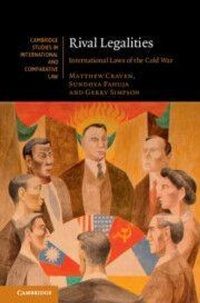
Rival Legalities
International Laws of the Cold War
Will be published approx. on 31. October 2026
Book
Paperback/Softback
320 pages
978-1-108-81019-7 (ISBN)
Description
This book offers a wholly new way of thinking about the ideas, struggles and practices that constituted the 'historical' Cold War. In particular, it seeks to redescribe and defamiliarise what we might think of as Cold War international law in order to bring out a rich but now obscured plurality of law and legal forms during the period and to make visible the ways in which we live and work in the aftermath of this legal order. This book challenges the dominant myths about the history of the Cold War, arguing that far from being defined only by ideologically rivalry, the US and the Soviet Union were engaged in a conjoint project of world ordering.
Reviews / Votes
'Rival Legalities fundamentally re-orients received understandings of the cold war through a nuanced and illuminating account of the relationship between the history of law and the history of international relations. It brilliantly reinterprets how the encounter between competing legal worlds co-created a pluriverse of empire and resistance, risk and possibility.' Vasuki Nesiah, New York University 'This rich and illuminating reinterpretation of the Cold War, competing visions of international ordering and international law, will compel a re-evaluation of the discipline and its relationship to the Cold War. This is a valuable and rewarding book.' Antony Anghie, National University of Singapore and University of Utah 'Confronting the ongoing afterlives of the Cold War, this field-expanding work of legal history radiates with resistance against the foreclosure of alternative international legalities.' Dimitri Van Den Meerssche, Queen Mary University of London 'A vitally imagined and executed history that fundamentally resets our understanding of the Cold War. This fascinating and endlessly probing work offers a complex braiding of worldviews of and beyond the 'Amero-Soviet' project as well as the part or parts claimed for public international law within that context. It is slow history undertaken at its cerebral best, complicating well-worn and well-rehearsed narratives that, in turn, richly refracts back on the very discipline itself. As elegant as it is enlightening, Craven, Pahuja and Simpson have delivered a masterclass in collaborative endeavour with rewards for the reader leaping off every page.' Dino Kritsiosis, University of Nottingham 'By unsettling the commonplace 'Cold War' periodization that has narcotized the field of international law for decades, this book challenges us to reconsider what we know about the practice of international law, past and present, and wrestle with rival memories, imaginations and horizons of the 'international' that remain urgent and necessary. Written with clarity, insight and wit, Rival Legalities is a welcome and important intervention, untimely in the best sense.' Christopher Gevers, University of The Witwatersrand 'This highly anticipated book provides a powerful conceptual framework for observers of international law. Rival Legalities comes at a crucial moment when the international legal order appears upended. The authors' brilliant theory of worldmaking offers desperately needed clarity on the future of the international. An essential guide for uncertain times.' Jason Jackson, Massachusetts Institute of TechnologyMore details
Series
Language
English
Place of publication
Cambridge
United Kingdom
Product notice
Paperback (trade)
Illustrations
Worked examples or Exercises
Weight
25 gr
ISBN-13
978-1-108-81019-7 (9781108810197)
Copyright in bibliographic data and cover images is held by Nielsen Book Services Limited or by the publishers or by their respective licensors: all rights reserved.
Schweitzer Classification
Other editions
Additional editions
Book
approx. 10/2026
Cambridge University Press
€142.50
Not yet published
Persons
Matthew Craven is Professor of International Law at SOAS University of London. He is author of The Decolonisation of International Law (2007), which won the inaugural European Society of International Law prize in the same year, and has authored or edited a number of other books including International Law and the Cold War (2019). He is currently working on a project on international law and geopolitics exploring the interconnections between the two traditions of thought and practice. Sundhya Pahuja is Melbourne Laureate Professor and ARC Kathleen Fitzpatrick Laureate Fellow, Director of the Laureate Program in Global Corporations and International Law. She is the winner of the Max Planck-Cambridge Prize for International Law. She is known for her work on the encounter between plural forms of international law and the legal, historical, political and economic dimensions of the relations between Global South and North. Sundhya is the author of the prize-winning book, Decolonising International Law: Development, Economic Growth and the Politics of Universality (Cambridge 2011) and the co-editor of International Law and the Cold War (2019). Gerry Simpson is Professor of Public International Law at the London School of Economics and Political Science. He is the author of Great Powers and Outlaw States (2004), Law, War and Crime: War Crimes Trials and the Reinvention of International Law (2008) and The Sentimental Life of International Law: Literature, Language and Longing in Global Politics (2021). Gerry is currently writing a book on nuclearism entitled: The Atomics: My Nuclear Family at the End of the Earth.
Content
1. Introduction; 2. A (Dis)United nations, a hesitant inauguration; 3. The Amero-soviet cold war; 4. Practices of diplomacy or international law and being neutral; 5. International legal experimentalism: anti-anti colonialism and third world legalities; 6. Disrupting the cold war: revolutionary internationalism in the global south; 7. Secrets and spies: espionage, surveillance and the covert cold war; 8. Nuclearism: globalising the cold war; 9. Fallout: redescription, periodisation and aftermath; Acknowledgements; A note on the cover image; Bibliography; Index.