

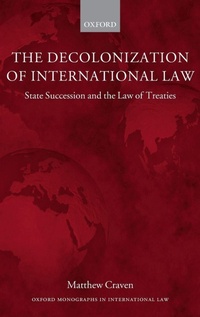
The Decolonization of International Law
State Succession and the Law of Treaties
Published on 27. December 2007
Book
Hardback
306 pages
978-0-19-921762-5 (ISBN)
Description
The issue of state succession continues to be a vital and complex focal point for public international lawyers, yet it has remained strangely resistant to effective articulation. The formative period in this respect was that of decolonization which marked for many the time when international law came of age and when the promises of the UN Charter would be realized in an international community of sovereign peoples. Throughout the 1990s a series of territorial adjustments placed succession once again at the centre of international legal practice, in new contexts that went beyond the traditional model of decolonization: the disintegration of the Soviet Union, Yugoslavia, and Czechoslovakia, and the unifications of Germany and Yemen brought to light the fundamentally unresolved character of issues within the law of succession.
Why have attempts to codify the practice of succession met with so little success? Why has succession remained so problematic a feature of international law? This book argues that the answers to these questions lie in the political backdrop of decolonization and self-determination, and that the tensions and ambiguities that run throughout the law of succession can only be understood by looking at the historical relationship between discourses on state succession, decolonization, and imperialism within the framework of international law.
Why have attempts to codify the practice of succession met with so little success? Why has succession remained so problematic a feature of international law? This book argues that the answers to these questions lie in the political backdrop of decolonization and self-determination, and that the tensions and ambiguities that run throughout the law of succession can only be understood by looking at the historical relationship between discourses on state succession, decolonization, and imperialism within the framework of international law.
Reviews / Votes
Matthew Craven's excellent study...does succeed very well in demonstrating the tensions in international law laid bare by the post-war process of decolonization (and therefore hidden by imperialism), and it should...come as no surprise that those tensions played out in particular in the body of law dealing with the consequences of decolonization: the law on state succession... an incisive analysis of state succession and academic debates on the topic, the work is unparalleled...Matthew Craven is capable of writing with a keen eye for black letter detail but also of seeing bigger theoretical pictures. * Jan Klabbers, Finnish Yearbook of International Law (Vol XVIII) *More details
Series
Language
English
Place of publication
Oxford
United Kingdom
Target group
Professional and scholarly
Dimensions
Height: 240 mm
Width: 161 mm
Thickness: 21 mm
Weight
625 gr
ISBN-13
978-0-19-921762-5 (9780199217625)
Copyright in bibliographic data and cover images is held by Nielsen Book Services Limited or by the publishers or by their respective licensors: all rights reserved.
Schweitzer Classification
Other editions
Additional editions
Book
10/2009
Oxford University Press
€68.09
Shipment within 15-20 days
Person
Matthew Craven is Professor of International Law, School of Oriental and African Studies, University of London
Content
Introduction ; PART ONE: CRITICAL DIAGNOSTICS ; 1. What's Wrong with State Succession? ; 2. A Brief History ; 3. Succession, Identity and Continuity ; 4. The Ends of Succession ; PART TWO: CODIFICATION AND DECOLONIZATION ; 5. The Move to Codification ; 6. Initial Positions ; A) The ILC Sub-Committee ; B) The ILA ; 7. The Waldock Reports ; A) From Contract to Status ; B) New States ; C) Residual Categories ; D) Real Treaties ; 8. Final Moves: The Vienna Conference ; PART THREE: NEW BEGINNINGS, NEW ENDS ; 9. Beyond Decolonization: 1989 - ; 10. The Perils of Formalism ; 11. Treaty Continuity ; 12. Being Pragmatic? ; CONCLUSION