

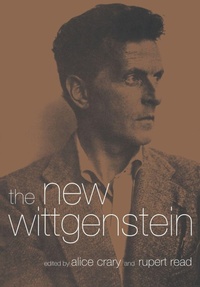
The New Wittgenstein
Published on 30. March 2000
Book
Paperback/Softback
416 pages
978-0-415-17319-3 (ISBN)
Description
This text offers major re-evaluation of Wittgenstein's thinking. It is a collection of essays that presents a significantly different portrait of Wittgenstein. The essays clarify Wittgenstein's modes of philosophical criticism and shed light on the relation between his thought and different philosophical traditions and areas of human concern. With essays by Stanley Cavell, James Conant, Cora Diamond, Peter Winch and Hilary Putnam, we see the emergence of a new way of understanding Wittgenstein's thought. This is a controversial collection, with essays by highly regarded Wittgenstein scholars that may change the way we look at Wittgenstein's body of work.
Reviews / Votes
'There is plenty of interest in this collection for any serious reader of Wittgenstein.' - Common KnowledgeMore details
Language
English
Place of publication
London
United Kingdom
Publishing group
Taylor & Francis Ltd
Target group
College/higher education
Dimensions
Height: 244 mm
Width: 170 mm
Thickness: 23 mm
Weight
715 gr
ISBN-13
978-0-415-17319-3 (9780415173193)
Copyright in bibliographic data and cover images is held by Nielsen Book Services Limited or by the publishers or by their respective licensors: all rights reserved.
Schweitzer Classification
Other editions
Additional editions
Alice Crary | Rupert Read
The New Wittgenstein
Book
04/2000
Routledge
€185.00
Shipment within 15-20 days
Persons
Alice Crary is a Tutor in Philosophy at Harvard University. Rupert Read is a Lecturer in Philosophy at The University of East Anglia.
Content
Introduction PART I Wittgenstein's later writings: the illusory comfort of an external standpoint 1 Excursus on Wittgenstein's vision of language 2 Non-cognitivism and rule-following 3 Wittgenstein on rules and platonism 4 What 'There can be no such thing as meaning anything by any word' could possibly mean 5 Wittgenstein on deconstruction 6 Wittgenstein's philosophy in relation to political thought PART II The Tractatus as forerunner of Wittgenstein's later writings 7 Ethics, imagination and the method of Wittgenstein's Tractatus 8 Elucidation and nonsense in Frege and early Wittgenstein 9 Rethinking mathematical necessity 10 Wittgenstein, mathematics and philosophy 11 Does Bismarck have a beetle in his box? The private language argument in the Tractatus 12 How to do things with wood: Wittgenstein, Frege and the problem of illogical thought 13 Conceptions of nonsense in Carnap and Wittgenstein A dissenting voice 14 Was he trying to whistle it?