

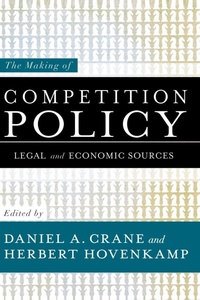
The Making of Competition Policy
Legal and Economic Sources
Published on 7. March 2013
Book
Hardback
510 pages
978-0-19-978279-6 (ISBN)
Description
This book provides edited selections of primary source material in the intellectual history of competition policy from Adam Smith to the present day. Chapters include classical theories of competition, the U.S. founding era, classicism and neoclassicism, progressivism, the New Deal, structuralism, the Chicago School, and post-Chicago theories. Although the focus is largely on Anglo-American sources, there is also a chapter on European Ordoliberalism, an influential school of thought in post-War Europe. Each chapter begins with a brief essay by one of the editors pulling together the important themes from the period under consideration.
Reviews / Votes
Students of antitrust learn about defining cases and underlying economics but little of its history. This unique collection addresses this gap. Editors Crane and Hovenkamp provide informative introductions to 12 groups of readings from Colonial times through the Progressive Era and to structural, Chicago-school, and post-Chicago approaches. This publication could valuably supplement policy history courses and antitrust courses in law schools. Highly recommended. Students, upper-division undergraduate and up; faculty; antitrust practitioners. * CHOICE * The volume does represent an invaluable addition to the antitrust literature and a very useful reference for the whole antitrust community. * Nicola Giocoli, HISTORY OF ECONOMIC THOUGHT09/03/2017 *More details
Language
English
Place of publication
New York
United States
Target group
College/higher education
Illustrations
1 illustration
Dimensions
Height: 260 mm
Width: 183 mm
Thickness: 32 mm
Weight
1144 gr
ISBN-13
978-0-19-978279-6 (9780199782796)
Copyright in bibliographic data and cover images is held by Nielsen Book Services Limited or by the publishers or by their respective licensors: all rights reserved.
Schweitzer Classification
Other editions
Additional editions
E-Book
01/2013
1st Edition
OUP eBook
€89.99
Available for download
Persons
Daniel A. Crane is Professor of Law at the University of Michigan Law School, where he teaches contracts, antitrust, and legislation and regulation. He was formerly Professor of Law at the Benjamin N. Cardozo School of Law, Visiting Professor at NYU and the University of Chicago, and a Fulbright Scholar at the Universidade Catolica Portuguesa in Lisbon, Portugal.
Herbert Hovenkamp is the Ben V. & Dorothy Willie Professor of Law at the University of Iowa. He is a fellow of the American Academy of Arts and Sciences and recipient of the Justice Department's John Sherman Award. He teaches antitrust, innovation and competition policy, torts, and American legal history.
Herbert Hovenkamp is the Ben V. & Dorothy Willie Professor of Law at the University of Iowa. He is a fellow of the American Academy of Arts and Sciences and recipient of the Justice Department's John Sherman Award. He teaches antitrust, innovation and competition policy, torts, and American legal history.
Content
Acknowledgments ; Introduction ; Chapter 1. Classical Theories ; Adam Smith, The Wealth of Nations ; David Ricardo, Principles of Political Economy and Taxation ; John Stuart Mill, Principles of Political Economy ; Chapter 2. Federalism, Antifederalism, and Jacksonianism ; Max Farrand, Records of the Federal Convention of 1787 ; Agrippa, To the People ; Alexander Hamilton, Contintentalist ; Thomas Cooley, Limits to State Control of Private Business ; Chapter 3. Classicism, Neoclassicism, and the Sherman Act ; Alfred Marshall, Principles of Economics ; Arthur Twining Hadley, Economics: An Account of the Relations Between Private Property and Public Welfare ; Henry Rand Hatfield, The Chicago Trust Conference (of 1899) ; Chapter 4. Progressivism and the 1912 Election ; Theodore Roosevelt, The Trusts, the People, and the Square Deal ; William Howard Taft, We Must Get Back to Competition ; Woodrow Wilson, The Tariff and the Trusts ; Chapter 5. Imperfect, Monopolistic, and Workable Competition ; Edward Chamberlin, The Theory of Monopolistic Competition ; Joan Robinson, The Economics of Imperfect Competition ; John Maurice Clark, Toward a Concept of Workable Competition ; Chapter 6. The New Deal and the Institutionalists ; Adolf A. Berle and Gardiner C. Means, The Modern Corporation and Private Property ; Louis Brandeis, The Curse of Bigness ; Rexford Tugwell, The Industrial Discipline and the Governmental Arts ; Thurman Arnold, The Bottlenecks of Business ; Chapter 7. Antitrust After Populism ; Richard Hofstadter, What Happened to the Antitrust Movement? ; Chapter 8. Ordoliberalism and the Freiburg School ; Franz Bohm, Walter Eucken & Hans Grossmann-Doerth, The Ordo Manifesto of 1936 ; Franz Bohm, Democracy and Economic Power ; Chapter 9. Competition and Innovation ; Joseph Schumpeter, Capitalism, Socialism and Democracy ; Kenneth Arrow, Economic Welfare and the Allocation of Resources for Invention ; Chapter 10. Structuralism ; Joe Bain, Industrial Organization ; Carl Kaysen and Donald Turner, Antitrust Policy: An Economic and Legal Analysis ; The Neal Report (1967) ; Chapter 11. The Chicago School ; George Stigler, The Organization of Industry ; Aaron Director and Edward Levi, Law the Future: Trade Regulation ; Robert H. Bork, The Antitrust Paradox ; Richard A. Posner, The Chicago School of Antitrust Analysis ; Chapter 12. Transactions Costs Economics and the Post-Chicago Movement ; Oliver Williamson, Markets and Hierarchies: Analysis and Antitrust Implications ; F.M. Scherer, Conservative Economics and Antitrust: A Variety of Influences ; Herbert Hovenkamp, Post-Chicago Antitrust: A Review and Critique