

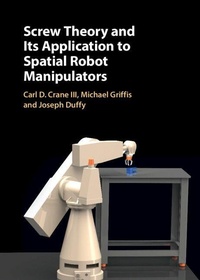
Screw Theory and its Application to Spatial Robot Manipulators
Published on 15. September 2022
Book
Hardback
224 pages
978-0-521-63089-4 (ISBN)
Description
Discover a fresh take on classical screw theory and understand the geometry embedded within robots and mechanisms with this essential text. The book begins with a geometrical study of points, lines, and planes and slowly takes the reader toward a mastery of screw theory with some cutting-edge results, all while using only basic linear algebra and ordinary vectors. It features a discussion of the geometry of parallel and serial robot manipulators, in addition to the reciprocity of screws and a singularity study. All 41 essential screw systems are unveiled, establishing the possible freedom twists and constraint wrenches for a kinematic joint. Familiarizing the reader with screw geometry in order to study the statics and kinematics of robots and mechanisms, this is a perfect resource for engineers and graduate students.
More details
Language
English
Place of publication
Cambridge
United Kingdom
Target group
College/higher education
Illustrations
Worked examples or Exercises
Dimensions
Height: 250 mm
Width: 175 mm
Thickness: 17 mm
Weight
574 gr
ISBN-13
978-0-521-63089-4 (9780521630894)
Copyright in bibliographic data and cover images is held by Nielsen Book Services Limited or by the publishers or by their respective licensors: all rights reserved.
Schweitzer Classification
Other editions
Additional editions
Carl D. Crane, III | Michael Griffis | Joseph Duffy
Screw Theory and its Application to Spatial Robot Manipulators
E-Book
08/2022
Cambridge University Press
€116.99
Available for download
Persons
Carl Crane is Professor in the Department of Mechanical and Aerospace Engineering at the University of Florida. He is a fellow of the ASME. Michael Griffis is Senior Lecturer at the University of Florida. Joseph Duffy was a great kinematician who passionately promoted screw theory. He was the Director of the Center for Intelligent Machines and Robotics at the University of Florida and a Graduate Research Professor, who taught screw theory. He received countless awards, including the ASME Machine Design Award in 2000.
Content
1. Geometry of points, lines, and planes; 2. Coordinate transformations and manipulator kinematics; 3. Statics of a rigid body; 4. Velocity analysis; 5. Reciprocal screws; 6. Singularity analysis of serial chains; 7. Acceleration analysis of serially connected rigid bodies.