

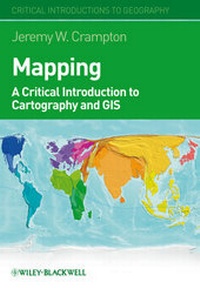
Mapping
A Critical Introduction to Cartography and GIS
Published on 22. January 2010
Book
Paperback/Softback
232 pages
978-1-4051-2173-6 (ISBN)
Description
Mapping: A Critical Introduction to Cartography and GIS is an introduction to the critical issues surrounding mapping and Geographic Information Systems (GIS) across a wide range of disciplines for the non-specialist reader.
* Examines the key influences Geographic Information Systems (GIS) and cartography have on the study of geography and other related disciplines
* Represents the first in-depth summary of the "new cartography" that has appeared since the early 1990s
* Provides an explanation of what this new critical cartography is, why it is important, and how it is relevant to a broad, interdisciplinary set of readers
* Presents theoretical discussion supplemented with real-world case studies
* Brings together both a technical understanding of GIS and mapping as well as sensitivity to the importance of theory
More details
Series
Edition
1. Auflage
Language
English
Place of publication
Hoboken
United Kingdom
Publishing group
John Wiley and Sons Ltd
Target group
College/higher education
Professional and scholarly
Product notice
Paperback (trade)
Unsewn / adhesive bound
Dimensions
Height: 244 mm
Width: 167 mm
Thickness: 17 mm
Weight
382 gr
ISBN-13
978-1-4051-2173-6 (9781405121736)
Schweitzer Classification
Other editions
Additional editions
E-Book
09/2011
Wiley-Blackwell
€31.99
Available for download
Book
01/2010
1st Edition
Wiley
€126.50
Shipment within 3-4 weeks
E-Book
12/2009
Wiley-Blackwell
€31.99
Available for download
Person
Jeremy W. Crampton is Associate Professor of Geography at Georgia State University, where he teaches cartography and political geography. He is the author of The Political Mapping of Cyberspace (2003) and Space, Knowledge and Power: Foucault and Geography (edited with Stuart Elden, 2007), and is the editor of the journal Cartographica: The International Journal for Geographic Information and Geovisualization.
Content
Part I MAPPING AND ITS DISCONTENTS.
1 Mapping landscape.
2 How to lie with maps.
3 Mapping and technology.
4 Critiques of GIS and cartography.
Interlude 1: The Peters projection controvery.
PART II WHY USE MAPS.
5 The communication model in the C20.
6 Emergence of thematic mapping in modern Europe.
7 Contemporary GIS as governmental rationality.
Interlude 2: Maps, silences, and secrecy.
Part III PRODUCING AND REPRESENTING THE LANDSCAPE.
8 Mapping and the production of space.
9 Producing the intangible: mapping cyberspace.
10 GIS and society.
Interlude 3: GIS and security.
PART IV TOWARDS A POLITICS OF GIS AND CARTOGRAPHY.
11 Genealogy and politics of GIS and cartography.
12 From the national body to the personal body.
13 Dwelling in the polis