

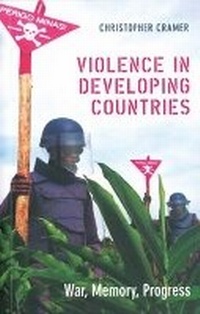
Violence in Developing Countries
War, Memory, Progress
Published on 29. December 2006
Book
Paperback/Softback
256 pages
978-0-253-21928-2 (ISBN)
Description
Why is there so much violence in the developing countries? What does it have to do with economic development? What does it have to do with globalization? Christopher Cramer takes a hard look at war, recent uprisings, insurgencies, and violence in Angola, Brazil, and Iraq. Cramer explains the financing of wars and compares post-conflict reconstruction efforts. He takes special issue with common perspectives on violence, which deny that war has any positive effects and believe that peace can be easily achieved through democratization and free trade. Cramer identifies common fallacies and shows that modern (Western) liberal democracies haven't outgrown violence, and don't only resort to it in self-defense. Providing a far more practical assessment, Cramer boldly argues that violent conflict has led to radical and positive reshaping of social relationships and provoked favorable social change. Violence in Developing Countries forges an alternative understanding of how violence shapes a globalizing society.
Reviews / Votes
"There is a growing preoccupation . . . of violence in the world, and particularly in the 'South' or the 'developing world'. Governments in advanced industrialised countries . . . have increasingly strained to catch up with the realization of just how pervasive violent conflict and other manifestations of violence are in much of the world."-from Violence in Developing CountriesMore details
Language
English
Place of publication
Bloomington, IN
United States
Target group
Professional and scholarly
Product notice
Paperback (trade)
Dimensions
Height: 216 mm
Width: 140 mm
Weight
431 gr
ISBN-13
978-0-253-21928-2 (9780253219282)
Copyright in bibliographic data and cover images is held by Nielsen Book Services Limited or by the publishers or by their respective licensors: all rights reserved.
Schweitzer Classification
Person
Christopher Cramer is Professor in Development Studies at the School of Oriental and African Studies, London.
Content
Preface and Acknowledgments
Introduction: A Whiff of Angola
1. Violence, Memory, and Progress
2. Categories, Trends, and Evidence of Violent Conflict
3. Deviant Conditions
4. Angola and the Theory of War
5. How to Pay for a War
6. Passionate Interests
7. The Great Post-Conflict Makeover Fantasy
Conclusions
Notes
Bibliography
Index
Introduction: A Whiff of Angola
1. Violence, Memory, and Progress
2. Categories, Trends, and Evidence of Violent Conflict
3. Deviant Conditions
4. Angola and the Theory of War
5. How to Pay for a War
6. Passionate Interests
7. The Great Post-Conflict Makeover Fantasy
Conclusions
Notes
Bibliography
Index