

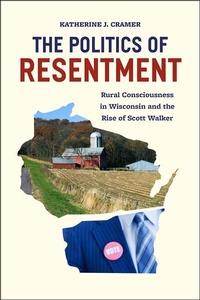
The Politics of Resentment - Rural Consciousness in Wisconsin and the Rise of Scott Walker
Rural Consciousness in Wisconsin and the Rise of Scott Walker
Published on 23. March 2016
Book
Paperback/Softback
256 pages
978-0-226-34911-4 (ISBN)
Description
Since the election of Scott Walker, Wisconsin has been seen as ground zero for debates about the appropriate role of government in the wake of the Great Recession. In a time of rising inequality, Walker not only survived a bitterly contested recall that brought thousands of protesters to Capitol Square, he was subsequently reelected. How could this happen? How is it that the very people who stand to benefit from strong government services not only vote against the candidates who support those services but are vehemently against the very idea of big government?
With The Politics of Resentment, Katherine J. Cramer uncovers an oft-overlooked piece of the puzzle: rural political consciousness and the resentment of the "liberal elite." Rural voters are distrustful that politicians will respect the distinct values of their communities and allocate a fair share of resources. What can look like disagreements about basic political principles are therefore actually rooted in something even more fundamental: who we are as people and how closely a candidate's social identity matches our own. Using Scott Walker and Wisconsin's prominent and protracted debate about the appropriate role of government, Cramer illuminates the contours of rural consciousness, showing how place-based identities profoundly influence how people understand politics, regardless of whether urban politicians and their supporters really do shortchange or look down on those living in the country.
The Politics of Resentment shows that rural resentment-no less than partisanship, race, or class-plays a major role in dividing America against itself.
With The Politics of Resentment, Katherine J. Cramer uncovers an oft-overlooked piece of the puzzle: rural political consciousness and the resentment of the "liberal elite." Rural voters are distrustful that politicians will respect the distinct values of their communities and allocate a fair share of resources. What can look like disagreements about basic political principles are therefore actually rooted in something even more fundamental: who we are as people and how closely a candidate's social identity matches our own. Using Scott Walker and Wisconsin's prominent and protracted debate about the appropriate role of government, Cramer illuminates the contours of rural consciousness, showing how place-based identities profoundly influence how people understand politics, regardless of whether urban politicians and their supporters really do shortchange or look down on those living in the country.
The Politics of Resentment shows that rural resentment-no less than partisanship, race, or class-plays a major role in dividing America against itself.
More details
Series
Language
English
Place of publication
Chicago
United States
Publishing group
The University of Chicago Press
Target group
Professional and scholarly
Product notice
Paperback (trade)
Unsewn / adhesive bound
Dimensions
Height: 228 mm
Width: 151 mm
Thickness: 20 mm
Weight
437 gr
ISBN-13
978-0-226-34911-4 (9780226349114)
Copyright in bibliographic data and cover images is held by Nielsen Book Services Limited or by the publishers or by their respective licensors: all rights reserved.
Schweitzer Classification
Person
Katherine J. Cramer is professor of political science at the University of Wisconsin-Madison, where she is also director of the Morgridge Center for Public Service and an affiliate faculty member in the School of Journalism and Mass Communication, the LaFollette School of Public Affairs, the Department of Forest and Wildlife Ecology, the Wisconsin Center for the Advancement of Postsecondary Education, and the Center for Community and Nonprofit Studies. She is the author of Talking about Race and Talking about Politics, both also published by the University of Chicago Press.