

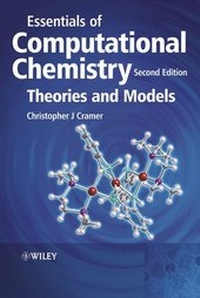
Essentials of Computational Chemistry
Theories and Models
2nd Edition
Published on 24. September 2004
Book
Paperback/Softback
618 pages
978-0-470-09182-1 (ISBN)
Description
Essentials of Computational Chemistry provides a balanced introduction to this dynamic subject. Suitable for both experimentalists and theorists, a wide range of samples and applications are included drawn from all key areas. The book carefully leads the reader thorough the necessary equations providing information explanations and reasoning where necessary and firmly placing each equation in context.
More details
Other editions
Additional editions
E-Book
04/2013
2nd Edition
Wiley
€53.99
Available for download
E-Book
06/2005
2nd Edition
Wiley
€53.99
Available for download

Book
09/2004
2nd Edition
Wiley
€165.00
Article exhausted; check different version
Previous edition
Book
03/2002
1st Edition
Wiley
€149.00
Article exhausted; check for reprint
Person
Christopher Cramer, Professor of Computational Chemistry Department of Chemistry, University of Minnesota,Minneapolis, USA
Content
Preface to the First Edition.
Preface to the Second Edition.
Acknowledgments.
1. What are Theory, Computation, and Modeling?
2. Molecular Mechanics.
3. Simulations of Molecular Ensembles.
4. Foundations of Molecular Orbital Theory.
5. Semiempirical Implementations of Molecular Orbital Theory..
6. Ab Initio Implementations of Hartree-Fock Molecular Orbital.
Theory.
7. Including Electron Correlation in Molecular Orbital Theory.
8. Density Functional Theory.
9. Charge Distribution and Spectroscopic Properties.
10. Thermodynamic Properties.
11. Implicit Models for Condensed Phases.
12. Explicit Models for Condensed Phases.
13. Hybrid Quantal/Classical Models.
14. Excited Electronic States.
15. Adiabatic Reaction Dynamics.
Appendix A Acronym Glossary.
Appendix B Symmetry and Group Theory.
Appendix C Spin Algebra.
Appendix D Orbital Localization.