

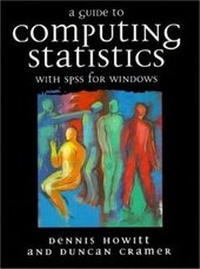
Complete Guide Computing Stats SPSS Windows Version 6
Published on 23. December 1996
Book
Paperback/Softback
208 pages
978-0-13-729197-7 (ISBN)
Description
This Book is a practical guide to SPSS for Windows when analysing psychological and similar data. It si based on the latest version of SPSS for Windows (Release 6 for Windows Version 3.1 and Release 7 for Windows 95. This uncomplicated manual expertly leads the student through the use of SPSS software in windows format, starting with the very basic How to access SPSS for Windows, to dealing with and manipulating statistical analyses using hierachical and multiple regressions.
A Guide to Computing can be used as a stand-alone guide to SPSS for Windows. However, it draws on the examples of research described and explained in An Introduction to Statistics in Psychology (Howitt and Cramer, 1977), an introductory but extended textbook on psychological statistics.
A Guide to Computing can be used as a stand-alone guide to SPSS for Windows. However, it draws on the examples of research described and explained in An Introduction to Statistics in Psychology (Howitt and Cramer, 1977), an introductory but extended textbook on psychological statistics.
More details
Language
English
Place of publication
Upper Saddle River
United States
Publishing group
Pearson Education (US)
Target group
Professional and scholarly
Dimensions
Height: 235 mm
Width: 175 mm
Thickness: 11 mm
Weight
320 gr
ISBN-13
978-0-13-729197-7 (9780137291977)
Copyright in bibliographic data and cover images is held by Nielsen Book Services Limited or by the publishers or by their respective licensors: all rights reserved.
Schweitzer Classification
Content
Introduction
1. How to access SPSS for Windows and enter data
2. Describing variables: tables and diagrams
3. Describing variables numerically: averages, variation and spread
4. Shapes of distributions of scores
5. Standard deviation: the standard unit of measurement in statistics
6. Relationships between two or more variables: diagrams and tables
7. Correlation coefficients: Pearson's correlation and Spearman's Rho
8. Regression: prediction with precision
9. Samples and populations: generating a random sample
10. Selecting cases
11. Standard error
12. The t-test: comparing two samples of correlated/related scores
13. The t-test: comparing two groups of unrelated/uncorrelated scores
14. Chi-square: differences between samples of frequency data
15. Missing values
16. Recoding values
17. Computing new variables
18. Ranking tests: nonparametric statistics
19. The variance ratio test: the F-ratio to compare two variances
20. Analysis of variance (ANOVA): introduction to the one-way unrelated or uncorrelated
ANOVA
21. Analysis of variance for correlated scores or repeated measures
22. Two-way analysis of variance for unrelated/uncorrelated scores
23. Multiple comparisons in ANOVA
24. Analysis of covariance (ANCOVA)
25. Reading ASCII text files into Newdata
26. Partial correlation
27. Factor analysis
28. Stepwise multiple regression
29. Hierarchical multiple regression
Appendix. Other statistics on SPSS
Index
1. How to access SPSS for Windows and enter data
2. Describing variables: tables and diagrams
3. Describing variables numerically: averages, variation and spread
4. Shapes of distributions of scores
5. Standard deviation: the standard unit of measurement in statistics
6. Relationships between two or more variables: diagrams and tables
7. Correlation coefficients: Pearson's correlation and Spearman's Rho
8. Regression: prediction with precision
9. Samples and populations: generating a random sample
10. Selecting cases
11. Standard error
12. The t-test: comparing two samples of correlated/related scores
13. The t-test: comparing two groups of unrelated/uncorrelated scores
14. Chi-square: differences between samples of frequency data
15. Missing values
16. Recoding values
17. Computing new variables
18. Ranking tests: nonparametric statistics
19. The variance ratio test: the F-ratio to compare two variances
20. Analysis of variance (ANOVA): introduction to the one-way unrelated or uncorrelated
ANOVA
21. Analysis of variance for correlated scores or repeated measures
22. Two-way analysis of variance for unrelated/uncorrelated scores
23. Multiple comparisons in ANOVA
24. Analysis of covariance (ANCOVA)
25. Reading ASCII text files into Newdata
26. Partial correlation
27. Factor analysis
28. Stepwise multiple regression
29. Hierarchical multiple regression
Appendix. Other statistics on SPSS
Index