

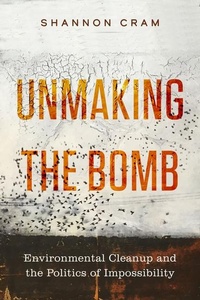
Unmaking the Bomb
Environmental Cleanup and the Politics of Impossibility
1st Edition
Published on 26. September 2023
Book
Paperback/Softback
222 pages
978-0-520-39512-1 (ISBN)
Description
"A powerfully researched and important look at the ravages of nuclear waste remediation."-?One of the Best Indie Books of 2023, Kirkus Reviews
What does it mean to reckon with a contaminated world? In Unmaking the Bomb, Shannon Cram considers the complex social politics of this question and the regulatory infrastructures designed to answer it. Blending history, ethnography, and memoir, she investigates remediation efforts at the Hanford Nuclear Reservation, a former weapons complex in Washington State. Home to the majority of the nation's high-level nuclear waste and its largest environmental cleanup, Hanford is tasked with managing toxic materials that will long outlast the United States and its institutional capacities. Cram examines the embodied uncertainties and structural impossibilities integral to that endeavor. In particular, this lyrical book engages in a kind of narrative contamination, toggling back and forth between cleanup's administrative frames and the stories that overspill them. It spends time with the statistical people that inhabit cleanup's metrics and models and the nonstatistical people that live with their effects. And, in the process, it explores the uneven social relations that make toxicity a normative condition.
What does it mean to reckon with a contaminated world? In Unmaking the Bomb, Shannon Cram considers the complex social politics of this question and the regulatory infrastructures designed to answer it. Blending history, ethnography, and memoir, she investigates remediation efforts at the Hanford Nuclear Reservation, a former weapons complex in Washington State. Home to the majority of the nation's high-level nuclear waste and its largest environmental cleanup, Hanford is tasked with managing toxic materials that will long outlast the United States and its institutional capacities. Cram examines the embodied uncertainties and structural impossibilities integral to that endeavor. In particular, this lyrical book engages in a kind of narrative contamination, toggling back and forth between cleanup's administrative frames and the stories that overspill them. It spends time with the statistical people that inhabit cleanup's metrics and models and the nonstatistical people that live with their effects. And, in the process, it explores the uneven social relations that make toxicity a normative condition.
Reviews / Votes
"In prose that's both calm and solidly grounded in cited research, Cram presents. . . .a quietly devastating indictment that calls to mind such environmentalist classics as Rachel Carson's Silent Spring." * Kirkus Reviews (starred review) * "Cram is calling for nothing less than a revolution in social norms and expectations that would make the elimination of nuclear weapons not only a possibility, but a certainty."* Medicine, Conflict and Survival * "This book critically challenges the ways in which government bodies have defined risk from nuclear waste and reveals the daily experiences of those who have no choice but to embrace it" * International Affairs *
More details
Series
Edition
First Edition
Language
English
Place of publication
Berkerley
United States
Target group
Professional and scholarly
Product notice
Paperback (trade)
Illustrations
16 black and white illustrations
Dimensions
Height: 229 mm
Width: 152 mm
Thickness: 15 mm
Weight
318 gr
ISBN-13
978-0-520-39512-1 (9780520395121)
Copyright in bibliographic data and cover images is held by Nielsen Book Services Limited or by the publishers or by their respective licensors: all rights reserved.
Schweitzer Classification
Other editions
Additional editions
E-Book
09/2023
1st Edition
Naval Institute Press
€28.99
Available for download
Person
Shannon Cram is Associate Professor in the School of Interdisciplinary Arts and Sciences at the University of Washington Bothell.
Content
Contents
Introduction: On Telling Impossible Stories
1. Tender
2. Anatomy of a Phantom
3. Rational Mutants
4. Body Burden
5. Trespassing
Conclusion: Here, in the Plutonium
Acknowledgments
Notes
References
Index
Introduction: On Telling Impossible Stories
1. Tender
2. Anatomy of a Phantom
3. Rational Mutants
4. Body Burden
5. Trespassing
Conclusion: Here, in the Plutonium
Acknowledgments
Notes
References
Index