

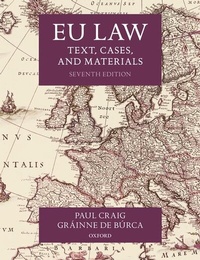
EU Law
Text, Cases, and Materials
7th Edition
Published on 21. July 2020
Book
Paperback/Softback
1344 pages
978-0-19-885664-1 (ISBN)
Description
If you are studying EU law in the UK, please see the UK version of this textbook: EU Law: Text, Cases, and Materials UK Version, ISBN 9780198859840.
Building on its unrivalled reputation as the definitive EU law textbook, this seventh edition continues to provide clear and insightful analysis of all aspects of European Union law.
Drawing on their wealth of experience, Paul Craig and Grainne de Burca succeed in bringing together a unique mix of illuminating commentary and well-chosen extracts from a wide range of cases, legislation and academic publications.
Chapters have been carefully structured and designed to enhance student learning at all levels, laying the foundations of the subject while building analysis of more complex areas and cutting-edge debates.
The seventh edition has been comprehensively updated to reflect the extensive legal developments that have taken place since publication of the sixth edition, and a new chapter on current challenges facing the EU (including Brexit and the rule of law crisis) has been added.
Digital formats and resources
The seventh edition is available for students and institutions to purchase in a variety of formats, and is supported by online resources.
- The e-book offers a mobile experience and convenient access along with functionality tools, navigation features and links that offer extra learning support: www.oxfordtextbooks.co.uk/ebooks
- The book is accompanied by online resources which include the following:
- Updates to the law post-publication
- A timeline of key events in the development of the EU
Building on its unrivalled reputation as the definitive EU law textbook, this seventh edition continues to provide clear and insightful analysis of all aspects of European Union law.
Drawing on their wealth of experience, Paul Craig and Grainne de Burca succeed in bringing together a unique mix of illuminating commentary and well-chosen extracts from a wide range of cases, legislation and academic publications.
Chapters have been carefully structured and designed to enhance student learning at all levels, laying the foundations of the subject while building analysis of more complex areas and cutting-edge debates.
The seventh edition has been comprehensively updated to reflect the extensive legal developments that have taken place since publication of the sixth edition, and a new chapter on current challenges facing the EU (including Brexit and the rule of law crisis) has been added.
Digital formats and resources
The seventh edition is available for students and institutions to purchase in a variety of formats, and is supported by online resources.
- The e-book offers a mobile experience and convenient access along with functionality tools, navigation features and links that offer extra learning support: www.oxfordtextbooks.co.uk/ebooks
- The book is accompanied by online resources which include the following:
- Updates to the law post-publication
- A timeline of key events in the development of the EU
More details
Series
Edition
7th Revised edition
Language
English
Place of publication
Oxford
United Kingdom
Target group
College/higher education
Edition type
Revised edition
Dimensions
Height: 245 mm
Width: 194 mm
Thickness: 47 mm
Weight
2224 gr
ISBN-13
978-0-19-885664-1 (9780198856641)
Copyright in bibliographic data and cover images is held by Nielsen Book Services Limited or by the publishers or by their respective licensors: all rights reserved.
Schweitzer Classification
Other editions
New editions
Book
08/2024
8th Edition
Oxford University Press
€67.50
Available immediately
Persons
Paul Craig, QC, FBA, is Emeritus Professor of English Law at St John's College, Oxford. Paul is one of the foremost scholars on European law and administrative law and has published extensively in these areas.
Grainne de Burca is the Florence Ellinwood Allen Professor of Law and Director of both the Hauser Global Law School and Jean Monnet Center for International and Regional Economic Law and Justice at New York University. Grainne is a leading expert on European Union law, European human rights law, and European and transnational governance and has written widely in these areas.
Grainne de Burca is the Florence Ellinwood Allen Professor of Law and Director of both the Hauser Global Law School and Jean Monnet Center for International and Regional Economic Law and Justice at New York University. Grainne is a leading expert on European Union law, European human rights law, and European and transnational governance and has written widely in these areas.
Content
1: The development of European integration
2: EU Membership: tensions and challenges
3: The institutions
4: Competence
5: Instruments and the hierarchy of norms
6: Legislation and decision-making
7: Decision-making and new forms of governance
8: The nature and effect of EU law: direct effect and beyond
9: The application of EU law: remedies in national courts
10: The relationship between EU law and national law: supremacy
11: EU international relations law
12: Human rights in the EU
13: Enforcement action against Member States
14: Preliminary rulings
15: Review of legality: access
16: Review of legality: grounds of review
17: Damages actions and money claims
18: The single market
19: Free movement of goods: duties, charges, and taxes
20: Free movement of goods: quantitative restrictions
21: Free movement of capital and economic and monetary union
22: Free movement of workers
23: Freedom of establishment and to provide services
24: Citizenship of the European Union
25: Equal treatment and non-discrimination
26: AFSJ: EU criminal law
27: Competition law: Article 101
28: Competition law: Article 102
29: Competition law: mergers
30: The state and the common market
2: EU Membership: tensions and challenges
3: The institutions
4: Competence
5: Instruments and the hierarchy of norms
6: Legislation and decision-making
7: Decision-making and new forms of governance
8: The nature and effect of EU law: direct effect and beyond
9: The application of EU law: remedies in national courts
10: The relationship between EU law and national law: supremacy
11: EU international relations law
12: Human rights in the EU
13: Enforcement action against Member States
14: Preliminary rulings
15: Review of legality: access
16: Review of legality: grounds of review
17: Damages actions and money claims
18: The single market
19: Free movement of goods: duties, charges, and taxes
20: Free movement of goods: quantitative restrictions
21: Free movement of capital and economic and monetary union
22: Free movement of workers
23: Freedom of establishment and to provide services
24: Citizenship of the European Union
25: Equal treatment and non-discrimination
26: AFSJ: EU criminal law
27: Competition law: Article 101
28: Competition law: Article 102
29: Competition law: mergers
30: The state and the common market