

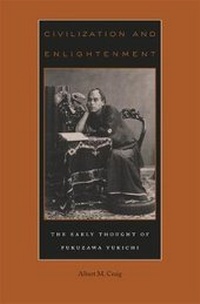
Civilization and Enlightenment
The Early Thought of Fukuzawa Yukichi
Published on 1. January 2009
Book
Hardback
212 pages
978-0-674-03108-1 (ISBN)
Description
The idea that society progresses through stages of development, from savagery to civilization, arose in eighteenth-century Europe. Albert Craig traces how Fukuzawa Yukichi, deeply influenced by the Scottish Enlightenment, "translated" the idea for Japanese society, both enriching and challenging the concept.
Fukuzawa, an official in the Tokugawa government, saw his career collapse when the shogunate ended in 1867. Reinventing himself as a thinker and writer, he made his life work the translation and interpretation of the Western idea of the stages of civilization. He interpreted key Scottish intellectuals- Adam Smith, Adam Ferguson, William Robertson, John Millar; relied on American geographies to help explain how societies progress; and focused on invention as a key to civilization.
By defining the role of "less developed" nations in the world order, Fukuzawa added a new dimension to the stage theory. But by the end of the 1880s, he had come to dismiss the philosophy of natural rights as "the fatuous idealism of Christian ministers." Though civilization-as represented by Britain-was still his goal for Japan, he no longer saw the West as a uniformly beneficial moral force.
This engaging history offers an illuminating look at an important figure and the world of ideas in nineteenth-century Japan.
Fukuzawa, an official in the Tokugawa government, saw his career collapse when the shogunate ended in 1867. Reinventing himself as a thinker and writer, he made his life work the translation and interpretation of the Western idea of the stages of civilization. He interpreted key Scottish intellectuals- Adam Smith, Adam Ferguson, William Robertson, John Millar; relied on American geographies to help explain how societies progress; and focused on invention as a key to civilization.
By defining the role of "less developed" nations in the world order, Fukuzawa added a new dimension to the stage theory. But by the end of the 1880s, he had come to dismiss the philosophy of natural rights as "the fatuous idealism of Christian ministers." Though civilization-as represented by Britain-was still his goal for Japan, he no longer saw the West as a uniformly beneficial moral force.
This engaging history offers an illuminating look at an important figure and the world of ideas in nineteenth-century Japan.
Reviews / Votes
An important book about Japan's leading nineteenth-century thinker. In tracing the origins of Fukuzawa's ideas and showing us how and why he emphasized certain aspects of Western thought, Albert Craig offers excellent insights into the forces for change that Fukuzawa spearheaded in Japan's quest to achieve equality with the West. A tour de force of succinct, clear prose, this work is a significant contribution to intellectual and Japanese history. -- Fred G. Notehelfer, University of California, Los Angeles Considering Fukuzawa's towering importance in the intellectual and cultural history of modern Japan, the English-language literature on him is astonishingly thin, so Craig's fine, elegant book is a welcome addition. In a rich and subtle analysis, Craig reconstructs Fukuzawa's reading of thinkers ranging from Locke and the luminaries of the Scottish Enlightenment, Guizot and Buckle, to American popular geographers. He provides a real sense of the texture and tone of the mid-nineteenth century--of the world as it first industrialized--as it impinged on Fukuzawa's consciousness. -- Andrew Barshay, University of California, BerkeleyMore details
Language
English
Place of publication
Cambridge, Mass
United States
Target group
College/higher education
Illustrations
5 halftones, 7 line illustrations
Dimensions
Height: 235 mm
Width: 156 mm
ISBN-13
978-0-674-03108-1 (9780674031081)
Copyright in bibliographic data and cover images is held by Nielsen Book Services Limited or by the publishers or by their respective licensors: all rights reserved.
Schweitzer Classification
Other editions
Additional editions
E-Book
01/2009
Harvard University Press
€98.99
Available for download
Person
Albert M. Craig is Harvard-Yenching Research Professor of History, Emeritus, at Harvard University.
Content
* Preface * Introduction * The Scottish Enlightenment and the Stages of Civilization * American Geography Textbooks * John Hill Burton's Political Economy * Invention, the Engine of Progress *An Outline of Theories of Civilization * Reflections * Notes * Bibliography * Illustration Sources and Credits * Index