


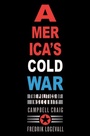
America's Cold War
The Politics of Insecurity
Published on 1. October 2009
Book
Hardback
448 pages
978-0-674-03553-9 (ISBN)
Description
The Cold War dominated world affairs during the half century following World War II. It ended in victory for the United States, yet it was a costly triumph, claiming trillions of dollars in defense spending and the lives of nearly 100,000 U.S. soldiers. Apocalyptic anti-communism sharply limited the range of acceptable political debate, while American actions overseas led to the death of millions of innocent civilians and destabilized dozens of nations that posed no threat to the United States. In a brilliant new interpretation, Campbell Craig and Fredrik Logevall reexamine the successes and failures of America's Cold War. The United States dealt effectively with the threats of Soviet predominance in Europe and of nuclear war in the early years of the conflict. But in engineering this policy, American leaders successfully paved the way for domestic actors and institutions with a vested interest in the struggle's continuation.
Long after the USSR had been effectively contained, Washington continued to wage a virulent Cold War that entailed a massive arms buildup, wars in Korea and Vietnam, the support of repressive regimes and counterinsurgencies, and a pronounced militarization of American political culture. American foreign policy after 1945 was never simply a response to communist power or a crusade contrived solely by domestic interests. It was always an amalgamation of both. This provocative book lays bare the emergence of a political tradition in Washington that feeds on external dangers, real or imagined, a mindset that inflames U.S. foreign policy to this day.
Long after the USSR had been effectively contained, Washington continued to wage a virulent Cold War that entailed a massive arms buildup, wars in Korea and Vietnam, the support of repressive regimes and counterinsurgencies, and a pronounced militarization of American political culture. American foreign policy after 1945 was never simply a response to communist power or a crusade contrived solely by domestic interests. It was always an amalgamation of both. This provocative book lays bare the emergence of a political tradition in Washington that feeds on external dangers, real or imagined, a mindset that inflames U.S. foreign policy to this day.
Reviews / Votes
This is a creative, carefully researched, and incisive analysis of U.S. strategy during the long struggle against the Soviet Union. There are plenty of good books on this topic already, but Craig and Logevall's is one of the best, and their interpretation has important implications for contemporary strategic debates. -- Stephen M. Walt foreignpolicy.com 20091027More details
Language
English
Place of publication
Cambridge, Mass.
United States
Publishing group
Harvard University Press
Target group
Professional and scholarly
Product notice
sewn/stitched
Cloth over boards
With printed dust jacket
Dimensions
Height: 210 mm
Width: 140 mm
ISBN-13
978-0-674-03553-9 (9780674035539)
Copyright in bibliographic data is held by Nielsen Book Services Limited or its licensors: all rights reserved.
Schweitzer Classification
Other editions
Additional editions
E-Book
10/2009
Harvard University Press
€51.99
Available for download
Persons
Campbell Craig is Professor of International Politics, Aberystwyth University. Fredrik Logevall is Professor of History at Cornell University.
Content
* Introduction * The Demise of Free Security * Confrontation * To the Ends of the Earth * Leaner and Meaner * The Nuclear Rubicon * Gulliver's Travails * Nixon's World * A New Cold War * Endgame * Conclusion * Notes* * Acknowledgments * Index