

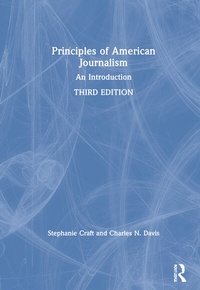
Principles of American Journalism
An Introduction
3rd Edition
Published on 31. May 2021
Book
Hardback
218 pages
978-0-8153-6467-2 (ISBN)
Description
Designed to engage, inspire, and challenge students while laying out the fundamentals of the craft, this textbook introduces readers to the core values of journalism and its singular role in a democracy.
From the First Amendment to Facebook, this popular textbook - now in its third edition - provides a comprehensive exploration of the guiding principles of journalism and what makes it unique. Authors Stephanie Craft and Charles Davis cover the profession's ethical and legal foundations, its historical and modern precepts, the economic landscape of journalism, the relationships among journalism and other social institutions, and the key issues and challenges that contemporary journalists face. They also discuss the current ambiguities and transitions - economic and technological - occurring in the field, from nonprofit news sites to social media's effects on journalism.
Filled with relevant case studies, exercises, and discussion questions that encourage critical thinking about journalism and its role in society, this book helps students become better-informed media consumers as well as more mindful practitioners of journalism.
The companion website features chapter-by-chapter flashcards, quizzes, and annotated weblinks for students and a separate instructor resource section that features sample test questions, PowerPoint slides, sample syllabi, and chapter-by-chapter activities and discussion questions.
From the First Amendment to Facebook, this popular textbook - now in its third edition - provides a comprehensive exploration of the guiding principles of journalism and what makes it unique. Authors Stephanie Craft and Charles Davis cover the profession's ethical and legal foundations, its historical and modern precepts, the economic landscape of journalism, the relationships among journalism and other social institutions, and the key issues and challenges that contemporary journalists face. They also discuss the current ambiguities and transitions - economic and technological - occurring in the field, from nonprofit news sites to social media's effects on journalism.
Filled with relevant case studies, exercises, and discussion questions that encourage critical thinking about journalism and its role in society, this book helps students become better-informed media consumers as well as more mindful practitioners of journalism.
The companion website features chapter-by-chapter flashcards, quizzes, and annotated weblinks for students and a separate instructor resource section that features sample test questions, PowerPoint slides, sample syllabi, and chapter-by-chapter activities and discussion questions.
Reviews / Votes
Praise for the previous edition:"This revised edition of Principles of American Journalism examines journalism's past, present, and future to underscore the essential functions that journalism fulfills in a democracy. The book's conversational tone is allied to ample testimonies from journalists in the field, making it an accessible and engaging text for journalism students." -Ryan Thomas, Missouri School of Journalism
"Craft and Davis adeptly articulate the importance of journalism in society through its history, impact, successes and challenges, particularly in the significant changes revolutionizing the field today. No other book boils this down as succinctly and clearly. Their book should be required reading for anyone considering a career in journalism.
New sections illuminate the rapidly changing media landscape, including industry changes in ownership, an update to the Society of Professional Journalists code of ethics, and the effects of social media on news. Nobody else covers so much material in such a clear, concise way, bolstered by professionals' real stories and practical assignments for learning the craft." - David Cuillier, University of Arizona
More details
Edition
3rd edition
Language
English
Place of publication
New York
United States
Publishing group
Taylor & Francis Inc
Target group
College/higher education
Illustrations
26 s/w Abbildungen, 25 s/w Photographien bzw. Rasterbilder, 1 s/w Zeichnung
1 Line drawings, black and white; 25 Halftones, black and white; 26 Illustrations, black and white
Dimensions
Height: 254 mm
Width: 178 mm
Weight
571 gr
ISBN-13
978-0-8153-6467-2 (9780815364672)
Copyright in bibliographic data and cover images is held by Nielsen Book Services Limited or by the publishers or by their respective licensors: all rights reserved.
Schweitzer Classification
Other editions
New editions
Book
04/2025
4th Edition
Routledge
€240.50
Shipment within 10-20 days
Additional editions
Book
05/2021
3rd Edition
Routledge
€84.36
Article exhausted; check for reprint
Previous edition
Book
04/2016
2nd Edition
Routledge
€237.70
Withdrawn from sale
Persons
Stephanie Craft is Professor and Head of the Department of Journalism at the University of Illinois at Urbana-Champaign. She chaired the Journalism Studies faculty at the University of Missouri School of Journalism and previously headed the Journalism Studies Division of the International Communication Association and the Media Ethics Division of AEJMC. Before earning a doctorate, she worked as a newspaper journalist.
Charles N. Davis is the Dean of Grady College at the University of Georgia and was a longtime faculty member at the University of Missouri School of Journalism. A veteran journalist before becoming an academic, Davis also served as executive director for the National Freedom of Information Coalition (NFOIC) and as director of the University of Missouri Freedom of Information Center.
Charles N. Davis is the Dean of Grady College at the University of Georgia and was a longtime faculty member at the University of Missouri School of Journalism. A veteran journalist before becoming an academic, Davis also served as executive director for the National Freedom of Information Coalition (NFOIC) and as director of the University of Missouri Freedom of Information Center.
Content
1. The Mirror, the Watchdog, and the Marketplace 2. What is Journalism? 3. Making Journalism: New Ways Honor Timeless Values 4. The Independent Journalist 5. From Disruption, New Models Emerge 6. What do Journalists Owe Us? 7. The Foundations of Free Expression 8. Conclusion: The Power of the Free Press