

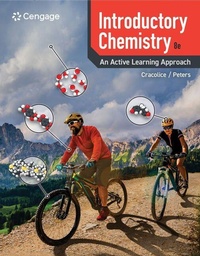
Introductory Chemistry: An Active Learning Approach
8th Edition
Will be published approx. on 10. March 2026
Book
Paperback/Softback
976 pages
978-1-5358-8492-1 (ISBN)
Description
Learn the skills you need to succeed in your chemistry course with "Introductory Chemistry," 8th Edition. This proven resource will help you every step of the way as you develop quantitative skills, apply scientific reasoning and learn how to study. Available in WebAssign, this text includes everything you need to succeed in chemistry.
More details
Edition
8th edition
Language
English
Place of publication
CA
United States
Publishing group
Cengage Learning, Inc
Target group
College/higher education
Product notice
Paperback (trade)
Unsewn / adhesive bound
Dimensions
Height: 273 mm
Width: 216 mm
Thickness: 40 mm
Weight
2277 gr
ISBN-13
978-1-5358-8492-1 (9781535884921)
Copyright in bibliographic data and cover images is held by Nielsen Book Services Limited or by the publishers or by their respective licensors: all rights reserved.
Schweitzer Classification
Other editions
Previous edition
Book
01/2020
7th Edition
Brooks/Cole
€344.50
Shipment within 15-20 days
Persons
Mark S. Cracolice is a professor in the Department of Chemistry and Biochemistry at the University of Montana, where he teaches freshman-level chemistry courses, as well as graduate-level courses in teaching chemistry, theories of learning, and chemical education research. He directs a research group that seeks answers to questions about how students learn and is involved in conducting professional development workshops for high school, college, and university chemistry instructors. Ed Peters received his B.S. from Rensselaer Polytechnic Institute in 1943 in Chemical Engineering and his M.S. from Northwestern University in 1947. He had a long and varied career. He worked as an engineer for the United States Navy and was employed as a chemistry teacher for various high schools and colleges in California. He retired in 1987.
Content
1. Introduction to Chemistry and Introduction to Active Learning.
2. Matter and Energy.
3. Measurement and Chemical Calculations.
4. Introduction to Gases.
5. Atomic Theory: The Nuclear Model of the Atom.
6. Chemical Nomenclature.
7. Chemical Formula and Relationships.
8. Chemical Reactions.
9. Chemical Change.
10. Quantity Relationships in Chemical Reactions.
11. Atomic Theory: The Quantum Model of the Atom.
12. Chemical Bonding.
13. Structure and Shape.
14. The Ideal Gas Law and Its Applications.
15. Gases, Liquids, and Solids.
16. Solutions.
17. Acid-Base (Proton-Transfer) Reactions.
18. Chemical Equilibrium.
19. Oxidation-Reduction (Electron Transfer) Reactions.
20. Nuclear Chemistry.
21. Organic Chemistry.
22. Biochemistry.
Chapter Summaries.
Appendix I: Chemical Calculations.
Appendix II: The SI System of Units.
Glossary.
2. Matter and Energy.
3. Measurement and Chemical Calculations.
4. Introduction to Gases.
5. Atomic Theory: The Nuclear Model of the Atom.
6. Chemical Nomenclature.
7. Chemical Formula and Relationships.
8. Chemical Reactions.
9. Chemical Change.
10. Quantity Relationships in Chemical Reactions.
11. Atomic Theory: The Quantum Model of the Atom.
12. Chemical Bonding.
13. Structure and Shape.
14. The Ideal Gas Law and Its Applications.
15. Gases, Liquids, and Solids.
16. Solutions.
17. Acid-Base (Proton-Transfer) Reactions.
18. Chemical Equilibrium.
19. Oxidation-Reduction (Electron Transfer) Reactions.
20. Nuclear Chemistry.
21. Organic Chemistry.
22. Biochemistry.
Chapter Summaries.
Appendix I: Chemical Calculations.
Appendix II: The SI System of Units.
Glossary.