

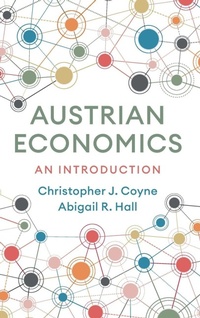
Austrian Economics
An Introduction
1st Edition
Published on 6. February 2026
Book
Hardback
224 pages
978-1-5095-4705-0 (ISBN)
Description
How can people peacefully cooperate with others to improve their lives? This important book answers this question by introducing readers to the Austrian school of economics.
Austrian economics is a heterodox tradition with a distinct philosophy of science stressing purposive individual action, subjective value, the unique nature of economic knowledge, and the importance of prices and markets for coordination. Beginning in Austria in the 1870s with the work of Carl Menger, the ideas of those working in this tradition shaped the field of economics as we know it today. Coyne and Hall tell the story of the key thinkers and ideas in the Austrian school. In doing so, they demonstrate the tradition's ongoing relevance to a wide range of contemporary issues, including entrepreneurship, development, government regulation, artificial intelligence, business cycles and recessions, infectious diseases, recovery from natural disasters, and war.
Comprehensive and accessibly written, Austrian Economics: An Introduction is an indispensable resource on its topic. Readers will come away with a better understanding of economics and an appreciation of the marvel of human cooperation.
Austrian economics is a heterodox tradition with a distinct philosophy of science stressing purposive individual action, subjective value, the unique nature of economic knowledge, and the importance of prices and markets for coordination. Beginning in Austria in the 1870s with the work of Carl Menger, the ideas of those working in this tradition shaped the field of economics as we know it today. Coyne and Hall tell the story of the key thinkers and ideas in the Austrian school. In doing so, they demonstrate the tradition's ongoing relevance to a wide range of contemporary issues, including entrepreneurship, development, government regulation, artificial intelligence, business cycles and recessions, infectious diseases, recovery from natural disasters, and war.
Comprehensive and accessibly written, Austrian Economics: An Introduction is an indispensable resource on its topic. Readers will come away with a better understanding of economics and an appreciation of the marvel of human cooperation.
Reviews / Votes
"Professors Coyne and Hall provide readers with an excellent introduction to the ideas of the Austrian school, followed by a discussion of policy issues to show why those ideas make a difference."Randall Holcombe, Florida State University
"I've always struggled to find a recommendation when I'm asked what book to read as an introduction to Austrian Economics. Thanks to Chris Coyne and Abigail Hall, I now have a 'go to' answer."
Benjamin Powell, Free Market Institute and Texas Tech University
More details
Language
English
Place of publication
Oxford
United Kingdom
Publishing group
John Wiley and Sons Ltd
Target group
Professional and scholarly
Product notice
sewn/stitched
Cloth over boards
Dimensions
Height: 229 mm
Width: 152 mm
Thickness: 14 mm
Weight
472 gr
ISBN-13
978-1-5095-4705-0 (9781509547050)
Copyright in bibliographic data and cover images is held by Nielsen Book Services Limited or by the publishers or by their respective licensors: all rights reserved.
Schweitzer Classification
Other editions
Additional editions
E-Book
04/2026
1st Edition
Wiley
€17.99
Available for download
Book
02/2026
1st Edition
Polity Press
€24.00
Shipment within 15-20 days
Persons
Christopher J. Coyne is Professor of Economics at George Mason University.
Abigail R. Hall is Associate Professor of Economics at the University of Tampa.
Abigail R. Hall is Associate Professor of Economics at the University of Tampa.
Content
Preface
Acknowledgments
List of Figures
1. What is Austrian Economics?
2. The Science of Economics
3. Catallaxy: The Study of Coordination and Exchange
4. Economic Calculation and Planning
5. The Market Process
6. Interventionism
7. Money and Banking
8. Austrian Business Cycle Theory
9. Austrian Economics: Yesterday, Today, and Tomorrow
Notes
References
Index
Acknowledgments
List of Figures
1. What is Austrian Economics?
2. The Science of Economics
3. Catallaxy: The Study of Coordination and Exchange
4. Economic Calculation and Planning
5. The Market Process
6. Interventionism
7. Money and Banking
8. Austrian Business Cycle Theory
9. Austrian Economics: Yesterday, Today, and Tomorrow
Notes
References
Index