

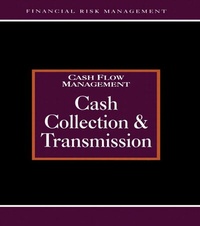
Cash Collections and Transmission
1st Edition
Published on 1. June 2000
Book
Hardback
128 pages
978-1-57958-100-8 (ISBN)
Description
First Published in 2000. Money has a cost or a value. It has a cost to businesses that don't have it and need to borrow it. It has a value to businesses that can deposit it to earn interest. All companies, large or small, should try to manage their cash to keep interest costs as low as possible, or to achieve high-interest income. Cash management is concerned with using money efficiently and effectively to control interest costs or optimize income. This volume book considers three important aspects of cash management: cash collection, banking configurations and electronic banking systems. They concern: the methods of collecting cash and making payments; the way in which bank accounts are organized; and the use of electronic systems for making payments and directing money flows.
More details
Language
English
Place of publication
New York
United States
Publishing group
Taylor & Francis Inc
Target group
Professional and scholarly
Dimensions
Height: 234 mm
Width: 156 mm
Weight
418 gr
ISBN-13
978-1-57958-100-8 (9781579581008)
Copyright in bibliographic data and cover images is held by Nielsen Book Services Limited or by the publishers or by their respective licensors: all rights reserved.
Schweitzer Classification
Other editions
Additional editions
Brian Coyle
Cash Collections and Transmission
E-Book
12/2013
1st Edition
Routledge
€48.99
Available for download
Brian Coyle
Cash Collections and Transmission
E-Book
12/2013
1st Edition
Routledge
€48.99
Available for download
Person
Graham, Alistair
Content
Chapter 1 Introduction; Chapter 2 Cash Collection; Chapter 3 Cash Collection: International Banking; Chapter 4 Reviewing Cash Collection and Payments; Chapter 5 The Customer-Bank Relationship; Chapter 6 Bank Account Configurations; Chapter 7 Netting; Chapter 8 Cash Pooling and Concentration Accounts; Chapter 9 Electronic Banking Systems; Chapter 10 Conclusion;