

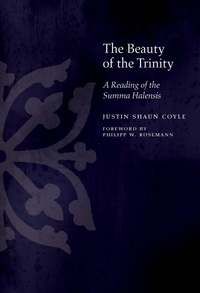
The Beauty of the Trinity
A Reading of the Summa Halensis
Published on 3. January 2023
Book
Hardback
224 pages
978-1-5315-0003-0 (ISBN)
Description
In this book Justin Shaun Coyle remembers the theology of beauty of the forgotten Summa Halensis, an early-thirteenth-century text written by Franciscan friars at the University of Paris. Many scholars vaunt the Summa Halensis-conceived but not drafted entirely by Alexander of Hales (d. 1245)-for its teaching on beauty and its influence on giants of the high scholastic idiom. But few read the text's teaching theologically-as a teaching about God. The Beauty of the Trinity: A Reading of the Summa Halensis proposes an interpretation of the Summa's beauty-teaching as deeply and inexorably theological, even trinitarian.
The book takes as its keystone a passage in which the Summa Halensis identifies beauty with the "sacred order of the divine persons." If beauty names a trinitarian structure rather than a divine attribute, then the text teaches beauty where it teaches trinity. So The Beauty of the Trinity trawls the massive Summa Halensis for beauty across passages largely ignored by the literature. Taking seriously the Summa's own definition of beauty rather than imposing onto the text modernity's narrow aesthetic categories allows Coyle to identity beauty nearly everywhere across the text's pages: in its teaching on the transcendental determinations of being, on the trinity proper, on creation, on psychology, on grace. A medieval text must teach beauty that appreciates beauty theologically beyond the constricted and anachronistic boundaries that often limit study of medieval aesthetics. Readers of medieval theology and theological aesthetics both will find in The Beauty of the Trinity a depiction of how an early scholastic summa thinks beauty according to the mystery of the trinity.
The book takes as its keystone a passage in which the Summa Halensis identifies beauty with the "sacred order of the divine persons." If beauty names a trinitarian structure rather than a divine attribute, then the text teaches beauty where it teaches trinity. So The Beauty of the Trinity trawls the massive Summa Halensis for beauty across passages largely ignored by the literature. Taking seriously the Summa's own definition of beauty rather than imposing onto the text modernity's narrow aesthetic categories allows Coyle to identity beauty nearly everywhere across the text's pages: in its teaching on the transcendental determinations of being, on the trinity proper, on creation, on psychology, on grace. A medieval text must teach beauty that appreciates beauty theologically beyond the constricted and anachronistic boundaries that often limit study of medieval aesthetics. Readers of medieval theology and theological aesthetics both will find in The Beauty of the Trinity a depiction of how an early scholastic summa thinks beauty according to the mystery of the trinity.
More details
Series
Edition
New edition
Language
English
Place of publication
New York
United States
Target group
Professional and scholarly
Edition type
New edition
Product notice
Cloth over boards
Dimensions
Height: 232 mm
Width: 159 mm
Thickness: 24 mm
Weight
494 gr
ISBN-13
978-1-5315-0003-0 (9781531500030)
Copyright in bibliographic data and cover images is held by Nielsen Book Services Limited or by the publishers or by their respective licensors: all rights reserved.
Schweitzer Classification
Other editions
Additional editions
E-Book
01/2023
Fordham University Press
€59.49
Available for download
Persons
Justin Coyle (Author)
Justin Shaun Coyle (PhD, Boston College) is Associate Professor of Theology, Church History, and Philosophy and Associate Academic Dean at Mount Angel Seminary in St. Benedict, Oregon. He is a tonsured reader in the Ukrainian Greek Catholic Church.
Justin Shaun Coyle (PhD, Boston College) is Associate Professor of Theology, Church History, and Philosophy and Associate Academic Dean at Mount Angel Seminary in St. Benedict, Oregon. He is a tonsured reader in the Ukrainian Greek Catholic Church.
Content
Foreword by Philipp W. Rosemann / vii
List of Abbreviations / xi
Introduction / 1
Part I: Beauty among the Transcendentals
1 Transcendentals and Trinity / 9
Transcendentals in the Summa Halensis * A Trinitarian Motive
2 Transcendentals as Trinitarian Appropriation / 22
A Grammar of Trinitarian Appropriation * One, True, and Good
as Trinitarian Appropriations
3 Beauty as Transcendental Order / 35
Is Beauty a Transcendental? An Aesthetic Aporia * An Anonymous
Proposal * Beauty as Sacred Order of the Trinity * Beauty as Order
of the Transcendentals
Part II: The Trinity's Beauty ad intra
4 The Beauty the Trinity Is / 57
Persons and Processions * The Order of the Trinity *
Is Not the Son Beauty, Too?
Part III: The Trinity's Beauty ad extra
5 The Beauty Creation Is / 77
Creation and Trinitarian Processions * Trinitarian Causality *
Trinitarian Traces * The Beauty of Creation
6 The Beauty the Soul Is / 96
The Soul and Its Powers: A Disputed Question * The Soul and Its Powers
in the Early Halensian School * Brother Alexander on the Imago trinitatis
7 The Beauty Grace Gives / 112
Sin as Antitrinity * Grace's Trinitarian Condition * The Trinitarian
Structure of Grace * Grace as Trinitarian Enjoyment
Conclusion & ad obiectiones / 131
Acknowledgments / 141
Notes / 143
Bibliography / 201
Index / 221
List of Abbreviations / xi
Introduction / 1
Part I: Beauty among the Transcendentals
1 Transcendentals and Trinity / 9
Transcendentals in the Summa Halensis * A Trinitarian Motive
2 Transcendentals as Trinitarian Appropriation / 22
A Grammar of Trinitarian Appropriation * One, True, and Good
as Trinitarian Appropriations
3 Beauty as Transcendental Order / 35
Is Beauty a Transcendental? An Aesthetic Aporia * An Anonymous
Proposal * Beauty as Sacred Order of the Trinity * Beauty as Order
of the Transcendentals
Part II: The Trinity's Beauty ad intra
4 The Beauty the Trinity Is / 57
Persons and Processions * The Order of the Trinity *
Is Not the Son Beauty, Too?
Part III: The Trinity's Beauty ad extra
5 The Beauty Creation Is / 77
Creation and Trinitarian Processions * Trinitarian Causality *
Trinitarian Traces * The Beauty of Creation
6 The Beauty the Soul Is / 96
The Soul and Its Powers: A Disputed Question * The Soul and Its Powers
in the Early Halensian School * Brother Alexander on the Imago trinitatis
7 The Beauty Grace Gives / 112
Sin as Antitrinity * Grace's Trinitarian Condition * The Trinitarian
Structure of Grace * Grace as Trinitarian Enjoyment
Conclusion & ad obiectiones / 131
Acknowledgments / 141
Notes / 143
Bibliography / 201
Index / 221