

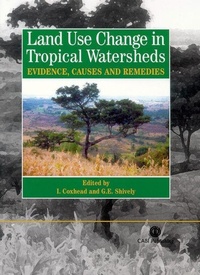
Land Use Changes in Tropical Watersheds
Evidence, Causes and Remedies
Published on 15. December 2005
Book
Hardback
208 pages
978-0-85199-912-8 (ISBN)
Description
This book studies land use change in tropical landscapes, with particular emphasis on the economic processes that influence rates of land degradation and forest clearing. Multidisciplinary contributions draw lessons from a rich, decade-long collection of economic, social and environmental data on the Manupali upland watershed in the southern Philippines. Through this detailed case study the book documents forces leading to land use changes, in particular the potential impacts of institutional evolution and policy reforms, and highlights interrelationships between biological, economic, and social phenomena.
More details
Language
English
Place of publication
Wallingford
United Kingdom
Target group
College/higher education
Professional and scholarly
Product notice
Unsewn / adhesive bound
Cloth over boards
Dimensions
Height: 246 mm
Width: 173 mm
Thickness: 20 mm
Weight
612 gr
ISBN-13
978-0-85199-912-8 (9780851999128)
Copyright in bibliographic data and cover images is held by Nielsen Book Services Limited or by the publishers or by their respective licensors: all rights reserved.
Schweitzer Classification
Persons
Content
1: Economic development and watershed degradation, 2: Agricultural development and institutional transitions, 3: Water quality changes in the Manupali River watershed, 4: How do national markets and price policies affect land use at the forest margin?, 5: How do relative price changes alter land use decisions? 6: Economic incentives and agricultural outcomes in upland settings, 7: Simulating soil erosion and sediment yield in small upland watersheds using the WEPP model, 8: Identifying soil erosion hotspots in the Manupali River watershed, 9: Alternatives to traditional annual crop agriculture in the uplands, 10: Linking economic policies and environmental outcomes at a watershed scale, 11: Using Payments for Environmental Services (PES) to assist in watershed management, 12: Conclusions and some directions for future research,