

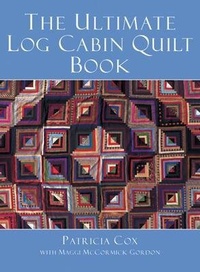
The Ultimate Log Cabin Quilt Book
Description
The secret of Log Cabin lies in its simplicity. In its most basic form the block consists of a central square around which are stitched strips of fabric of uniform width. These can be arranged around the central shape consecutively or they can be alternated on opposite sides, and the key to making an effective Log Cabin design is the way in which the colours - lights and darks - are organised.
However, much of the enduring fascination of Log Cabin is in its infinite range of variations. Different widths of strips can be used. The centre can be any straight-sided shape. Shapes can be added at the ends of each strip to create additional, secondary patterns within each block. And again, the choice of colour values - the juxtaposition of darks and lights - is crucial to the overall design.
The book covers the origins of log cabin, step-by-step projects for the techniques used such as press piecing, strip piecing, courthouse steps, using folded strips and making a foundation grid. Another chapter explores the huge variety of log cabin designs possible, with many colour photographs of traditional and modern quilts. The way in which blocks can be combined to produce strikingly different effects is is also covered, followed by a 'workbook' chapter of full-page black and white quilt designs which can be photocopied and coloured in to show you in advance how a finished combination of blocks would look. Altogether, 'The Ultimate Log Cabin Quilt Book' covers every angle and answers any questions the reader may have on the subject.
To most people, the quintessential quilt design is the block known as Log Cabin. The versatility of the pattern, both in terms of individual blocks and in the enormous number of ways in which blocks can be put together, or set, has given Log Cabin a unique place in the quilting world. Its origins are ancient, its traditions are long-standing, and its modern interpretations are widespread.
The secret of Log Cabin lies in its simplicity. In its most basic form the block consists of a central square around which are stitched strips of fabric of uniform width. These can be arranged around the central shape consecutively or they can be alternated on opposite sides, and the key to making an effective Log Cabin design is the way in which the colours - lights and darks - are organised.
However, much of the enduring fascination of Log Cabin is in its infinite range of variations. Different widths of strips can be used. The centre can be any straight-sided shape. Shapes can be added at the ends of each strip to create additional, secondary patterns within each block. And again, the choice of colour values - the juxtaposition of darks and lights - is crucial to the overall design.
The book covers the origins of log cabin, step-by-step projects for the techniques used such as press piecing, strip piecing, courthouse steps, using folded strips and making a foundation grid. Another chapter explores the huge variety of log cabin designs possible, with many colour photographs of traditional and modern quilts. The way in which blocks can be combined to produce strikingly different effects is is also covered, followed by a 'workbook' chapter of full-page black and white quilt designs which can be photocopied and coloured in to show you in advance how a finished combination of blocks would look. Altogether, 'The Ultimate Log Cabin Quilt Book' covers every angle and answers any questions the reader may have on the subject.
More details
Person
Patricia Cox returns in this book to the design that most fascinated her early in her career as a quilter and a collector of quilts. She lives in Minneapolis. Co-author Maggi McCormick Gordon rewrites her classic monograph The Log Cabin Workbook. Maggi lives in London.