

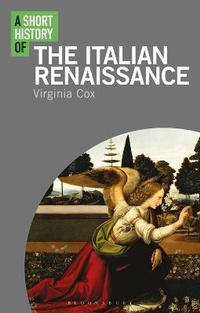
A Short History of the Italian Renaissance
Published on 8. October 2015
Book
Hardback
272 pages
978-1-78453-077-8 (ISBN)
Description
The extraordinary creative energy of Renaissance Italy lies at the root of modern Western culture. In her elegant new introduction, Virginia Cox offers a fresh vision of this iconic moment in European cultural history, when - between the fourteenth and sixteenth centuries - Italy led the world in painting, building, science and literature. Her book explores key artistic, literary and intellectual developments, but also histories of food and fashion, map-making, exploration and anatomy. Alongside towering figures such as Leonardo da Vinci, Michelangelo, Raphael, Petrarch, Machiavelli and Isabella d'Este, Cox reveals a cast of lesser-known protagonists including printers, travel writers, actresses, courtesans, explorers, inventors and even celebrity chefs. At the same time, Italy's rich regional diversity is emphasised; in addition to the great artistic capitals of Florence, Rome and Venice, smaller but cutting-edge centres such as Ferrara, Mantua, Bologna, Urbino and Siena are given their due.
As the author demonstrates, women played a far more prominent role in this exhilarating resurgence than was recognized until very recently - both as patrons of art and literature and as creative artists themselves. 'Renaissance woman', she boldly argues, is as important a legacy as 'Renaissance man'.
As the author demonstrates, women played a far more prominent role in this exhilarating resurgence than was recognized until very recently - both as patrons of art and literature and as creative artists themselves. 'Renaissance woman', she boldly argues, is as important a legacy as 'Renaissance man'.
Reviews / Votes
This is a short and pithy book by an outstanding scholar at the top of her game. Prioritizing literature, it uses newly-discovered or unfamiliar writings to re-describe social classes, as well as topics like individualism and gender. Its innovative chapters on "Renaissance Man" and especially "Renaissance Woman" help to reset the agenda for understanding the Italian Renaissance, making this book an invaluable twenty-first-century guide, not only for students but for the rest of us as well. * Alison Brown, Emerita Professor of Italian Renaissance History, Royal Holloway, University of London, author of The Renaissance * Virginia Cox's short history of the Italian Renaissance is an exemplary introduction: concise, lucid, elegant, balanced, perceptive and accessible. It summarizes traditional views of the Renaissance, especially Jacob Burckhardt's, criticizes them, and offers a revised interpretation of the movement. Cox's Renaissance is, in her own words, "broader and deeper" than its predecessors. She places more emphasis than usual on the coexistence and conflict between different ideas and styles. She re-interprets Burckhardt's idea of Renaissance "individualism" with the aid of recent work on social psychology. Her book includes discussions of the applied arts, notably fashion, as well as a chapter on "the Renaissance woman", based on the author's own research. Students will be grateful for this book, general readers will enjoy it, and fellow-scholars will be appreciative of the knowledge and thought underlying its apparently effortless production. * Peter Burke, FBA, Emeritus Professor of Cultural History, University of Cambridge, author of The Italian Renaissance * Virginia Cox's rich, thought-provoking and elegantly written introduction to the Italian Renaissance conceives the cultural movement widely and inclusively, and encourages us to see it in new ways. Cox shows how it was rooted in an emulative and endlessly inventive dialogue with the models of ancient Rome and Greece that responded to, and was made more urgent by, the new needs of expanding cities and commerce. The cultural production that she considers includes of course literature, fine art, music and thought, but also material culture (including cooking and fashion), geography and science. Cox argues convincingly that the Renaissance in Italy should be seen as lasting until as late as the start of the seventeenth century, and as multipolar, with important developments emerging as much from princely courts as from the republics of Florence and Venice. Her approach enables her to go beyond the cultures of the social elites to study those of the literate urban classes in general. Perhaps most strikingly, she can devote equal space to Renaissance man merchants, courtiers and artists in a broad senseand to Renaissance woman, the secular and religious figures whose engagement with culture flourished most fully towards the end of the period. This finely judged book achieves much more than one might expect from a short history. It should be read and pondered by anyone interested in the Italian Renaissance, whether they are experienced scholars, students or non-specialists. * Brian Richardson, Emeritus Professor of Italian Language, University of Leeds, author of Manuscript Culture in Renaissance Italy *
More details
Series
Language
English
Place of publication
United Kingdom
Publishing group
Bloomsbury Publishing PLC
Target group
College/higher education
Illustrations
32 b/w integrated, 2 maps
Dimensions
Height: 216 mm
Width: 138 mm
Weight
360 gr
ISBN-13
978-1-78453-077-8 (9781784530778)
Copyright in bibliographic data and cover images is held by Nielsen Book Services Limited or by the publishers or by their respective licensors: all rights reserved.
Schweitzer Classification
Other editions
Additional editions
Virginia Cox
A Short History of the Italian Renaissance
E-Book
10/2015
1st Edition
I.B. Tauris
€16.49
Available for download
Virginia Cox
A Short History of the Italian Renaissance
E-Book
10/2015
I.B. Tauris
€14.49
Available for download
Person
Virginia Cox is Professor of Italian at New York University. She is the author of The Prodigious Muse: Women's Writing in Counter-Reformation Italy, Women's Writing in Italy, 1400-1650 and The Renaissance Dialogue: Literary Dialogue in its Social and Political Contexts, Castiglione to Galileo.