

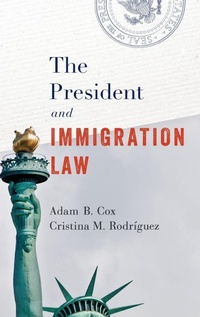
The President and Immigration Law
Published on 12. November 2020
Book
Hardback
360 pages
978-0-19-069436-4 (ISBN)
Description
Who controls American immigration policy? The biggest immigration controversies of the last decade have all involved policies produced by the President - policies such as President Obama's decision to protect Dreamers from deportation and President Trump's proclamation banning immigrants from several majority-Muslim nations. While critics of these policies have been separated by a vast ideological chasm, their broadsides have embodied the same widely shared belief: that Congress, not the President, ought to dictate who may come to the United States and who will be forced to leave.
This belief is a myth. In The President and Immigration Law, Adam B. Cox and Cristina M. Rodriguez chronicle the untold story of how, over the course of two centuries, the President became our immigration policymaker-in-chief. Diving deep into the history of American immigration policy - from founding-era disputes over deporting sympathizers with France to contemporary debates about asylum-seekers at the Southern border - they show how migration crises, real or imagined, have empowered presidents. Far more importantly, they also uncover how the Executive's ordinary power to decide when to enforce the law, and against whom, has become an extraordinarily powerful vehicle for making immigration policy.
This pathbreaking account helps us understand how the United States has come to run an enormous shadow immigration system-one in which nearly half of all noncitizens in the country are living in violation of the law. It also provides a blueprint for reform, one that accepts rather than laments the role the President plays in shaping the national community, while also outlining strategies to curb the abuse of law enforcement authority in immigration and beyond.
This belief is a myth. In The President and Immigration Law, Adam B. Cox and Cristina M. Rodriguez chronicle the untold story of how, over the course of two centuries, the President became our immigration policymaker-in-chief. Diving deep into the history of American immigration policy - from founding-era disputes over deporting sympathizers with France to contemporary debates about asylum-seekers at the Southern border - they show how migration crises, real or imagined, have empowered presidents. Far more importantly, they also uncover how the Executive's ordinary power to decide when to enforce the law, and against whom, has become an extraordinarily powerful vehicle for making immigration policy.
This pathbreaking account helps us understand how the United States has come to run an enormous shadow immigration system-one in which nearly half of all noncitizens in the country are living in violation of the law. It also provides a blueprint for reform, one that accepts rather than laments the role the President plays in shaping the national community, while also outlining strategies to curb the abuse of law enforcement authority in immigration and beyond.
Reviews / Votes
The President and Immigration Law is a timely myth-busting study of a subject that has divided the nation right in the middle. Taking a unique scholarly take on the subject, Adam B. Cox and Cristina M. Rodriguez argue that initially the power to conduct immigration policy belonged to Congress but Congress has slowly delegated its right to make and implement immigration policy to the White House. Their clear-eyed analysis cuts through the messy constitutional history and controversies and presents a neutral, balanced view of the issue. In addition to providing insight and unique perspectives, they also stress the importance of bringing about constitutional reform. Adam B. Cox and Cristina M. Rodriguez once again prove they are the leading authorities on immigration law and history. It is a must-read to understand the current immigration controversy. * The Washington BookReview *More details
Language
English
Place of publication
New York
United States
Target group
Professional and scholarly
Dimensions
Height: 240 mm
Width: 161 mm
Thickness: 24 mm
Weight
699 gr
ISBN-13
978-0-19-069436-4 (9780190694364)
Copyright in bibliographic data and cover images is held by Nielsen Book Services Limited or by the publishers or by their respective licensors: all rights reserved.
Schweitzer Classification
Other editions
Additional editions
Adam B. Cox | Cristina M. Rodríguez
The President and Immigration Law
E-Book
08/2020
OUP eBook
€9.99
Available for download
Adam B. Cox | Cristina M. Rodríguez
The President and Immigration Law
E-Book
08/2020
OUP eBook
€9.99
Available for download
Persons
Adam B. Cox is Robert A. Kindler Professor of Law at New York University School of Law. He is a leading expert on immigration law, voting rights, and constitutional law. His writing has appeared in the Yale Law Journal, Stanford Law Journal, Journal of Law and Economics, and many other scholarly publications, and has been covered by the New York Times, the Los Angeles Times, and others.
Cristina M. Rodriguez is Leighton Homer Surbeck Professor of Law at Yale Law School and a nationally recognized scholar of administrative, constitutional, and immigration law. Her work has been published in numerous academic journals, including the Yale Law Journal, the Columbia Law Review, and Daedelus. She also has appeared regularly in media outlets, including National Public Radio, The Washington Post, The New York Times, Democracy Journal, and Forbes. Beyond academia, she served as Deputy Assistant Attorney General for the Office of Legal Counsel in the Department of Justice during the Obama Administration and clerked for U.S. Supreme Court Justice Sandra Day O'Connor.
Cristina M. Rodriguez is Leighton Homer Surbeck Professor of Law at Yale Law School and a nationally recognized scholar of administrative, constitutional, and immigration law. Her work has been published in numerous academic journals, including the Yale Law Journal, the Columbia Law Review, and Daedelus. She also has appeared regularly in media outlets, including National Public Radio, The Washington Post, The New York Times, Democracy Journal, and Forbes. Beyond academia, she served as Deputy Assistant Attorney General for the Office of Legal Counsel in the Department of Justice during the Obama Administration and clerked for U.S. Supreme Court Justice Sandra Day O'Connor.
Content
Introduction: Who Controls Immigration Law?
Part I: The Rise of Presidential Immigration Law
1. The Diplomatic Origins of Immigration Law
2. Managing and Manufacturing Crisis
3. The Deportation State
4. Our Shadow Immigration System
Part II: Executive Power Consolidated
5. Sidelining the States
6. Controlling the Enforcement Bureaucracy
Part III: Assessing Presidential Immigration Law
7. Wither Legislative Supremacy?
8. Executive Governance through Enforcement
Epilogue: Toward a New Presidential Immigration Law
Part I: The Rise of Presidential Immigration Law
1. The Diplomatic Origins of Immigration Law
2. Managing and Manufacturing Crisis
3. The Deportation State
4. Our Shadow Immigration System
Part II: Executive Power Consolidated
5. Sidelining the States
6. Controlling the Enforcement Bureaucracy
Part III: Assessing Presidential Immigration Law
7. Wither Legislative Supremacy?
8. Executive Governance through Enforcement
Epilogue: Toward a New Presidential Immigration Law