

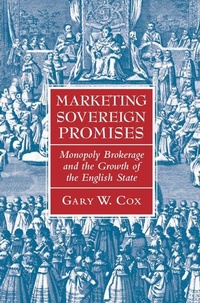
Marketing Sovereign Promises
Monopoly Brokerage and the Growth of the English State
Published on 9. May 2016
Book
Hardback
238 pages
978-1-107-14062-2 (ISBN)
Description
How did England, once a minor regional power, become a global hegemon between 1689 and 1815? Why, over the same period, did she become the world's first industrial nation? Gary W. Cox addresses these questions in Marketing Sovereign Promises. The book examines two central issues: the origins of the great taxing power of the modern state and how that power is made compatible with economic growth. Part I considers England's rise after the revolution of 1689, highlighting the establishment of annual budgets with shutdown reversions. This core reform effected a great increase in per capita tax extraction. Part II investigates the regional and global spread of British budgeting ideas. Cox argues that states grew only if they addressed a central credibility problem afflicting the Ancien Regime - that rulers were legally entitled to spend public revenue however they deemed fit.
Reviews / Votes
'Seventeenth-century British public finance stands at the intersection of several fields of scholarship - economics, political science, and history - and research on it lies at the foundation of contemporary political economy. In this important work, Gary W. Cox revisits the topic and offers an interpretation of his own. The book is pure Cox: deeply researched, closely argued, and profound - political economy done right.' Robert H. Bates, Harvard University, Massachusetts 'This is a major contribution to institutional economics, the application of those methods to understanding British political development, the comparative history of fiscal constitutions, and an interesting extension of arguments about the Industrial Revolution.' Michael Braddick, Sheffield University 'Cox combines attention to history with carefully laid out models of political economy to understand just how England arrived at limited government. This is the most important book in historical political economy in the last decade.' Jean-Laurent Rosenthal, California Institute of Technology 'Cox provides us with an important new analysis of a critical historical episode, the growth of parliamentary responsibility in Britain, its economic consequences, and the diffusion of this practice to other countries. He adds greatly to our understanding of how the modern state came to be.' David Stasavage, New York University 'Summing Up: Recommended. Upper-division undergraduates through faculty.' B. B. Andrew, ChoiceMore details
Series
Language
English
Place of publication
Cambridge
United Kingdom
Target group
College/higher education
Professional and scholarly
Illustrations
14 Tables, black and white; 21 Line drawings, unspecified
Dimensions
Height: 235 mm
Width: 157 mm
Thickness: 19 mm
Weight
543 gr
ISBN-13
978-1-107-14062-2 (9781107140622)
Copyright in bibliographic data and cover images is held by Nielsen Book Services Limited or by the publishers or by their respective licensors: all rights reserved.
Schweitzer Classification
Other editions
Additional editions
E-Book
08/2016
Cambridge University Press
€20.49
Available for download
E-Book
04/2016
Cambridge University Press
€19.49
Available for download
Book
04/2016
Cambridge University Press
€37.50
Shipment within 15-20 days
Person
Gary W. Cox is the William Bennett Munro Professor of Political Science at Stanford University, California. Cox has written numerous articles and is author of The Efficient Secret (winner of the 1983 Samuel H. Beer Dissertation Prize and the 2003 George H. Hallett Award), coauthor of Legislative Leviathan (winner of the 1993 Richard F. Fenno Prize), author of Making Votes Count (winner of the 1998 Woodrow Wilson Foundation Award, the 1998 Luebbert Prize, and the 2007 George H. Hallett Award), and coauthor of Setting the Agenda (winner of the 2006 Leon D. Epstein Book Award). Cox was elected to the American Academy of Arts and Sciences in 1996 and the National Academy of Sciences in 2005.
Content
1. Sovereign credibility and public revenue; Part I. The Glorious Revolution and the English State: 2. The market for taxes and platforms; 3. More credible platforms, more taxes; 4. Pricing sovereign debts; 5. Establishing monopoly brokerage of sovereign debts; 6. The consequences of monopoly brokerage of debt; 7. Property rights; 8. From constitutional commitment to Industrial Revolution; 9. Summarizing the Revolution; Part II. The English Constitutional Diaspora: 10. Exporting the Revolution - the early adopters; 11. Exporting the Revolution - the late adopters; 12. Good political institutions.