

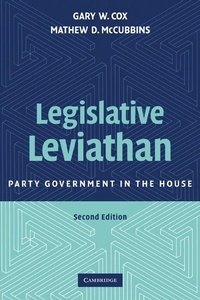
Legislative Leviathan
Party Government in the House
2nd Edition
Published on 5. March 2007
Book
Paperback/Softback
328 pages
978-0-521-69409-4 (ISBN)
Description
The second edition of Legislative Leviathan provides an incisive new look at the inner workings of the House of Representatives in the post-World War II era. Re-evaluating the role of parties and committees, Gary W. Cox and Mathew D. McCubbins view parties in the House - especially majority parties - as a species of 'legislative cartel'. These cartels seize the power, theoretically resident in the House, to make rules governing the structure and process of legislation. Most of the cartel's efforts are focused on securing control of the legislative agenda for its members. The first edition of this book had significant influence on the study of American politics and is essential reading for students of Congress, the presidency, and the political party system.
Reviews / Votes
"Legislative Leviathan was a stellar piece of research that had a profound impact on how scholars thought about the Congress. It was marked by clear and compelling theory, sophisticated analysis, and an enormous amount of relevant and convincing evidence. In this revised edition, updated by consideration of the period of the Republican majority and with discussions of recent research, 'Leviathan' remains one of the truly essential works for students of the legislative politics."David Rohde, Duke University "In Legislative Leviathan, Cox and McCubbins have produced the most sophisticated, nuanced theoretical treatment of congressional parties to date. It is a special treat to see that they have incorporated the most recent thinking about congressional parties in this new edition. If you read and learned from the first edition, you must read this edition, too. If you are new to the subject of congressional parties, then start here."
Steven S. Smith, Washington University, St. Louis
More details
Edition
2nd Revised edition
Language
English
Place of publication
Cambridge
United Kingdom
Target group
Professional and scholarly
College/higher education
Edition type
Revised edition
Product notice
Paperback (trade)
Illustrations
36 Tables, unspecified
Dimensions
Height: 229 mm
Width: 152 mm
Thickness: 20 mm
Weight
534 gr
ISBN-13
978-0-521-69409-4 (9780521694094)
Copyright in bibliographic data and cover images is held by Nielsen Book Services Limited or by the publishers or by their respective licensors: all rights reserved.
Schweitzer Classification
Other editions
Additional editions
E-Book
05/2007
2nd Edition
Cambridge University Press
€27.99
Available for download
Persons
Gary W. Cox is a Distinguished Professor of Political Science at the University of California, San Diego. In addition to numerous articles in the areas of legislative and electoral politics, he is author of The Efficient Secret (winner of the Samuel H. Beer dissertation prize in 1983); co-author of Legislative Leviathan: Party Government in the House (winner of the Richard F. Fenno Prize in 1993) and Elbridge Gerry's Salamander: The Electoral Consequences of the Reapportionment Revolution (Cambridge, 2002); and author of Making Votes Count: Strategic Coordination in the World's Electoral Systems (1997), which was awarded APSA's award for the best book in political science (Woodrow Wilson Foundation Award), the best book in comparative politics (Gregory Luebbert Prize), and the best book in political economy. His latest book, Setting the Agenda: Responsible Party Government in the US House of Representatives, with co-author Mathew McCubbins, was published in 2005. Cox is a former Guggenheim Fellow and was elected to the American Academy of Arts and Sciences in 1996. Mathew D. McCubbins is a Professor of Political Science at the University of California, San Diego. His authored and co-authored works include Legislative Leviathan: Party Government in the House, 1st Edition (1993); Under the Watchful Eye: Managing Presidential Campaigns in the Television Era (1992); and Stealing the Initiative: How State Government Responds to Direct Democracy (2001). Recent co-edited books include The Origins of Liberty: Political and Economic Liberalization in the Modern World (1997) and Elements of Reason: Cognition, Choice, and the Bounds of Rationality (2000). His most recent book is Setting the Agenda: Responsible Party Government in the US House of Representatives (Cambridge, 2005) with Gary Cox. McCubbins is also the author of numerous articles in journals such as Legislative Studies Quarterly; the Journal of Law, Economics, and Organization; Law and Contemporary Problems and the American Journal of Political Science. He is the coordinator of the Law and the Behavioral Sciences Project and was a Fellow at the Center for Advanced Study in the Behavioral Sciences for 1994-5.
Content
Part I. The Autonomy and Distinctiveness of Committees: 1. Self-selection and the subgovernment thesis; 2. The seniority system in Congress; 3. Subgovernments and the representativeness of committees; Part II. A Theory of Party Organization: 4. Institutions as solutions to collective dilemmas; 5. A theory of legislative parties; Part III. Parties as Floor Voting Coalitions: 6. On the decline of party voting in Congress; Part IV. Parties as Procedural Coalitions: Committee Appointments: 7. Party loyalty and committee assignments; 8. Contingents and parties; Part V. Parties as Procedural Coalitions: The Scheduling Power: 9. The majority party and the legislative agenda; 10. Controlling the legislative agenda.