

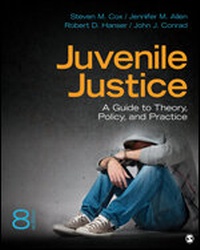
Juvenile Justice
A Guide to Theory, Policy, and Practice
8th Edition
Published on 28. January 2014
Book
Paperback/Softback
472 pages
978-1-4522-5823-2 (ISBN)
Description
Brief, focused, and up-to-date, this must-have text takes students on a journey through the juvenile justice system by covering topics such as the history of the juvenile justice system, crime measurements, theories of crime causation, the juvenile justice process, community-based sanctions, treatment and rehabilitation, gangs, and international youth crime.
Featuring new examples and new illustrations, this thoroughly updated Eighth Edition helps students develop a comprehensive understanding of the interrelationships among theory, policy, and the practical world of juvenile justice today.
Featuring new examples and new illustrations, this thoroughly updated Eighth Edition helps students develop a comprehensive understanding of the interrelationships among theory, policy, and the practical world of juvenile justice today.
More details
Edition
8th Revised edition
Language
English
Place of publication
Thousand Oaks
United States
Target group
College/higher education
Edition type
Revised edition
Dimensions
Height: 254 mm
Width: 203 mm
Weight
922 gr
ISBN-13
978-1-4522-5823-2 (9781452258232)
Copyright in bibliographic data and cover images is held by Nielsen Book Services Limited or by the publishers or by their respective licensors: all rights reserved.
Schweitzer Classification
Other editions
New editions
Steven M. Cox | Jennifer M. Allen | Robert D. Hanser
Juvenile Justice
A Guide to Theory, Policy, and Practice
Book
9th Edition
SAGE Publications (USA)
€127.97
Withdrawn from sale
Previous edition
Steven M. Cox | Jennifer M. Allen | Robert D. Hanser
Juvenile Justice
A Guide to Theory, Policy, and Practice
Book
02/2011
7th Edition
SAGE Publications Inc
€117.96
Article exhausted; check for reprint
Persons
Steven M. Cox earned his BS in psychology, MA in sociology, and PhD in sociology at the University of Illinois in Urbana-Champaign. Dr. Cox was a member of the Law Enforcement and Justice Administration faculty at Western Illinois University from 1975 to 2007. For the past 45 years, he has served as trainer and consultant to numerous criminal justice agencies in the United States and abroad and has worked with several universities in the area of course development. In addition, Dr. Cox has authored and co-authored numerous successful textbooks and articles.
Jennifer M. Allen is a professor in the School of Criminal Justice at Nova Southeastern University and former department head of the Department of Criminal Justice at the University of North Georgia. She has worked with juveniles in detention, on probation, and with those victimized by abuse and neglect. Dr. Allen has served on advisory boards for Big Brother/Big Sister mentoring programs, Rainbow Children's Home, domestic violence/sexual assault programs, and teen courts and as a consultant to police and probation departments. She regularly creates academic curriculum and training materials in her areas of expertise. Dr. Allen has published in the areas of restorative justice, juvenile delinquency and justice, youth programming, police crime, and policing administration and ethics. She is also the coauthor of Criminal Justice Administration: A Service Quality Approach; The SAGE Guide to Writing in Criminal Justice; The SAGE Guide to Writing in Research Methods; The SAGE Guide to Writing in Corrections; The SAGE Guide to Writing in Policing; Research Methods in Criminal Justice; and Victimology: Theories, Impact, and Prevention in the 21st Century.
Robert D. Hanser is a past professor of criminal justice and the coordinator of the Criminal Justice program at the University of Louisiana at Monroe. He is now a professor of Marriage and Family Therapy at the University of Louisiana at Monroe. Dr. Hanser has a PhD in marriage and family therapy and a PhD in criminal justice. He is a national certified counselor, a licensed professional counselor in the states of Louisiana and Texas, a licensed addiction counselor, a certified hypnotherapist, and a certified anger management therapist. He is the President Elect for the Louisiana Marriage and Family Counselor chapter of the Louisiana Counseling Association. He is also the Board President for the Arkansas Association for the Treatment and Prevention of Sexual Abuse (AR-ATSA). He holds a gubernatorial appointment on the Reentry Advisory Council of Louisiana, serves on the Board of Directors of the Louisiana Coalition Against Domestic Violence (LCADV), a member of the Louisiana Domestic Abuse Fatality Review (LADAFR) board. has been appointed to the Professional Educational Counsel with the American Correctional Association (ACA), and is an Executive Counselor for the Corrections section for the Academy of Criminal Justice Sciences (ACJS). He is a past member of the 4th Judicial District's Youth Services Planning Board, a past therapeutic director of the 4th Judicial District Drug Court, and is the director of the Northeast Louisiana Batterer's Intervention Program. For fourteen years, he was the Clinical Director for New Day Recovery with facilities in West Monroe and Shreveport. In addition, for 13 years, he was the program director at Richwood Correctional Center (RCC), Madison Parish Correctional Center (MPCC), and the Louisiana Transitional Center for Women (LTCW). He has written Introduction to Corrections (3rd ed.), Community Corrections (2nd ed.), Correctional Counseling, Multiculturalism in the Criminal Justice System, Special Needs Offenders, and over 65 other textbooks, anthologies, and peer-reviewed articles.
John J.Conrad served as chair of the Department of Law Enforcement and Justice Administration at Western Illinois University and was very active in the department, university, and surrounding community. After teaching for more than 30 years, he is now retired and enjoying his time traveling throughout the United States.
Jennifer M. Allen is a professor in the School of Criminal Justice at Nova Southeastern University and former department head of the Department of Criminal Justice at the University of North Georgia. She has worked with juveniles in detention, on probation, and with those victimized by abuse and neglect. Dr. Allen has served on advisory boards for Big Brother/Big Sister mentoring programs, Rainbow Children's Home, domestic violence/sexual assault programs, and teen courts and as a consultant to police and probation departments. She regularly creates academic curriculum and training materials in her areas of expertise. Dr. Allen has published in the areas of restorative justice, juvenile delinquency and justice, youth programming, police crime, and policing administration and ethics. She is also the coauthor of Criminal Justice Administration: A Service Quality Approach; The SAGE Guide to Writing in Criminal Justice; The SAGE Guide to Writing in Research Methods; The SAGE Guide to Writing in Corrections; The SAGE Guide to Writing in Policing; Research Methods in Criminal Justice; and Victimology: Theories, Impact, and Prevention in the 21st Century.
Robert D. Hanser is a past professor of criminal justice and the coordinator of the Criminal Justice program at the University of Louisiana at Monroe. He is now a professor of Marriage and Family Therapy at the University of Louisiana at Monroe. Dr. Hanser has a PhD in marriage and family therapy and a PhD in criminal justice. He is a national certified counselor, a licensed professional counselor in the states of Louisiana and Texas, a licensed addiction counselor, a certified hypnotherapist, and a certified anger management therapist. He is the President Elect for the Louisiana Marriage and Family Counselor chapter of the Louisiana Counseling Association. He is also the Board President for the Arkansas Association for the Treatment and Prevention of Sexual Abuse (AR-ATSA). He holds a gubernatorial appointment on the Reentry Advisory Council of Louisiana, serves on the Board of Directors of the Louisiana Coalition Against Domestic Violence (LCADV), a member of the Louisiana Domestic Abuse Fatality Review (LADAFR) board. has been appointed to the Professional Educational Counsel with the American Correctional Association (ACA), and is an Executive Counselor for the Corrections section for the Academy of Criminal Justice Sciences (ACJS). He is a past member of the 4th Judicial District's Youth Services Planning Board, a past therapeutic director of the 4th Judicial District Drug Court, and is the director of the Northeast Louisiana Batterer's Intervention Program. For fourteen years, he was the Clinical Director for New Day Recovery with facilities in West Monroe and Shreveport. In addition, for 13 years, he was the program director at Richwood Correctional Center (RCC), Madison Parish Correctional Center (MPCC), and the Louisiana Transitional Center for Women (LTCW). He has written Introduction to Corrections (3rd ed.), Community Corrections (2nd ed.), Correctional Counseling, Multiculturalism in the Criminal Justice System, Special Needs Offenders, and over 65 other textbooks, anthologies, and peer-reviewed articles.
John J.Conrad served as chair of the Department of Law Enforcement and Justice Administration at Western Illinois University and was very active in the department, university, and surrounding community. After teaching for more than 30 years, he is now retired and enjoying his time traveling throughout the United States.
Content
Chapter 1. Juvenile Justice in Historical Perspective
Chapter 2. Defining and Measuring Offenses by and Against Juveniles
Chapter 3. Characteristics of Juvenile Offenders
Chapter 4. Theories of Causation
Chapter 5. Child Abuse and Neglect
Chapter 6. Purpose and Scope of Juvenile Court Acts
Chapter 7. Juvenile Justice Procedures
Chapter 7. Juvenile Justice Procedures
Chapter 8. Juveniles and the Police
Chapter 9. Key Figures in Juvenile Court Proceedings
Chapter 10. Prevention and Diversion Programs
Chapter 11. Dispositional Alternatives
Chapter 12. Violent Juveniles and Gangs
Chapter 13. Juvenile Justice Around the World
Chapter 14. The Future of Juvenile Justice
Chapter 2. Defining and Measuring Offenses by and Against Juveniles
Chapter 3. Characteristics of Juvenile Offenders
Chapter 4. Theories of Causation
Chapter 5. Child Abuse and Neglect
Chapter 6. Purpose and Scope of Juvenile Court Acts
Chapter 7. Juvenile Justice Procedures
Chapter 7. Juvenile Justice Procedures
Chapter 8. Juveniles and the Police
Chapter 9. Key Figures in Juvenile Court Proceedings
Chapter 10. Prevention and Diversion Programs
Chapter 11. Dispositional Alternatives
Chapter 12. Violent Juveniles and Gangs
Chapter 13. Juvenile Justice Around the World
Chapter 14. The Future of Juvenile Justice