

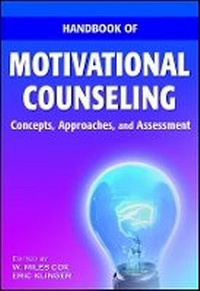
Handbook of Motivational Counseling
Concepts, Approaches and Assessment
Published on 22. August 2003
Book
Hardback
538 pages
978-0-470-84517-2 (ISBN)
Description
Motivation is a pervasive force that can affect well-being in a variety of life situations, from the more minor through to the ability to overcome addictions and other serious psychological problems. This book presents empirically supported theories (featuring current concerns theory), questionnaires based on these theories (highlighting the Motivational Structure Questionnaire) and varied interventions based on these, with special emphasis on Systematic Motivational Counselling but also including chapters on such approaches as Personality Systems Interaction Theory, expectancy-based approaches, Motivational Interviewing, logotherapy and several others.
More details
Language
English
Place of publication
Chichester
United Kingdom
Publishing group
John Wiley and Sons Ltd
Target group
Professional and scholarly
Illustrations
Illustrations
Dimensions
Height: 249 mm
Width: 181 mm
Thickness: 36 mm
Weight
1154 gr
ISBN-13
978-0-470-84517-2 (9780470845172)
Copyright in bibliographic data and cover images is held by Nielsen Book Services Limited or by the publishers or by their respective licensors: all rights reserved.
Schweitzer Classification
Other editions
New editions
W. Miles Cox | Eric Klinger
Handbook of Motivational Counseling
Goal-Based Approaches to Assessment and Intervention with Addiction and Other Problems
Book
04/2011
2nd Edition
Wiley
€116.31
Shipment within 10-20 days
Additional editions
E-Book
01/2004
1st Edition
Wiley
€146.99
Available for download
Content
About the Editors. List of Contributors. Foreword by Professor Peter E. Nathan. Preface. PART I. BASIC CONCEPTS AND THEORIES. Chapter 1. Motivation and the Theory of Current Concerns (Eric Klinger and W. Miles Cox). Chapter 2. Motivation and Addiction: The Role of Incentive Motivation in Understanding and Treating Addictive Disorders (Suzette V. Glasner). Chapter 3. Behavioral Economics: Basic Concepts and Clinical Applications (Christopher J. Correia). Chapter 4. Personal Project Pursuit: On Human Doings and Well Beings (Brian R. Little and Neil C. Chambers). Chapter 5. Goal Conflicts: Concepts, Findings and Consequences for Psychotherapy (Johannes Michalak, et al.). Chapter 6. Motivational Counseling in an Extended Functional Context: Personality Systems Interaction Theory and Assessment (Reiner Kaschel and Julius Kuhl). Chapter 7. A Motivational Model of Alcohol Use: Determinants of Use and Change (W. Miles Cox and Eric Klinger). PART II. ASSESSMENT AND RELATIONSHIPS TO BEHAVIOR. Chapter 8. Measuring Motivation: The Motivational Structure Questi onnaire and Personal Concerns Inventory (W. Miles Cox and Eric Klinger). Chapter 9. The Motivational Structure Questionnaire and Personal Concerns Inventory: Psychometric Properties (Eric Klinger and W. Miles Cox). Chapter 10. Volitional and Emotional Correlates of the Motivational Structure Questionnaire: Further Evidence for Construct Validity (Nicola Bumann). PART III. SYSTEMATIC MOTIVATIONAL COUNSELING AND ITS APPLICATIONS. Chapter 11. Systematic Motivational Counseling: The Motivational Structure Questionnaire in Action (W. Miles Cox and E. Klinger). Chapter 12. Systematic Motivational Counseling in Groups: Clarifying Motivational Structure during Psychotherapy (Bernhard M. Schroer, et al.). Chapter 13. Systematic Motivational Analysis as Part of Self-Help Technique Aimed at Personal Goal Attainment (Renate de Jong-Meyer). Chapter 14. Systematic Motivational Counseling at Work: Improving Employee Performance, Satisfaction, and Socialization (Loriann Roberson and David M. Sluss). Chapter 15. Systematic Motivational Counseling in Rehabilitation Medicine (S. Vincent Miranti, et al.). Chapter 16. Assessing and Changing Motivation to Offend (Mary McMurran). PART IV. OTHER MOTIVATIONAL APPROACHES TO CHANGING BEHAVIOR. Chapter 17. Enhancing Motivation for Psychotherapy: The Elaboration of Positive Perspectives (EPOS) to Develop Clients' Goal Structure (Ulrike Willutzki and Christoph Koban). Chapter 18. Viktor E. Frankl's Existential Analysis and Logotherapy (Manfred Hillmann). Chapter 19. Changing Alcohol Expectancies: Techniques for Altering Motivations for Drinking (Barry T. Jones). Chapter 20. The Motivational Drinker's Check-Up: A Brief Intervention for Early Stage Problem Drinkers (Maria J. Emmen, et al.). Chapter 21. Motivational Enhancement as a Brief Intervention for College Student Drinkers (Arthur W. Blume and G. Alan Marlatt). Chapter 22. Community Reinforcement Approach and Contingency Management Interventions for Substance Abuse (Conrad J. Wong, et al.). Chapter 23. Goal Setting as a Motivational Technique for Neurorehabilitation (Siegfried Gauggel and Martina Hoop). Chapter 24. Motivational Interviewing in Health Promotion and Behavioral Medicine (Ken Resnicow, et al.). PART V. CONCLUSION. Chapter 25. Motivational Counseling: Taking Stock and Looking Ahead (W. Miles Cox and Eric Klinger). Author Index. Subject Index.