

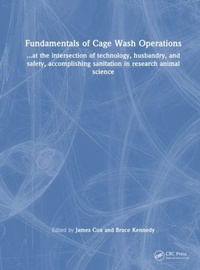
Fundamentals of Cage Wash Operations
At the intersection of technology, husbandry, safety, and compliance, accomplishing sanitation in research animal science
1st Edition
Will be published approx. on 10. August 2026
Book
Hardback
426 pages
978-1-041-34075-1 (ISBN)
Description
The animal care and use facility support-or cage wash-area has evolved tremendously in the past 50 years. It is now recognized as a critical component in programs of animal care and use throughout the world, yet there has previously been no single, comprehensive resource to support it. This much-needed book describes facility support operations that have a direct, substantial effect on the program's ability to provide quality animal care. Editors James D. Cox and Bruce W. Kennedy, practitioners with more than 80 years of experience in laboratory animal facilities between them, show how cage wash serves as the hub of the entire research animal enterprise. After all, when cage wash comes to a halt, there are no clean cages or equipment, and research struggles to continue.
There is a significant volume of knowledge necessary to work in facility support roles, spread across many different resources, many of which are unpublished and/or at a highly skilled technical level. This book brings all the relevant information together in an accessible, highly practical guide.
By increasing staff knowledge and skills in the operation, maintenance, and troubleshooting of equipment, the book shows that cage wash can be a viable career path, especially as facilities increasingly depend on different types of automation.
There is a significant volume of knowledge necessary to work in facility support roles, spread across many different resources, many of which are unpublished and/or at a highly skilled technical level. This book brings all the relevant information together in an accessible, highly practical guide.
By increasing staff knowledge and skills in the operation, maintenance, and troubleshooting of equipment, the book shows that cage wash can be a viable career path, especially as facilities increasingly depend on different types of automation.
More details
Language
English
Place of publication
London
United Kingdom
Publishing group
Taylor & Francis Ltd
Target group
Professional and scholarly
Professional Practice & Development
Illustrations
32 farbige Zeichnungen, 40 farbige Tabellen, 114 farbige Abbildungen, 82 Farbfotos bzw. farbige Rasterbilder
40 Tables, color; 32 Line drawings, color; 82 Halftones, color; 114 Illustrations, color
Dimensions
Height: 280 mm
Width: 210 mm
ISBN-13
978-1-041-34075-1 (9781041340751)
Copyright in bibliographic data and cover images is held by Nielsen Book Services Limited or by the publishers or by their respective licensors: all rights reserved.
Schweitzer Classification
Other editions
Additional editions
James D. Cox | Bruce W. Kennedy
Fundamentals of Cage Wash Operations
At the intersection of technology, husbandry, safety, and compliance, accomplishing sanitation in research animal science
Book
approx. 08/2026
1st Edition
CRC Press
€99.00
Not yet published

James D. Cox | Bruce W. Kennedy
Fundamentals of Cage Wash Operations
At the intersection of technology, husbandry, safety, and compliance, accomplishing sanitation in research animal science
E-Book
approx. 08/2026
CRC Press
€98.99
Not yet available
James D. Cox | Bruce W. Kennedy
Fundamentals of Cage Wash Operations
At the intersection of technology, husbandry, safety, and compliance, accomplishing sanitation in research animal science
E-Book
approx. 08/2026
CRC Press
€98.99
Not yet available
Persons
James (Jim) D. Cox, BS, MLAS, RLATG, is Senior Director of Animal and Biological Services at the Howard Hughes Medical Institute's Janelia Research Campus in Ashburn, Virginia, where he leads multidisciplinary teams supporting cutting-edge neuroscience and cell physiology research. He built Janelia's animal care and use program from the ground up, establishing the IACUC, developing institutional policies and procedures, and designing staffing models and service infrastructure that have sustained the program through multiple AAALAC accreditation cycles.
Jim's career in laboratory animal facility management spans roles at SmithKline, University of Pennsylvania, Georgetown University, and Charles River Laboratories. This breadth of experience, across academic medical centers, contract research organizations, and a private research institute, informs a practical, operations-centered perspective on facility management.
He is the 2026 recipient of the AAALAC International Fellowship Award and has served in leadership and editorial roles within both AALAS and the Laboratory Animal Management Association (LAMA). Jim served on the Board for Americans for Medical Progress and has provided advisory expertise to institutions including the Max Planck Institute of Molecular Cell Biology and Genetics, the Max Planck Florida Institute, the German Cancer Research Center, and Human Technopole.
Jim holds a Master of Laboratory Animal Science from Drexel University and a B.S. in Animal Science from Virginia Tech.
Bruce W. Kennedy, IACUC Administrator, has had a career in research spanning animals, chemistry, people, and gain of knowledge, which started in California, shifted to Virginia and Maryland, then brought him back. Writing this bio-sketch in an unconventional manner, I have appreciated even more how these concepts (metaphorical in some ways, applying to jobs and career) meshed together personally. Bruce had a variety of pets as a child and aspired to become a veterinarian, but for what discipline he had little idea. It wasn't until he used coturnix quail in nutritional toxicology studies at UC Davis that he learned about lab animal science and its multiple aspects. "Last century", he received his bachelors in Zoology and masters in Avian Sciences at UC Davis. Marrying and moving across country, he landed at Virginia Tech, where he ran assays in protein chemistry. Thereafter, heading to Maryland, it was back to animals, managing them and learning regulations. Bruce worked at the bench (analytical chemistry) with dogs in protein metabolism and rats in carbohydrate nutrition studies (USDA), writing GLP toxicology reports (Hazleton), preparing experimental diets with test substances for rodents and rabbits (FDA), and learning the care of mice in the emerging field of transgenic technology (NIH). Along the way, he went "back to school" for the first time to obtain his AALAS credentials of Laboratory Animal Technologist (LATG; when it was paper-n-pencil) and Certified Manager of Animal Resources (CMAR). He also became more active with AALAS, serving on committees and becoming a trustee.
Just before the 20th century turned, there was an opportunity for a return to California. What Bruce had learned prepared him to manage a transgenic mouse barrier facility at Caltech and later the research compliance office (IACUC and IRB) at Cal Poly Pomona (CPP), where he also taught students of veterinary technology about laboratory animal management and research. As well, it was a return to the familiar environments of school and learning. And again he went "back to school", obtaining the Certified Professional in IACUC Administration (CPIA) credential from PRIM&R and, as a "mature" student, completing his doctorate in educational leadership at CPP. Broadening his compliance interests, he decided to study the influential roles of an IRB administrator (not IACUC!) on an institution's human subjects regulatory program. Equipped with these experiences and insights, Bruce became the IACUC administrator at other animal programs, namely Chapman University (pharmaceutical models) and presently at UC Santa Cruz (species diverse with rodent/zebrafish, field studies, and marine mammals).
Bruce is proud to share some important times in his career: memberships in many AALAS branches, LAMA, and PRIM&R; service on AALAS's education and certification committees and the Scientific Advisory Committee; board member of the California Society for Biomedical Research; coordinating conferences, especially on the subjects of genetically-engineered mice, training, and regulatory requirements; multiple seminars on cage wash topics; recipient of the B&K IAT award, the AALAS George R. Collins Award for training; and the Purina LabDiet laboratory animal technician award; serving as ad hoc specialist with AAALAC; writing the column Fruits of Education for Lab Animal; establishing an AALAS committee to promote vet techs working in lab animal science; past president of AALAS and LAWTE; and traveling to animal research meetings throughout the world. And now this seminal compilation about cage wash operations, meant to promote both the discipline and all involved with it.
Bruce has been been a life-long learner. His objectives have included to be teacher/trainer, share knowledge, prepare educational materials, present, and mentor. It's only logical he would become involved in such a project to co-develop this cage wash book for the "hub of the animal facility".
Jim's career in laboratory animal facility management spans roles at SmithKline, University of Pennsylvania, Georgetown University, and Charles River Laboratories. This breadth of experience, across academic medical centers, contract research organizations, and a private research institute, informs a practical, operations-centered perspective on facility management.
He is the 2026 recipient of the AAALAC International Fellowship Award and has served in leadership and editorial roles within both AALAS and the Laboratory Animal Management Association (LAMA). Jim served on the Board for Americans for Medical Progress and has provided advisory expertise to institutions including the Max Planck Institute of Molecular Cell Biology and Genetics, the Max Planck Florida Institute, the German Cancer Research Center, and Human Technopole.
Jim holds a Master of Laboratory Animal Science from Drexel University and a B.S. in Animal Science from Virginia Tech.
Bruce W. Kennedy, IACUC Administrator, has had a career in research spanning animals, chemistry, people, and gain of knowledge, which started in California, shifted to Virginia and Maryland, then brought him back. Writing this bio-sketch in an unconventional manner, I have appreciated even more how these concepts (metaphorical in some ways, applying to jobs and career) meshed together personally. Bruce had a variety of pets as a child and aspired to become a veterinarian, but for what discipline he had little idea. It wasn't until he used coturnix quail in nutritional toxicology studies at UC Davis that he learned about lab animal science and its multiple aspects. "Last century", he received his bachelors in Zoology and masters in Avian Sciences at UC Davis. Marrying and moving across country, he landed at Virginia Tech, where he ran assays in protein chemistry. Thereafter, heading to Maryland, it was back to animals, managing them and learning regulations. Bruce worked at the bench (analytical chemistry) with dogs in protein metabolism and rats in carbohydrate nutrition studies (USDA), writing GLP toxicology reports (Hazleton), preparing experimental diets with test substances for rodents and rabbits (FDA), and learning the care of mice in the emerging field of transgenic technology (NIH). Along the way, he went "back to school" for the first time to obtain his AALAS credentials of Laboratory Animal Technologist (LATG; when it was paper-n-pencil) and Certified Manager of Animal Resources (CMAR). He also became more active with AALAS, serving on committees and becoming a trustee.
Just before the 20th century turned, there was an opportunity for a return to California. What Bruce had learned prepared him to manage a transgenic mouse barrier facility at Caltech and later the research compliance office (IACUC and IRB) at Cal Poly Pomona (CPP), where he also taught students of veterinary technology about laboratory animal management and research. As well, it was a return to the familiar environments of school and learning. And again he went "back to school", obtaining the Certified Professional in IACUC Administration (CPIA) credential from PRIM&R and, as a "mature" student, completing his doctorate in educational leadership at CPP. Broadening his compliance interests, he decided to study the influential roles of an IRB administrator (not IACUC!) on an institution's human subjects regulatory program. Equipped with these experiences and insights, Bruce became the IACUC administrator at other animal programs, namely Chapman University (pharmaceutical models) and presently at UC Santa Cruz (species diverse with rodent/zebrafish, field studies, and marine mammals).
Bruce is proud to share some important times in his career: memberships in many AALAS branches, LAMA, and PRIM&R; service on AALAS's education and certification committees and the Scientific Advisory Committee; board member of the California Society for Biomedical Research; coordinating conferences, especially on the subjects of genetically-engineered mice, training, and regulatory requirements; multiple seminars on cage wash topics; recipient of the B&K IAT award, the AALAS George R. Collins Award for training; and the Purina LabDiet laboratory animal technician award; serving as ad hoc specialist with AAALAC; writing the column Fruits of Education for Lab Animal; establishing an AALAS committee to promote vet techs working in lab animal science; past president of AALAS and LAWTE; and traveling to animal research meetings throughout the world. And now this seminal compilation about cage wash operations, meant to promote both the discipline and all involved with it.
Bruce has been been a life-long learner. His objectives have included to be teacher/trainer, share knowledge, prepare educational materials, present, and mentor. It's only logical he would become involved in such a project to co-develop this cage wash book for the "hub of the animal facility".
Content
Section 1 - Origins and Foundations 1. Cage Wash - It's No Longer Entry Level 2. Cage Wash History, Evolution, and General Cage Wash Management Concepts 3. Laws and Regulations Impacting Cage Wash Operations Section 2 - Persons Working in Cage Wash 4. The Changing Job of Cage Wash Technicians 5. Managing the Cage Wash Facility 6. Safety Considerations Associated with Cage Wash Operations 7. Training and Developing the Support Team in Cage Wash Operations Section 3 - Design and Infrastructure of Cage Washrooms 8. Cage Wash Facility and Supporting 9. Utility Requirements for Cage Washing and Processing Section 4 - Machines, Equipment, Materials, and Maintenance 10. Cage Washing Machines 11. Sterilizing Machines 12. Automation in Cage Wash 13. Other Equipment, Machines, and Components 14. Maintenance and Troubleshooting of Cage Washers and Sterilizers Section 5 - Diverse Processes of Cage Wash Operations 15. Equipment to be Cleaned and the Cleaning Process 16. Chemicals in Cage Wash: Types, Uses, and Dispensing 17. Waste Processing and Discharge from Cage Washing Facilities 18. Recordkeeping in Cage Wash Operations 19. Disaster, Contingency, and Business Recovery Planning for Animal Facility Cage Wash Operations Section 6 - What's Next in Cage Wash 20. Looking Ahead Appendix: Case Studies. Glossary of Terms Applied to Cage Processing