

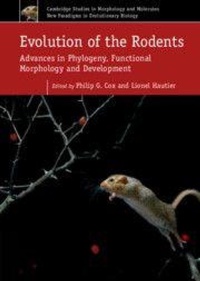
Evolution of the Rodents: Volume 5
Advances in Phylogeny, Functional Morphology and Development
Will be published approx. on 6. August 2015
Book
Hardback
624 pages
978-1-107-04433-3 (ISBN)
Description
The widespread use of mouse models in developmental, behavioural and genetic studies has sparked wider interest in rodent biology as a whole. This book brings together the latest research on rodents to better understand the evolution of both living and extinct members of this fascinating group. Topics analysed include the role of molecular techniques in the determination of robust phylogenetic frameworks; how geometric morphometric methods help quantify and analyse variation in shape; and the role of developmental biology in elucidating the origins of skeletal elements and the teeth. The editors unite these disciplines to present the current state of knowledge in rodent biology, whilst setting the landscape for future research. This book highlights interdisciplinary links across palaeontology, developmental biology, functional morphology, phylogenetics and biomechanics, making it a valuable resource for evolutionary biologists in all fields.
Reviews / Votes
'... this collection is a culmination of research that will certainly inform and rouse budding rodentologists, to echo the foreword. A major reference work.' Rajith Dissanayake, The BiologistMore details
Series
Language
English
Place of publication
Cambridge
United Kingdom
Target group
Professional and scholarly
Product notice
sewn/stitched
Cloth over boards
Illustrations
43 Tables, black and white; 18 Plates, color; 98 Halftones, unspecified; 26 Line drawings, unspecified
Dimensions
Height: 254 mm
Width: 180 mm
Thickness: 32 mm
Weight
1350 gr
ISBN-13
978-1-107-04433-3 (9781107044333)
Copyright in bibliographic data and cover images is held by Nielsen Book Services Limited or by the publishers or by their respective licensors: all rights reserved.
Schweitzer Classification
Other editions
Additional editions
Philip G. Cox
Evolution of the Rodents: Volume 5
Advances in Phylogeny, Functional Morphology and Development
E-Book
08/2015
Cambridge University Press
€84.99
Available for download
Philip G. Cox | Lionel Hautier
Evolution of the Rodents: Volume 5
Advances in Phylogeny, Functional Morphology and Development
E-Book
08/2015
Cambridge University Press
€100.99
Available for download
Persons
Philip G. Cox is a lecturer at the Department of Archaeology, University of York and the Hull York Medical School, and a researcher into the functional morphology of and evolution of mammals, particularly rodents. Much of his research has involved the application of sophisticated engineering techniques, namely finite element analysis, to rodent skulls and mandibles in order to understand the biomechanics of feeding in these species. Lionel Hautier is a researcher (CR2) at the National Center for Scientific Research (CNRS) posted at the Institute of Evolutionary Sciences in Montpellier (ISEM). He is a vertebrate palaeontologist, specialising in mammals and notably rodents. His research interests include the evolution of the masticatory apparatus of extinct and extant rodents, studied using morphological (osteological and myological), morphometrical, and palaeontological evidence.
Content
List of contributors; Foreword Jean-Louis Hartenberger and W. Patrick Luckett; 1. Rodentia: a model order? Lionel Hautier and Philip G. Cox; 2. A synopsis of rodent molecular phylogenetics, systematics and biogeography Pierre-Henri Fabre, Lionel Hautier and Emmanuel J. P. Douzery; 3. Emerging perspectives on some Paleocene sciurognaths rodents in Laurasia: the fossil record and its interpretation Mary R. Dawson; 4. Phylogeny and evolutionary history of hystricognathous rodents from the Old World during the Tertiary: new insights into the emergence of modern 'phiomorph' families Franck Barbiere and Laurent Marivaux; 5. The history of South American octodontoid rodents and its contribution to evolutionary generalisations Diego H. Verzi, Cecilia C. Morgan and A. Itati Olivares; 6. History, taxonomy and palaeobiology of the giant fossil rodents (Hystricognathi, Dinomyidae) Andres Rinderknecht and R. Ernesto Blanco; 7. Advances in integrative taxonomy and the evolution of African murid rodents: how morphological trees hide the molecular forest Christiane Denys and Alisa Winkler; 8. Themes and variation in sciurid evolution V. Louise Roth and John M. Mercer; 9. Marmot evolution and global change in the last 10 million years P. David Polly, Andrea Cardini, Edward B. Davis and Scott Steppan; 10. Grades and clades among rodents: the promise of geometric morphometrics Lionel Hautier, Philip G. Cox and Renaud Lebrun; 11. Biogeographic variations in wood mice: testing for the role of morphological variation as a line of least resistance to evolution Sabrina Renaud, Jean-Pierre Quere and Johan R. Michaux; 12. The oral apparatus of rodents: variations on the theme of a gnawing machine Robert E. Druzinsky; 13. The muscles of mastication in rodents and the function of the medial pterygoid Philip G. Cox and Nathan Jeffery; 14. Functional morphology of rodent middle ears Matthew J. Mason; 15. Variations and anomalies in rodent teeth and their importance for testing developmental models Cyril Charles and Laurent Viriot; 16. The great variety of dental structures and dynamics in rodents: new insights into their ecological diversity Helder Gomes Rodrigues; 17. Convergent evolution of molar morphology in Muroidea (Rodentia, Mammalia): connections between chewing movements and crown morphology Vincent Lazzari, Franck Guy, Pierre-Emmanuel Salais, Adelaide Euriat, Cyril Charles, Laurent Viriot, Paul Tafforeau and Jacques Michaux; 18. Developmental mechanisms in the evolution of phenotypic traits in rodent teeth Elodie Renvoise and Sophie Montuire; 19. Diversity and evolution of femoral variation in Ctenohystrica Laura A. B. Wilson and Madeleine Geiger; 20. Morphological disparity of the postcranial skeleton in rodents and its implications for palaeobiological inferences: the case of the extinct Theriodomyidae (Rodentia, Mammalia) Monique Vianey-Liaud, Lionel Hautier and Laurent Marivaux; Index.