

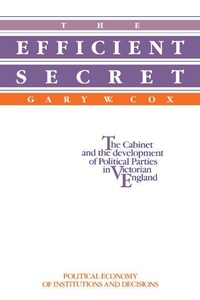
The Efficient Secret
The Cabinet and the Development of Political Parties in Victorian England
Published on 8. September 2005
Book
Paperback/Softback
204 pages
978-0-521-01901-9 (ISBN)
Description
The Efficient Secret is an analysis of the institutional changes in parliamentary government in nineteenth-century England, concentrating on the years between the first and third Reform Acts. Professor Gary W. Cox employs a rational choice model to analyze the problems of voter choice and to examine the emergence of party loyalty in the electorate, the development of cabinet government, and their legislative consequences. The introductory chapters provide the historical setting for this study and briefly survey nineteenth-century political and economic events. Professor Cox then focuses on the increases in party voting in Parliament and in the electorate. To support his argument concerning these parallel developments, he uses statistical evidence drawn from poll books and newspapers.
More details
Series
Language
English
Place of publication
Cambridge
United Kingdom
Target group
College/higher education
Professional and scholarly
Product notice
Paperback (trade)
Illustrations
Worked examples or Exercises
Dimensions
Height: 229 mm
Width: 152 mm
Thickness: 13 mm
Weight
339 gr
ISBN-13
978-0-521-01901-9 (9780521019019)
Copyright in bibliographic data and cover images is held by Nielsen Book Services Limited or by the publishers or by their respective licensors: all rights reserved.
Schweitzer Classification
Other editions
Additional editions
Gary W. Cox
The Efficient Secret
The Cabinet and the Development of Political Parties in Victorian England
Book
06/1987
Cambridge University Press
€74.28
Article exhausted; check for reprint
Previous edition
Gary W. Cox
The Efficient Secret
The Cabinet and the Development of Political Parties in Victorian England
Book
06/1987
Cambridge University Press
€74.28
Article exhausted; check for reprint
Content
Part I. Introduction: 1. Introduction and outline; 2. The historical setting; Part II. The Development of Disciplined Parliamentary Parties: 3. The measurement and theory of party cohesion; 4. The Peelites and the disruption of the party system; 5. The caucus; 6. The origin of the efficient secret; 7. The electoral connection and ministerial ambition; 8. The Cabinet's strength: threats of resignation and dissolution; Part III. The Electorate: 9. The development of a party-oriented electorate; 10. The causes of a party-oriented electorate; 11. The legislative consequences of a party-oriented electorate; 12. The influence of constituents in Victorian England; Part IV. Conclusion: 13. The history of party voting; Appendix; References; Author index; Subject index.