

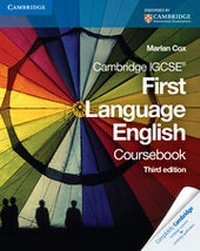
Cambridge IGCSE First Language Coursebook
3rd Edition
Published on 17. December 2009
Book
Paperback/Softback
160 pages
978-0-521-74359-4 (ISBN)
Description
Written specifically for the Cambridge syllabus, this updated series provides clear and practical support for students and teachers. Cambridge IGCSE First Language English, Third edition has been written specifically for the University of Cambridge International Examinations syllabus. Written by a highly experienced and well-known author, this new and updated coursebook includes clear, practical support for students, a diverse range of topical stimulus material to enliven the subject, imaginative activities and exam tips that build confidence and develop the skills needed to succeed in the examination.
More details
Series
Edition
3rd Revised edition
Language
English
Place of publication
Cambridge
United Kingdom
Target group
Primary & secondary/elementary & high school
Edition type
Revised edition
Product notice
Paperback (trade)
Dimensions
Height: 275 mm
Width: 219 mm
Thickness: 1 mm
Weight
470 gr
ISBN-13
978-0-521-74359-4 (9780521743594)
Copyright in bibliographic data and cover images is held by Nielsen Book Services Limited or by the publishers or by their respective licensors: all rights reserved.
Schweitzer Classification
Other editions
New editions
Book
07/2014
4th Edition
Cambridge University Press
€35.59
Article exhausted; check for reprint
Previous edition
Book
08/2006
2nd Edition
Cambridge University Press
€20.73
Article exhausted; check for reprint
Content
Introduction to the third edition; Objectives of the examination; Components of the examination; Part I. Leisure: Sport, Travel, Pastimes: 1. Reading: skimming and scanning, selecting points for summary, making notes using your own words, looking at writers' language choices; 2. Directed writing: diaries, formal and informal letters, considering audience, choosing a style; 3. Composition: planning continuous writing, descriptive writing, adjectives and imagery; 4. Speaking and listening: preparing a talk, conversation skills; Part II. Work: Information, Education, Employment: 5. Reading: understanding, selecting and organising material for summary questions; 6. Directed writing: presenting and transforming information, news reports, formal reports; 7. Composition: giving an account, organising information; 8. Speaking and listening: role-play dialogues, preparing an interview; Part III. People: Society, Lifestyles, Relationships: 9. Reading: expanding notes, sentence structure, vocabulary building, summary style, collating texts, looking at how writers achieve effects; 10. Directed writing: persuasive devices, analysing techniques, writing publicity material, drawing inferences, writing in role, targeting an audience; 11. Composition: composing narratives, engaging the reader, dialogue punctuation; 12. Speaking and listening: paired and group discussion, facts versus opinions; Part IV. Ideas: Art, Science, Technology: 13. Reading: collating texts, analysing style, vocabulary building, advanced punctuation; 14. Directed writing: expressing and supporting a view, collating and ordering information, reports and articles; 15. Composition: making a case, constructing an argument, presenting a discussion, rhetorical devices, improving spelling; 16. Speaking and listening: defending opinions, delivering a speech; List of terms; Acknowledgements.