

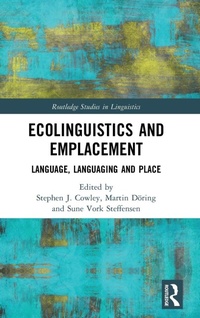
Ecolinguistics and Emplacement
Language, Languaging and Place
1st Edition
Published on 30. July 2025
Book
Hardback
214 pages
978-1-032-32847-8 (ISBN)
Description
This edited volume contributes to recent theoretical work in ecolinguistics that treats language as, not about nature, but of nature.
Through a dialogical interplay of theoretical and empirical work, the chapters apply ecological concepts of language, languaging, and emplacement to a multiplicity of issues, settings, and place-worlds. Empirically, the chapters meander through a universe of chimpanzees engaged in problem solving, children playing marbles, political constitutions, agricultural dictionaries, Sicilian nature reserves, children's experiences of devastating outbreaks of foot and mouth disease, expressions of sorrow across closed borders, and the linguistic conquest of uninhabited islands. By attending to locale, sense of place, and location across this diversity, the volume evokes new empirical, methodological, and practical horizons that allow ecolinguists to ask how people and their emplacement are affected by language and languaging, and how the effects of practices impact on, not just human lifeworlds, but also trillions of bioecologies.
This book will be of interest to students and scholars interested in ecolinguistics, discourse analysis, applied linguistics, language contact, environmental humanities, and human and social geography.
Through a dialogical interplay of theoretical and empirical work, the chapters apply ecological concepts of language, languaging, and emplacement to a multiplicity of issues, settings, and place-worlds. Empirically, the chapters meander through a universe of chimpanzees engaged in problem solving, children playing marbles, political constitutions, agricultural dictionaries, Sicilian nature reserves, children's experiences of devastating outbreaks of foot and mouth disease, expressions of sorrow across closed borders, and the linguistic conquest of uninhabited islands. By attending to locale, sense of place, and location across this diversity, the volume evokes new empirical, methodological, and practical horizons that allow ecolinguists to ask how people and their emplacement are affected by language and languaging, and how the effects of practices impact on, not just human lifeworlds, but also trillions of bioecologies.
This book will be of interest to students and scholars interested in ecolinguistics, discourse analysis, applied linguistics, language contact, environmental humanities, and human and social geography.
More details
Series
Language
English
Place of publication
London
United Kingdom
Publishing group
Taylor & Francis Ltd
Target group
College/higher education
Postgraduate
Illustrations
10 s/w Abbildungen, 7 s/w Photographien bzw. Rasterbilder, 3 s/w Zeichnungen, 7 s/w Tabellen
7 Tables, black and white; 3 Line drawings, black and white; 7 Halftones, black and white; 10 Illustrations, black and white
Dimensions
Height: 235 mm
Width: 157 mm
Thickness: 17 mm
Weight
479 gr
ISBN-13
978-1-032-32847-8 (9781032328478)
Copyright in bibliographic data and cover images is held by Nielsen Book Services Limited or by the publishers or by their respective licensors: all rights reserved.
Schweitzer Classification
Other editions
Additional editions
Stephen Cowley | Martin Doering | Sune Vork Steffensen
Ecolinguistics and Emplacement
Language, Languaging and Place
E-Book
07/2025
1st Edition
Routledge
€60.49
Available for download
Stephen Cowley | Martin Doering | Sune Vork Steffensen
Ecolinguistics and Emplacement
Language, Languaging and Place
E-Book
07/2025
1st Edition
Routledge
€60.49
Available for download
Persons
Stephen J. Cowley is Professor Emeritus of Organisational Cognition at the University of Southern Denmark, Denmark.
Martin Doering is Senior Scientist at the Institute of Geography at the University of Hamburg and the Institute for Coastal Research at the Helmholtz Centre Geesthacht, Germany.
Sune Vork Steffensen is Professor in Language, Interaction, and Cognition at the University of Southern Denmark, Denmark.
Martin Doering is Senior Scientist at the Institute of Geography at the University of Hamburg and the Institute for Coastal Research at the Helmholtz Centre Geesthacht, Germany.
Sune Vork Steffensen is Professor in Language, Interaction, and Cognition at the University of Southern Denmark, Denmark.
Content
List of Contributors
Introduction: Ecolinguistics and emplacement: Language, languaging and place
Martin Doering, Stephen J. Cowley and Sune Vork Steffensen
1. The spatial logic of language
Edward Baggs
2. Building ecocivilizations: Putting ecolinguistic expertise to work
Stephen J. Cowley
3. Ecological linguistics - On the path to a critically transformative science?
Wilhelm Trampe
4. Ecological discourse analysis: A unified perspective
Ruijie Zhang and Wei He
5. Priolo narratives: Evaluation and emplacement in South-East Sicily
Douglas Ponton and Anna Raimo
6. "I had a lamb I brought everywhere...": An ecolinguistic analysis of metaphors in children's poems during the 2001 FMD crisis in the UK
Martin Doering
7. Anthropocentrism and the human-animal relationship: Language problems and solutions
Reinhard Heuberger
8. What do they miss? An ecolinguistic approach to everyday language practices by inhabitants of the Polish-Czech border area
Magdalena Steciag and Urszula Majdanska-Wachowicz
9. Local and global discourses about managing Norfolk Island
Peter Muehlhaeusler
Index
Introduction: Ecolinguistics and emplacement: Language, languaging and place
Martin Doering, Stephen J. Cowley and Sune Vork Steffensen
1. The spatial logic of language
Edward Baggs
2. Building ecocivilizations: Putting ecolinguistic expertise to work
Stephen J. Cowley
3. Ecological linguistics - On the path to a critically transformative science?
Wilhelm Trampe
4. Ecological discourse analysis: A unified perspective
Ruijie Zhang and Wei He
5. Priolo narratives: Evaluation and emplacement in South-East Sicily
Douglas Ponton and Anna Raimo
6. "I had a lamb I brought everywhere...": An ecolinguistic analysis of metaphors in children's poems during the 2001 FMD crisis in the UK
Martin Doering
7. Anthropocentrism and the human-animal relationship: Language problems and solutions
Reinhard Heuberger
8. What do they miss? An ecolinguistic approach to everyday language practices by inhabitants of the Polish-Czech border area
Magdalena Steciag and Urszula Majdanska-Wachowicz
9. Local and global discourses about managing Norfolk Island
Peter Muehlhaeusler
Index