

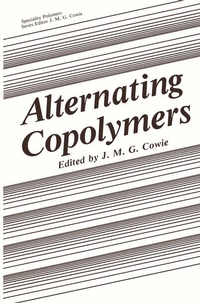
Alternating Copolymers
Published on 22. May 2013
Book
Paperback/Softback
XII, 282 pages
978-1-4757-9141-9 (ISBN)
Description
Examination of the early literature attests to the fact that the study of copolymerization was initiated when polymer science was in its infancy. It has continued to grow to a subject of major importance and has been a source of interest to both academic and industrialist alike. The wide spectrum of structures and properties available in the statistical copolymer has made this a fruitful field of exploration, but one particular and more restricted form which has held its own fascination for many is the limiting case of the strictly alternating copolymer. This is formed, in the ideal situation, when two monomers in a reaction mixture add consecutively to create a polymer chain with a regular {ABABAB} structure, irrespective of the monomer feed ratio. When this happens the resulting copolymer will always have the same composition, a feature which can be advantageous but also somewhat restrictive, as the ability to vary the properties is then limited. Within a series entitled Speciality Polymers it seems appropriate then to deal with this subject, particularly as no previous attempt has been made to draw together the various facets of alternating copolymerization into one volume. It also seems timely to present a more unified picture of the subject which will also illustrate the progress made.
More details
Series
Edition
Softcover reprint of the original 1st ed. 1985
Language
English
Place of publication
New York
United States
Target group
Professional and scholarly
Research
Illustrations
XII, 282 p.
Dimensions
Height: 229 mm
Width: 152 mm
Thickness: 17 mm
Weight
432 gr
ISBN-13
978-1-4757-9141-9 (9781475791419)
DOI
10.1007/978-1-4757-9139-6
Schweitzer Classification
Other editions
Additional editions
J.M.G. Cowie
Alternating Copolymers
Book
04/1985
Kluwer Academic/Plenum Publishers
€160.49
Shipment within 10-15 days
Content
1 Principles of Alternating Copolymerization.- 2 Radical Initiated Alternating Copolymerization.- 3 Alternating Copolymerization in the Presence of Lewis Acids.- 4 Alternating Copolymerization of Olefins and Diolefins.- 5 Alternating Copolymerization Involving Zwitterions.- 6 Physical Properties of Alternating Copolymers.