

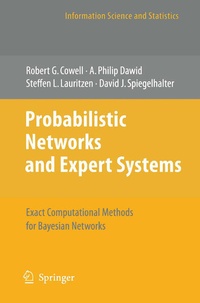
Probabilistic Networks and Expert Systems
Exact Computational Methods for Bayesian Networks
Published on 22. June 1999
Book
Hardback
XII, 324 pages
978-0-387-98767-5 (ISBN)
Description
The work reviewed in this book represents the synthesis of two
important developments in modelling of complex stochastic phenomena.
This book will be an essential reference for people interested in
artificial intelligence in both computer science and statistics.
Reviews / Votes
From the reviews:
JOURNAL OF THE AMERICAN STATISTICAL ASSOCIATION
"This important book fills a void in the graphical Markov models literature. The authors have summarized their extensive and influential work in this area and provided a valuable resource both for educators and for practitioners."
More details
Series
Edition
1st ed. 1999. Corr. 2nd printing 2003
Language
English
Place of publication
New York
United States
Target group
Professional and scholarly
Research
Edition type
Revised edition
Illustrations
XII, 324 p.
Dimensions
Height: 241 mm
Width: 160 mm
Thickness: 23 mm
Weight
676 gr
ISBN-13
978-0-387-98767-5 (9780387987675)
DOI
10.1007/b97670
Schweitzer Classification
Other editions
Additional editions
Robert G. Cowell | Philip Dawid | Steffen L. Lauritzen
Probabilistic Networks and Expert Systems
Exact Computational Methods for Bayesian Networks
Book
07/2007
1st Edition
Springer
€128.39
Shipment within 5-7 days
Robert G. Cowell | Philip Dawid | Steffen L. Lauritzen
Probabilistic Networks and Expert Systems
Exact Computational Methods for Bayesian Networks
E-Book
05/2006
Springer
€117.69
Available for download
Persons
Winner of the 2002 DeGroot Prize. Awarded by the International Society for Bayesian Analysis to a book judged to represent an important, timely, thorough, and notably original contribution to the statistics literature.Probabilistic expert systems are graphical networks that support the modelling of uncertainty and decisions in large complex domains, while retaining ease of calculation. Building on original research by the authors over a number of years, this book gives a thorough and rigorous mathematical treatment of the underlying ideas, structures, and algorithms, emphasizing those cases in which exact answers are obtainable. It covers both the updating of probabilistic uncertainty in the light of new evidence, and statistical inference, about unknown probabilities or unknown model structure, in the light of new data.The book will be of interest to researchers and graduate students in artificial intelligence who desire an understanding of the mathematical and statistical basis of probabilistic expert systems, and to students and research workers in statistics wanting an introduction to this fascinating and rapidly developing field. The careful attention to detail will also make this work an important reference source for all those involved in the theory and applications of probabilistic expert systems.Robert G. Cowell is a Lecturer in the Faculty of Actuarial Science and Statistics of the Sir John Cass Business School, City of London. He has been working in the field of probabilistic expert systems for over a decade, and has published a number of research and tutorial articles in the area.A. Philip Dawid is Pearson Professor of Statistics at University College London. He has served as Editor of the Journal of the Royal Statistical Society (Series B) and of Biometrika, and as President of the International Society for Bayesian Analysis. He holds the Royal Statistical Society Guy Medal in Bronze and in Silver, and the G. W. Snedecor Award for the Best Publication in Biometry.Steffen L. Lauritzen is Professor of Mathematics and Statistics at the University of Aalborg. He has served as Editor of the Scandinavian Journal of Statistics. He holds the Royal Statistical Guy Medal in Silver and is an Honorary Fellow of the same society. He has, jointly with David J. Spiegelhalter, received the American Statistical Association's award for an "Outstanding Statistical Application."David J. Spiegelhalter is a Senior Scientist at the MRC Biostatistics Unit in the Cambridge University Institute of Public Health. He has published extensively on Bayesian methodology and applications, and holds the Royal Statistical Society Guy Medal in Bronze and in Silver.
Content
Logic, Uncertainty, and Probability.- Building and Using Probabilistic Networks.- Graph Theory.- Markov Properties on Graphs.- Discrete Networks.- Gaussian and Mixed Discrete-Gaussian Networks.- Discrete Multistage Decision Networks.- Learning About Probabilities.- Checking Models Against Data.- Structural Learning.