

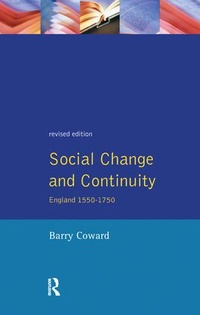
Social Change and Continuity
England 1550-1750
2nd Edition
Published on 18. January 2017
Book
Hardback
160 pages
978-1-138-16517-5 (ISBN)
Description
Barry Coward has revised his wide-ranging text which outlines the major social changes that occurred in England in the two hundred years after the Reformation. He examines the religious and intellectual changes resulting from revolutionary pressures, as well as considering the impact of rapid inflation and population expansion in the later sixteenth and early seventeenth centuries. Overall he stresses that social change combined with social continuity to produce a distinctive early modern English society.
More details
Series
Edition
2nd edition
Language
English
Place of publication
London
United Kingdom
Publishing group
Taylor & Francis Ltd
Target group
College/higher education
Dimensions
Height: 216 mm
Width: 138 mm
Weight
403 gr
ISBN-13
978-1-138-16517-5 (9781138165175)
Copyright in bibliographic data and cover images is held by Nielsen Book Services Limited or by the publishers or by their respective licensors: all rights reserved.
Schweitzer Classification
Other editions
Additional editions
E-Book
10/2014
2nd Edition
Routledge
€35.49
Available for download
E-Book
10/2014
2nd Edition
Routledge
€35.49
Available for download
Book
06/1997
2nd Edition
Longman
€39.10
Shipment within 10-20 days
Person
Barry Coward is Reader in History at Birkbeck College, University of London.
Content
Part One: The Structure of Early Modern English Society.
1. The Social Order in Early Modern England.
2. Geographical Mobility.
3. An Agrarian Society.
4. Contrasting Communities.
5. Family and Kinship.
6. Local Communities and the Nation.
Part Two: Changing Material Conditions
7. Population Fluctuations and Changing Social Fortunes.
8. Poverty and Dearth.
9. Affluence and Prosperity.
Part Three: Changing Ideas
10. Education and Literacy.
11. The Impact of Protestantism.
12. The Scientific Revolution.
Part Four: Documents.
Bibliography.
Index.
1. The Social Order in Early Modern England.
2. Geographical Mobility.
3. An Agrarian Society.
4. Contrasting Communities.
5. Family and Kinship.
6. Local Communities and the Nation.
Part Two: Changing Material Conditions
7. Population Fluctuations and Changing Social Fortunes.
8. Poverty and Dearth.
9. Affluence and Prosperity.
Part Three: Changing Ideas
10. Education and Literacy.
11. The Impact of Protestantism.
12. The Scientific Revolution.
Part Four: Documents.
Bibliography.
Index.