

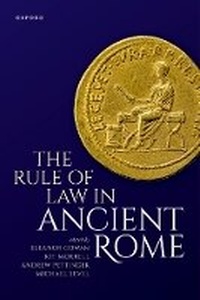
The Rule of Law in Ancient Rome
Published on 7. November 2025
Book
Hardback
296 pages
978-0-19-895932-8 (ISBN)
Description
The ideal of the rule of law - that the law should protect all citizens from arbitrary exercises of power - can be traced from ancient Greece to the present day. The Roman contribution to the rule of law tradition has been largely overlooked, however, both in rule-of-law scholarship and recent considerations of Roman law. This volume - the first of its kind - brings together the study of the rule of law and the study of ancient Rome. Its chapters apply insights and approaches drawn from modern legal theory in order to understand the ways in which Romans thought about law and the place of law in their community, the ways in which Roman institutions and political norms protected citizens against the arbitrary exercise of power, and how these ideas and practices changed with Rome's transition from republic to empire. Together, the contributors turn a new spotlight on the community of the Romans by asking whether and to what extent Rome may be said to have invested in the idea and practice of 'the rule of law', and how the rule of law intersected with other values including justice, popular sovereignty, and the personal authority of the emperor. At the same time, the volume seeks to enrich current thinking on the rule of law by providing an evidence-rich case-study of ancient Rome during the republic and empire. Recent years have witnessed increasing attacks on the rule of law, including attacks arising within liberal democracies and their institutions. It is a crucial time to be thinking about the rule of law. Deepening our historical understanding through close study of the rule of law in Rome is both timely and necessary.
More details
Language
English
Place of publication
Oxford
United Kingdom
Target group
Professional and scholarly
Product notice
sewn/stitched
Cloth over boards
With dust jacket
Dimensions
Height: 234 mm
Width: 156 mm
Thickness: 18 mm
Weight
590 gr
ISBN-13
978-0-19-895932-8 (9780198959328)
Copyright in bibliographic data and cover images is held by Nielsen Book Services Limited or by the publishers or by their respective licensors: all rights reserved.
Schweitzer Classification
Persons
Eleanor Cowan is a lecturer in Ancient History at the University of Sydney. She is an historian of the Roman Republic and the Early Imperial period. Her research concentrates on communities in - and post- conflict; on constructions of autocracy; on domestic abuse in the ancient world and on Latin historiography.
Kit Morrell is the Susan Blake Lecturer in Classics and Ancient History at the University of Queensland. Her research focuses on the political and legal history of the late Roman republic.
Andrew Pettinger is an honorary associate in Ancient History at the University of Sydney. His research focuses on the emergence of the Tiberian age, constitutional change under Augustus, and the role of politics in periods of transition.
Michael Sevel is Senior Lecturer in Jurisprudence at the University of Sydney Law School. He researches issues in general jurisprudence, the rule of law, and moral and political philosophy, including the nature of political authority and the moral obligation to obey the law.
Kit Morrell is the Susan Blake Lecturer in Classics and Ancient History at the University of Queensland. Her research focuses on the political and legal history of the late Roman republic.
Andrew Pettinger is an honorary associate in Ancient History at the University of Sydney. His research focuses on the emergence of the Tiberian age, constitutional change under Augustus, and the role of politics in periods of transition.
Michael Sevel is Senior Lecturer in Jurisprudence at the University of Sydney Law School. He researches issues in general jurisprudence, the rule of law, and moral and political philosophy, including the nature of political authority and the moral obligation to obey the law.
Volume editor
Lecturer in Ancient History, Discipline of Classics and Ancient HistoryLecturer in Ancient History, Discipline of Classics and Ancient History, University of Sydney
Susan Blake Lecturer in Classics and Ancient HistorySusan Blake Lecturer in Classics and Ancient History, University of Queensland
Honorary Associate in Classics and Ancient HistoryHonorary Associate in Classics and Ancient History, University of Sydney
Senior Lecturer in JurisprudenceSenior Lecturer in Jurisprudence, University of Sydney Law School
Content
Introduction
Framing Questions
1: Michael Sevel: The Rule of Law: A Thought Pattern
2: Michael Peachin: In Search of a Roman Rule of Law
The Republic
3: Kit Morrell: Cato and the Rule of Law
4: Amy Russell: The Populus and the Rule of Law
5: Catherine Steel: 'Rule of Law' and the Gods in the Late Republic
6: Andrew Pettinger: The Praetor's Edict and the Rule of Law
7: W.A Jeffrey Tatum: Non Iure Rogata: The People, the Senate, and the Rule of Law in Republican Rome
8: AndrewA M. Riggsby: Not in the Last Instance
Principate and Empire
9: Eleanor Cowan: Aspiration, Accountability, and Abuse: Augustus and the Law in Post-Conflict Rome
10: Tristan S. Taylor: Princeps legibus solutus est an non? Cultures of Legality in the Roman Empire
11: Kaius Tuori: The Emperor as the Good Judge: The Emergence of Roman Imperial Jurisdiction as a Discourse on Justice and Rule of Law
12: Cosimo Cascione: Some Remarks on Certainty Roman Law
Framing Questions
1: Michael Sevel: The Rule of Law: A Thought Pattern
2: Michael Peachin: In Search of a Roman Rule of Law
The Republic
3: Kit Morrell: Cato and the Rule of Law
4: Amy Russell: The Populus and the Rule of Law
5: Catherine Steel: 'Rule of Law' and the Gods in the Late Republic
6: Andrew Pettinger: The Praetor's Edict and the Rule of Law
7: W.A Jeffrey Tatum: Non Iure Rogata: The People, the Senate, and the Rule of Law in Republican Rome
8: AndrewA M. Riggsby: Not in the Last Instance
Principate and Empire
9: Eleanor Cowan: Aspiration, Accountability, and Abuse: Augustus and the Law in Post-Conflict Rome
10: Tristan S. Taylor: Princeps legibus solutus est an non? Cultures of Legality in the Roman Empire
11: Kaius Tuori: The Emperor as the Good Judge: The Emergence of Roman Imperial Jurisdiction as a Discourse on Justice and Rule of Law
12: Cosimo Cascione: Some Remarks on Certainty Roman Law