

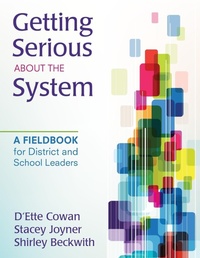
Getting Serious About the System
A Fieldbook for District and School Leaders
1st Edition
Published on 9. August 2012
Book
Paperback/Softback
160 pages
978-1-4522-0511-3 (ISBN)
Description
A focused approach to raising student achievement
For many districts, the improvement process can seem like trying to nail Jello to the wall. This fieldbook shows how to avoid a haphazard approach by focusing on all aspects of the system and specific issues that have most impact upon student achievement. This multidimensional process also entails increasing the competencies of everyone involved and implementing solutions districtwide. The authors outline a proven framework and offer step-by-step guidance for addressing the essential components and competencies of the local educational system. Key strategies include:
Concentrating on aligning curriculum, instruction, and assessment to state and Common Core State Standards
Working on the underlying issues and people that impact the system
Garnering support from all staff members to maximize time, resources, and energy
Included are vignettes for each phase that illustrate how the work might play out in typical districts and schools. Hands-on tools include an extensive Facilitator Guide with PowerPoint slides, handouts, and a companion website with online resources. A separate volume provides a brief overview of the process for staff and teachers that provides a brief rationale based on research, explains what it means to work systemically, and outlines the phases.
There is no "quick fix" for boosting school performance, but Getting Serious About the System will help district and school leaders set priorities, break the gridlock, and reap sustainable results.
For many districts, the improvement process can seem like trying to nail Jello to the wall. This fieldbook shows how to avoid a haphazard approach by focusing on all aspects of the system and specific issues that have most impact upon student achievement. This multidimensional process also entails increasing the competencies of everyone involved and implementing solutions districtwide. The authors outline a proven framework and offer step-by-step guidance for addressing the essential components and competencies of the local educational system. Key strategies include:
Concentrating on aligning curriculum, instruction, and assessment to state and Common Core State Standards
Working on the underlying issues and people that impact the system
Garnering support from all staff members to maximize time, resources, and energy
Included are vignettes for each phase that illustrate how the work might play out in typical districts and schools. Hands-on tools include an extensive Facilitator Guide with PowerPoint slides, handouts, and a companion website with online resources. A separate volume provides a brief overview of the process for staff and teachers that provides a brief rationale based on research, explains what it means to work systemically, and outlines the phases.
There is no "quick fix" for boosting school performance, but Getting Serious About the System will help district and school leaders set priorities, break the gridlock, and reap sustainable results.
Reviews / Votes
"This book is a critical roadmap to district and school transformation. It takes the guess work out of determining where improvement is needed." -- Freda Hicks, Assistant Principal "The working systemically model provides a research-based approach to school improvement. The clearly defined step-by-step approach will assist any school or district in its improvement efforts. My professional practice has been significantly changed as a result of my direct experience implementing SEDL's working systemically approach." -- Sally Bennett, Curriculum Coordinator "This book not only describes processes and strategies but provides the tools needed for those leading the process. This is a process that a campus or district leader could use that would examine and use the resources they already have and is not another program they need to buy." -- Cynthia Stone, Director of School Improvement "The vignettes pulled everything together and increased my understanding of the phases. The tips for building relationship between team members and dealing with sensitive issues are also very helpful." -- Debbie Langford, School Counselor "This is the most comprehensive approach to improving a school system that I have seen in one text. I would absolutely recommend this book to my colleagues." -- Diana Pratt, Assistant HS Principal (retired) "This book challenges leaders to focus on what is most important and identifies the improvement efforts required to achieve dramatic results in the classrooms. It is brimming with ideas on how to transform education systemically and provides teachers, administrators, and leaders with a comprehensive resource to improve student achievement." -- Debra Paradowski, Associate Principal "The authors provide decades of high-quality professional development and hands-on work with schools and school districts. I appreciate and applaud their efforts to translate research on data use, professional development, leadership, and collaboration into tools and processes useful to educators." -- Victoria Bernhardt, Executive Director, Education for the FutureMore details
Language
English
Place of publication
Thousand Oaks
United States
Publishing group
SAGE Publications Inc
Target group
Professional and scholarly
Dimensions
Height: 280 mm
Width: 216 mm
Thickness: 9 mm
Weight
426 gr
ISBN-13
978-1-4522-0511-3 (9781452205113)
Copyright in bibliographic data and cover images is held by Nielsen Book Services Limited or by the publishers or by their respective licensors: all rights reserved.
Schweitzer Classification
Persons
Before retiring from SEDL in October, 2010, D'Ette F. Cowan led Texas Comprehensive Center efforts to assist state and intermediate agencies in providing high-needs districts and schools with technical assistance that is systemic in nature. In her 12-year career at SEDL, she also assisted low-performing districts and schools throughout a five-state region to improve student learning, and investigated strategies for transforming schools into professional learning communities. Currently, Cowan serves as a consultant to SEDL on a variety of projects.
As one of the researchers and authors of Working Systemically in Action: A Guide for Facilitators, she has had first-hand experience in helping district and school leaders apply a systemic approach to improve learning outcomes for students. Her study of professional learning communities over her career has included conducting and applying research and presenting findings at conferences and in books and journals. She has authored chapters and articles in Demystifying Professional Learning Communities: School Leadership at Its Best; SEDL Letter; Journal of School Leadership; and Learning Together, Leading Together. Prior to joining SEDL in December 1997, she served as a junior high school teacher and an elementary school principal. Her continuing research interests include leadership for change, systemic improvement, and professional learning communities. Stacey Joyner is a Program Associate at SEDL-a nonprofit education research, development, and dissemination corporation based in Austin, TX. She participates in efforts to build state education staff capacity to serve districts and schools. She is the former editor of the USDE's Reading First newsletter The Notebook, and former editor of the Texas Comprehensive Center's newsletter Texas Focus. She is co-author of SEDL's Working Systemically in Action, a comprehensive process for school improvement.
Prior to joining SEDL, Ms. Joyner served as the Reading Coordinator for the Idaho State Department of Education. She has 11 years of teaching experience. She has served as a reading specialist and teacher trainer for the Clark County School District in Las Vegas, Nevada.
Ms. Joyner holds a BA in Elementary Education from Idaho State University and an MEd in Curriculum and Instruction from the University of Nevada at Las Vegas. She is currently a doctoral student at the University of Texas at Austin.
Shirley Beckwith is a Communications Associate with SEDL's Texas Comprehensive Center (TXCC). She provides editorial review of training materials and resources used in meetings hosted by the TXCC and prepares materials for submission to national evaluators. She also provides and reviews content for the TXCC Web site. She has been involved in several revisions of the Working Systemically approach, including the 2008 Working Systemically in Action: A Guide for Facilitators and a conversion of the process into a scripted training manual for school support teams.
Prior to joining SEDL Ms. Beckwith worked for several years at the University of Texas LBJ School of Public Affairs as the coordinator and researcher for the Guide to Texas State Agencies. Ms. Beckwith has a master's degree in Library and Information Science.
As one of the researchers and authors of Working Systemically in Action: A Guide for Facilitators, she has had first-hand experience in helping district and school leaders apply a systemic approach to improve learning outcomes for students. Her study of professional learning communities over her career has included conducting and applying research and presenting findings at conferences and in books and journals. She has authored chapters and articles in Demystifying Professional Learning Communities: School Leadership at Its Best; SEDL Letter; Journal of School Leadership; and Learning Together, Leading Together. Prior to joining SEDL in December 1997, she served as a junior high school teacher and an elementary school principal. Her continuing research interests include leadership for change, systemic improvement, and professional learning communities. Stacey Joyner is a Program Associate at SEDL-a nonprofit education research, development, and dissemination corporation based in Austin, TX. She participates in efforts to build state education staff capacity to serve districts and schools. She is the former editor of the USDE's Reading First newsletter The Notebook, and former editor of the Texas Comprehensive Center's newsletter Texas Focus. She is co-author of SEDL's Working Systemically in Action, a comprehensive process for school improvement.
Prior to joining SEDL, Ms. Joyner served as the Reading Coordinator for the Idaho State Department of Education. She has 11 years of teaching experience. She has served as a reading specialist and teacher trainer for the Clark County School District in Las Vegas, Nevada.
Ms. Joyner holds a BA in Elementary Education from Idaho State University and an MEd in Curriculum and Instruction from the University of Nevada at Las Vegas. She is currently a doctoral student at the University of Texas at Austin.
Shirley Beckwith is a Communications Associate with SEDL's Texas Comprehensive Center (TXCC). She provides editorial review of training materials and resources used in meetings hosted by the TXCC and prepares materials for submission to national evaluators. She also provides and reviews content for the TXCC Web site. She has been involved in several revisions of the Working Systemically approach, including the 2008 Working Systemically in Action: A Guide for Facilitators and a conversion of the process into a scripted training manual for school support teams.
Prior to joining SEDL Ms. Beckwith worked for several years at the University of Texas LBJ School of Public Affairs as the coordinator and researcher for the Guide to Texas State Agencies. Ms. Beckwith has a master's degree in Library and Information Science.
Content
Preface
Acknowledgments
About the Authors
Introduction to Systemic Improvement
Systems Thinking
Systems Thinking in Education
Working Systemically: A Process Grounded in Research
Testing and Refining the Working Systemically Approach
The Working Systemically Approach: Levels, Components, and Competencies
What It Takes
Summary
References
1. The "Works" of Working Systemically
Levels of the System
Components of the System
Competencies for Working Systemically
The Working Systemically Approach in Action
2. Phase I: Understanding Systemic Improvement
Step 1. Study the Approach
Step 2. Collect and Analyze Preliminary Data
Step 3. Present the Approach at the School Level
Step 4. Commit to Systemic Improvement
3. Phase II: Analyzing the System
Step 1. Form the District and School Leadership Teams
Step 2. Begin the Comprehensive Needs Assessment
Step 3. Conduct a Gap Analysis
Step 4. Begin the Process at the School Level
Step 5. Formulate Problem Statements
Step 6. Describe the Ideal State
Step 7. Review System Initiatives
Step 8. Continue the Process at the School Level
4. Phase III: Planning Action
Step 1. Investigate Research-Based Practices
Step 2. Explore the Professional Teaching and Learning Cycle (PTLC)
Step 3. Review Progress Made to Date and Existing Plan
Step 4. Develop a District Improvement Plan
Step 5. Formalize and Communicate the District Improvement Plan
Step 6. Develop School Improvement Plans
5. Phase IV: Taking Action & Monitoring Progress
Step 1. Implement and Monitor the Improvement Plans
Step 2. Provide Continuing Leadership for the Improvement Work
Step 3. Address Unique Challenges as They Arise
6. Phase V: Assessing & Reflecting on Outcomes
Step 1. Analyze and Reflect on Evidence of Implementation and Impact
Step 2. Decide on a Focus for Continuing the Improvement Work
Step 3. Recognize Work, Progress, and Accomplishments
Bibliography Matrix
Index
Acknowledgments
About the Authors
Introduction to Systemic Improvement
Systems Thinking
Systems Thinking in Education
Working Systemically: A Process Grounded in Research
Testing and Refining the Working Systemically Approach
The Working Systemically Approach: Levels, Components, and Competencies
What It Takes
Summary
References
1. The "Works" of Working Systemically
Levels of the System
Components of the System
Competencies for Working Systemically
The Working Systemically Approach in Action
2. Phase I: Understanding Systemic Improvement
Step 1. Study the Approach
Step 2. Collect and Analyze Preliminary Data
Step 3. Present the Approach at the School Level
Step 4. Commit to Systemic Improvement
3. Phase II: Analyzing the System
Step 1. Form the District and School Leadership Teams
Step 2. Begin the Comprehensive Needs Assessment
Step 3. Conduct a Gap Analysis
Step 4. Begin the Process at the School Level
Step 5. Formulate Problem Statements
Step 6. Describe the Ideal State
Step 7. Review System Initiatives
Step 8. Continue the Process at the School Level
4. Phase III: Planning Action
Step 1. Investigate Research-Based Practices
Step 2. Explore the Professional Teaching and Learning Cycle (PTLC)
Step 3. Review Progress Made to Date and Existing Plan
Step 4. Develop a District Improvement Plan
Step 5. Formalize and Communicate the District Improvement Plan
Step 6. Develop School Improvement Plans
5. Phase IV: Taking Action & Monitoring Progress
Step 1. Implement and Monitor the Improvement Plans
Step 2. Provide Continuing Leadership for the Improvement Work
Step 3. Address Unique Challenges as They Arise
6. Phase V: Assessing & Reflecting on Outcomes
Step 1. Analyze and Reflect on Evidence of Implementation and Impact
Step 2. Decide on a Focus for Continuing the Improvement Work
Step 3. Recognize Work, Progress, and Accomplishments
Bibliography Matrix
Index