

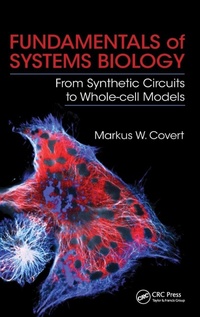
Fundamentals of Systems Biology
From Synthetic Circuits to Whole-cell Models
1st Edition
Published on 27. July 2017
Book
Hardback
368 pages
978-1-138-45987-8 (ISBN)
Description
For decades biology has focused on decoding cellular processes one gene at a time, but many of the most pressing biological questions, as well as diseases such as cancer and heart disease, are related to complex systems involving the interaction of hundreds, or even thousands, of gene products and other factors. How do we begin to understand this complexity?
Fundamentals of Systems Biology: From Synthetic Circuits to Whole-cell Models introduces students to methods they can use to tackle complex systems head-on, carefully walking them through studies that comprise the foundation and frontier of systems biology. The first section of the book focuses on bringing students quickly up to speed with a variety of modeling methods in the context of a synthetic biological circuit. This innovative approach builds intuition about the strengths and weaknesses of each method and becomes critical in the book's second half, where much more complicated network models are addressed including transcriptional, signaling, metabolic, and even integrated multi-network models.
The approach makes the work much more accessible to novices (undergraduates, medical students, and biologists new to mathematical modeling) while still having much to offer experienced modelers--whether their interests are microbes, organs, whole organisms, diseases, synthetic biology, or just about any field that investigates living systems.
Fundamentals of Systems Biology: From Synthetic Circuits to Whole-cell Models introduces students to methods they can use to tackle complex systems head-on, carefully walking them through studies that comprise the foundation and frontier of systems biology. The first section of the book focuses on bringing students quickly up to speed with a variety of modeling methods in the context of a synthetic biological circuit. This innovative approach builds intuition about the strengths and weaknesses of each method and becomes critical in the book's second half, where much more complicated network models are addressed including transcriptional, signaling, metabolic, and even integrated multi-network models.
The approach makes the work much more accessible to novices (undergraduates, medical students, and biologists new to mathematical modeling) while still having much to offer experienced modelers--whether their interests are microbes, organs, whole organisms, diseases, synthetic biology, or just about any field that investigates living systems.
Reviews / Votes
"Author has excellent command of both aspects of systems biology."-Joel Bader, Johns Hopkins University, Baltimore, Maryland, USA
"... an excellent introduction to systems thinking and modeling in the context of complex biological problems. ... uses concrete biological examples to develop systems concepts and model step by step, thus enabling the reader to understand the power of systems biology in the study of complex biological phenomena. ... develops a deep intuition of systems thinking in the context of complex biological phenomena. This intuition is then translated into concrete systems modeling approaches enabling readers to apply the systems approach to their own problems."
-Prof Werner Dubitzky, University of Ulster
More details
Language
English
Place of publication
London
United Kingdom
Publishing group
Taylor & Francis Ltd
Target group
College/higher education
Undergraduate
Dimensions
Height: 240 mm
Width: 161 mm
Thickness: 24 mm
Weight
716 gr
ISBN-13
978-1-138-45987-8 (9781138459878)
Copyright in bibliographic data and cover images is held by Nielsen Book Services Limited or by the publishers or by their respective licensors: all rights reserved.
Schweitzer Classification
Other editions
Additional editions
E-Book
10/2017
CRC Press
€128.99
Available for download
E-Book
10/2017
1st Edition
CRC Press
€128.99
Available for download
Book
12/2014
1st Edition
CRC Press
€117.50
Shipment within 15-20 days
Person
Markus Covert is an Associate Professor of Bioengineering and, by courtesy, Chemical and Systems Biology at Stanford University. He has received the National Institute of Health Director's Pioneer Award and an Allen Distinguished Investigator Award from the Paul Allen Family Foundation. He is best known for the development of the first "whole-cell" computational model of a bacterial cell.
Content
Introduction to Systems Biology. Biological Networks. High-throughput Data and the Omics Revolution. Biological Network Structure. From Network Diagrams to Computational Models. Studying the Dynamic Behavior of Biological Systems. Toward a Whole-Cell Model: Qualitative and Constraint-Based Approaches. How Cells Respond to Random Internal and External Fluctuations. Capturing Differences and Interactions between Cells. Systems Biology as a Community.