

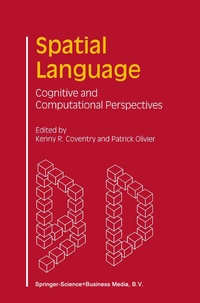
Spatial Language
Cognitive and Computational Perspectives
Published on 1. December 2010
Book
Paperback/Softback
XI, 283 pages
978-90-481-5910-9 (ISBN)
Description
People constantly talk to each other about experience or knowledge resulting from spatial perception; they describe the size, shape, orientation and position of objects using a wide range of spatial expressions. The semantic treatment of such expressions presents particular challenges for natural language processing. The meaning representation used must be capable of distinguishing between fine-grained sense differences and ambiguities grounded in our experience and perceptual structure. While there have been many different approaches to the representation and processing of spatial expressions, most computational characterisations have been restricted to particularly narrow problem domains. The chapters in the present volume reflect a commitment to the development of cognitively informed computational treatments of spatial language and spatial representation. Therefore the chapters present computational work, empirical work, or a combination of both.
The book will appeal to all those interested in spatial language and spatial representation, whether they work in artificial intelligence, cognitive science, cognitive psychology or linguistics.
The book will appeal to all those interested in spatial language and spatial representation, whether they work in artificial intelligence, cognitive science, cognitive psychology or linguistics.
More details
Edition
Softcover reprint of hardcover 1st ed. 2002
Language
English
Place of publication
Dordrecht
Netherlands
Target group
Professional and scholarly
Research
Illustrations
XI, 283 p.
Dimensions
Height: 235 mm
Width: 155 mm
Thickness: 17 mm
Weight
452 gr
ISBN-13
978-90-481-5910-9 (9789048159109)
DOI
10.1007/978-94-015-9928-3
Schweitzer Classification
Other editions
Additional editions
E-Book
03/2013
Springer
€96.29
Available for download
Book
12/2001
Kluwer Academic Publishers
€106.99
Shipment within 15-20 days
Content
1. Reasoning about Shape using the Tangential Axis Transform or the Shape's "Grain".- 2. A Conceptual Model for Representing Verbal Expressions used in Route Descriptions.- 3. Resolving Ambiguous Descriptions through Visual Information.- 4. An Anthropomorphic Agent for the Use of Spatial Language.- 5. Gesture, Thought, and Spatial Language.- 6. Organization of Temporal Situations.- 7. Grounding Meaning in Visual Knowledge. A Case Study: Dimensional Adjectives.- 8. Understanding How We Think about Space.- 9. The Real Story of "Over"?.- 10. Generating Spatial Descriptions from a Cognitive Point of View.- 11. Multiple Frames of Reference in Interpreting Complex Projective Terms.- 12. Goal-Directed Effects on Processing a Spatial Environment. Indications from Memory and Language.- 13. Memory for Text and Memory for Space. Two Concurrent Memory Systems?.- Author index.