

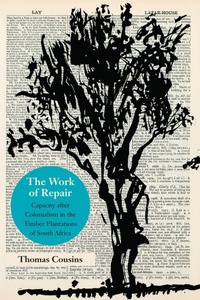
The Work of Repair
Capacity After Colonialism in the Timber Plantations of South Africa
Published on 6. June 2023
Book
Hardback
320 pages
978-1-5315-0353-6 (ISBN)
Description
In the timber plantations in northeastern South Africa, laborers work long hours among tall, swaying lines of eucalypts, on land once theirs. In 2008, at the height of the HIV/AIDS crisis, timber corporations distributed hot cooked meals as a nutrition intervention to bolster falling productivity and profits. But life and sustenance are about much more than calories and machinic bodies. What is at stake is the nurturing of capacity across all domains of life-physical, relational, cosmological-in the form of amandla. An Nguni word meaning power, strength or capacity, amandla organizes ordinary concerns with one's abilities to earn a wage, to strengthen one's body, and to take care of others; it describes the potency of medicines and sexual vitality; and it captures a history of anti-colonial and anti-apartheid struggle for freedom.
The ordinary actions coordinated by and directed at amandla do not obscure the wounding effects of plantation labor or the long history of racial oppression, but rather form the basis of what the Algerian artist Kader Attia calls repair. In this captivating ethnography, Cousins examines how amandla, as the primary material of the work of repair, anchors ordinary scenes of living and working in and around the plantations. As a space of exploitation that enables the global paper and packaging industry to extract labor power, the plantation depends on the availability of creative action in ordinary life to capitalize on bodily capacity.
The Work of Repair is a fine-grained exploration of the relationships between laborers in the timber plantations of KwaZulu-Natal, and the historical decompositions and reinventions of the milieu of those livelihoods and lives. Offering a fresh approach to the existential, ethical and political stakes of ethnography from and of late liberal South Africa, the book attends to urgent questions of postapartheid life: the fate of employment; the role of the state in providing welfare and access to treatment; the regulation of popular curatives; the queering of kinship; and the future of custom and its territories. Through detailed descriptions, Cousins explicates the important and fragile techniques that constitute the work of repair: the effort to augment one's capacity in a way that draws on, acknowledges, and reimagines the wounds of history, keeping open the possibility of a future through and with others.
The ordinary actions coordinated by and directed at amandla do not obscure the wounding effects of plantation labor or the long history of racial oppression, but rather form the basis of what the Algerian artist Kader Attia calls repair. In this captivating ethnography, Cousins examines how amandla, as the primary material of the work of repair, anchors ordinary scenes of living and working in and around the plantations. As a space of exploitation that enables the global paper and packaging industry to extract labor power, the plantation depends on the availability of creative action in ordinary life to capitalize on bodily capacity.
The Work of Repair is a fine-grained exploration of the relationships between laborers in the timber plantations of KwaZulu-Natal, and the historical decompositions and reinventions of the milieu of those livelihoods and lives. Offering a fresh approach to the existential, ethical and political stakes of ethnography from and of late liberal South Africa, the book attends to urgent questions of postapartheid life: the fate of employment; the role of the state in providing welfare and access to treatment; the regulation of popular curatives; the queering of kinship; and the future of custom and its territories. Through detailed descriptions, Cousins explicates the important and fragile techniques that constitute the work of repair: the effort to augment one's capacity in a way that draws on, acknowledges, and reimagines the wounds of history, keeping open the possibility of a future through and with others.
More details
Series
Edition
New edition
Language
English
Place of publication
New York
United States
Target group
Professional and scholarly
Edition type
New edition
Product notice
Cloth over boards
Illustrations
11 b/w illustrations
Dimensions
Height: 229 mm
Width: 152 mm
Thickness: 22 mm
Weight
640 gr
ISBN-13
978-1-5315-0353-6 (9781531503536)
Copyright in bibliographic data and cover images is held by Nielsen Book Services Limited or by the publishers or by their respective licensors: all rights reserved.
Schweitzer Classification
Other editions
Additional editions
Thomas Cousins
The Work of Repair
Capacity After Colonialism in the Timber Plantations of South Africa
E-Book
06/2023
Fordham University Press
€39.49
Available for download
Person
Thomas Cousins is Clarendon-Lienhardt Associate Professor in the Social Anthropology of Africa at the University of Oxford, and Fellow, St Hugh's College.
Content
Introduction: Repair and the Question of Capacity 1
1 Labor Power and Amandla 37
2 The Plantation and the Making of a Labor Regime 58
3 The Game of Marriage 88
4 Repair and the Substance of Others 115
5 In the Vicinity of the Social 144
Conclusion: The Work of Repair 181
Acknowledgments 197
Notes 201
Bibliography 277
Index 319
1 Labor Power and Amandla 37
2 The Plantation and the Making of a Labor Regime 58
3 The Game of Marriage 88
4 Repair and the Substance of Others 115
5 In the Vicinity of the Social 144
Conclusion: The Work of Repair 181
Acknowledgments 197
Notes 201
Bibliography 277
Index 319