

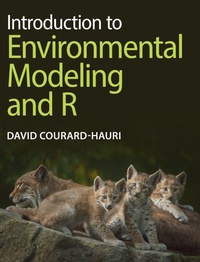
Introduction to Environmental Modeling and R
Published on 21. May 2026
Book
Hardback
302 pages
978-1-009-67497-3 (ISBN)
Description
R is fast becoming ubiquitous in the environmental sciences to analyse data. This book introduces environmental modeling and R. It assumes no background in either coding or calculus. It offers real-world examples, fully described programs, and detailed exercises. Readers learn how to analyse large datasets, create beautiful images, thoughtfully utilize the benefits of AI, and use techniques like optimization and sensitivity analysis in their modelling of complex environmental systems. Using examples from a range of environmental topics - including ecology, conservation, and climate science - the book will interest readers from a broad range of environmental and conservation sciences. Most graduate programs in environmental science and sustainability use R because it is both open source and powerful. R is common in government and consulting work, so students that go on to more advanced environmental modelling courses and potentially careers in the environmental field will find a grounding in R very useful.
More details
Language
English
Place of publication
Cambridge
United Kingdom
Illustrations
Worked examples or Exercises
Dimensions
Height: 260 mm
Width: 208 mm
Thickness: 21 mm
Weight
874 gr
ISBN-13
978-1-009-67497-3 (9781009674973)
Copyright in bibliographic data and cover images is held by Nielsen Book Services Limited or by the publishers or by their respective licensors: all rights reserved.
Schweitzer Classification
Other editions
Additional editions
David Courard-Hauri
Introduction to Environmental Modeling and R
Book
05/2026
Cambridge University Press
€64.50
Shipment within 15-20 days
Person
David Courard-Hauri has taught environmental modeling and other quantitative and policy-related courses at Drake University for twenty-five years. He has Ph.D. in Physical Chemistry from Stanford and an MPA with an Economics focus from Princeton, His research spreads across a variety of topics, including chemical dynamics, bacterial and butterfly movement, carbon sequestration, and consumer behavior. He co-authored a series of environmental science textbooks with Andrew Friedland and Rick Relyea.
Content
1. Introduction; 2. The hardest part of coding; 3. Getting started with R; 4. Numbers, units, and equations; 5. Data structures; 6. Introduction to dynamic models; 7. Exponential growth and loops; 8. Working with steady states; 9. Functions; 10. Phase space and optimization; 11. Files; 12. Data manipulation and visualization; 13. Continuous time; 14. Spatial variation; 15. Adding complexity and speed; 16. Radiative balance and using AI; 17. Delays and conveyors; 18. Sensitivity analysis and Monte Carlo; 19. Further reading; References; Index.